

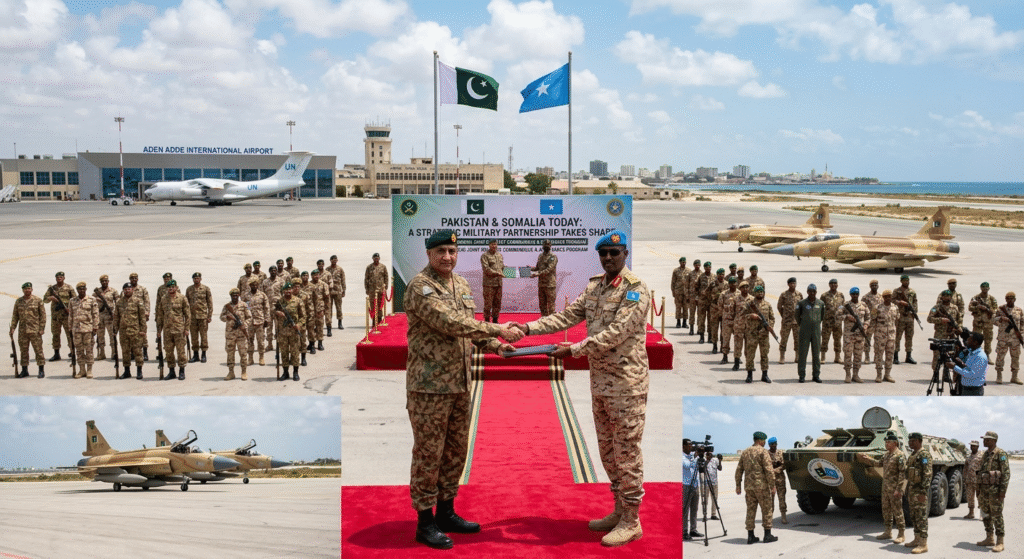
Pakistan and Somalia are forging a major defense partnership in August 2026, highlighted by high-level meetings and a signed Memorandum of Understanding (MoU) on defense cooperation. This rapprochement comes as both nations seek to recalibrate their positions in a rapidly evolving geopolitical landscape.
A Landmark Defense Agreement
The cornerstone of recent developments is the signing of a defense cooperation MoU between Somalia and Pakistan. The agreement envisages strengthening bilateral ties in defense and security, conducting joint exercises, and exchanging experiences . This formal framework represents a significant step beyond previous informal collaborations, signaling Islamabad’s intention to play a more active role in the security architecture of the Horn of Africa.
High-Level Engagements in Islamabad
The diplomatic momentum was palpable in early August when a high-level Somali delegation, led by Defence Minister Ambassador Ahmed Moallim Fiqi, visited Pakistan. The delegation held extensive talks with Pakistan’s top military and political leadership. The primary focus of these discussions was on deepening military-to-military relations and building Somalia’s institutional capacity to counter common security challenges .
Discussions at the General Headquarters in Rawalpindi with Pakistan’s Chief of Army Staff Field Marshal Syed Asim Munir centered on the evolving regional security landscape and ways to broaden bilateral military collaboration . The Pakistani military leadership reaffirmed its commitment to supporting Somalia in strengthening its security institutions .
What Pakistan Offers: Training and Institutional Support
Given the asymmetrical nature of this relationship, Pakistan is expected to play a crucial role in the training and professionalization of Somali forces. According to experts, Pakistan is likely to provide training in intelligence-led counterterrorism, special operations, logistics, communications, and military institutional building . The agreement is more focused on providing formal training and capacity building than establishing a permanent military presence . In the near term, cooperation is expected to involve Somali officers training inside Pakistan, allowing Mogadishu to benefit from Islamabad’s decades of experience in counterinsurgency and military institution-building.
Potential for Expanding Military Hardware
While the MoU focuses on cooperation and training, unconfirmed media reports suggest the two nations are discussing a significant arms deal. There is speculation about Somalia acquiring up to 24 JF-17 Block III fighter jets from Pakistan in a deal potentially worth $900 million . This development, if confirmed, would mark a major shift for Somalia, helping it rebuild a fixed-wing combat capability it has lacked for years .
Diplomatic Alignment and Support for Somalia’s Sovereignty
The partnership extends beyond the military. In early February 2026, at the sidelines of an OIC summit in Jeddah, Pakistan strongly reaffirmed its support for Somalia’s sovereignty and territorial integrity . Pakistan condemned the illegal Israeli recognition of Somaliland as a separate state, aligning itself firmly with Mogadishu. This diplomatic stance is significant as Somalia faces internal fragmentation and external pressures seeking to reshape its borders.
Conclusion
The Pakistan-Somalia rapprochement represents a strategic pivot for both nations. For Pakistan, it offers an opportunity to establish a strategic foothold in the Horn of Africa, a critical region for global maritime security near the Gulf of Aden and Bab al-Mandeb Strait. For Somalia, it provides access to crucial military expertise, institutional support, and potential hardware to combat the Al-Shabaab insurgency. As the relationship deepens, it promises to reshape the security dynamics of the Horn of Africa, offering Mogadishu a reliable partner to help shoulder its security burden as it prepares to take greater responsibility for its national defense.
