

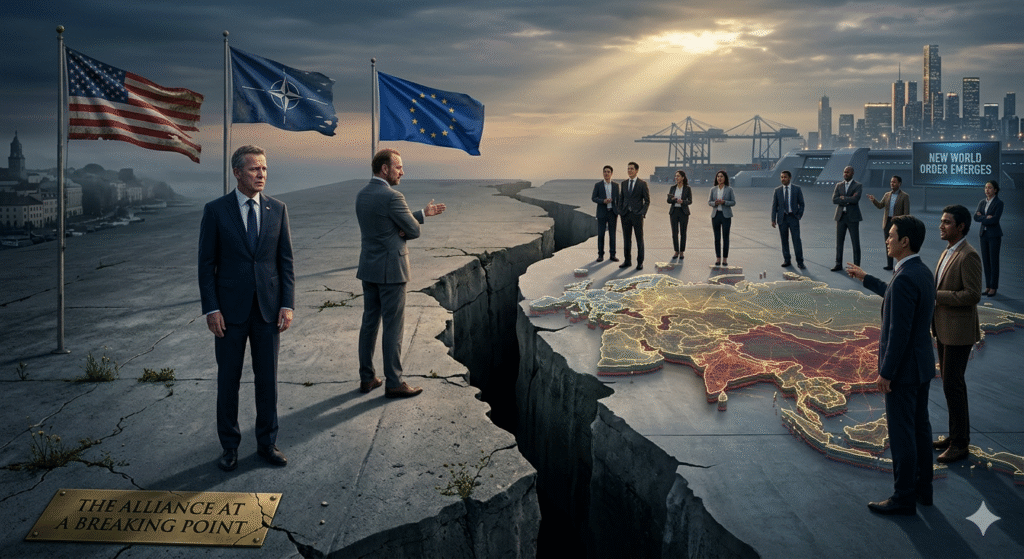
April 12, 2026 – For 76 years, the North Atlantic Treaty Organization has stood as the bedrock of Western security. But today, the alliance faces an existential crisis unlike any since its founding. A perfect storm of factors—a demanding US president threatening to walk away, European allies scrambling to rearm, an ongoing war in the Middle East, and rising Russian and Chinese power—has pushed NATO to the brink. As Secretary-General Mark Rutte himself admitted this week, the transatlantic relationship is shifting from “unhealthy co-dependence” toward something new, something untested, and something deeply uncertain .
Here is the state of NATO today.
Part 1: The Trump Ultimatum – “Wouldn’t You Leave If You Were Me?”
The immediate driver of NATO’s crisis is President Donald Trump’s fury over European reluctance to join the US-Israeli war against Iran. When the war began on February 28, Washington asked its NATO allies for naval support to reopen the Strait of Hormuz, a vital chokepoint for global oil. Most European nations declined .
Trump’s response was devastating. In an interview with Reuters, he declared he was considering withdrawing from the alliance entirely. “Wouldn’t you if you were me?” he asked . On Truth Social, he lashed out: “NATO WASN’T THERE WHEN WE NEEDED THEM, AND THEY WON’T BE THERE IF WE NEED THEM AGAIN. REMEMBER GREENLAND, THAT BIG, POORLY RUN, PIECE OF ICE!!!” .
While a 2023 law requires congressional approval for withdrawal—a high bar—Trump, as commander-in-chief, can simply decide not to defend an ally under attack. That prospect alone has shattered the certainty of collective defense that has defined NATO since 1949 .
Part 2: European Shock – “We Must Think of NATO Without the Americans”
The realization sinking in across European capitals is profound. As recently as February, Rutte dismissed the idea of Europe defending itself without the US as a “silly thought.” Now, many officials consider it the default expectation .
General Francois Lecointre, former French armed forces chief, put it starkly: “NATO remains necessary, but we must be capable of thinking of NATO without the Americans. Whether it should even continue to be called NATO—North Atlantic Treaty Organization—is a valid question” .
This is not abstract speculation. Canada is negotiating with the European Union to join a new project aimed at expanding the military-industrial complex and reducing dependence on the United States. The transatlantic alliance that has underpinned global order since World War II may never be the same .
Part 3: The Spending Surge – Sweden and the Netherlands Commit to 5%
One consequence of Trump’s pressure is already visible: a dramatic increase in defense spending. On April 10, Swedish Prime Minister Ulf Kristersson announced that Sweden will reach a new NATO spending target of 5 percent of GDP, with at least 3.5 percent allocated toward core defense requirements .
The Netherlands followed suit, with its caretaker government committing to increase defense spending to 3.5 percent of GDP as an interim step toward the 5 percent goal. Dutch Defense Minister Ruben Brekelmans called the decision “historic” .
Poland and the Baltic countries—Estonia, Latvia, and Lithuania—have already publicly committed to the 5 percent target. The question now is timing: Italy insists it needs a decade, while the US demands a near-term deadline .
Part 4: New Capability Targets – A 30% Increase in Weapons Stockpiles
Beyond spending percentages, NATO is fundamentally reshaping its military requirements. The alliance is finalizing new capability targets that will replace those set before Russia’s invasion of Ukraine. These targets, expected to be approved by early June, will require European allies and Canada to increase their weapons and military equipment stockpiles by approximately 30 percent across all sectors .
The implementation timeline spans five to 15 years, and the cost will be substantial. But as one senior NATO official noted, the new goals would make European and Canadian forces “much stronger and less dependent on the United States”—precisely the outcome Trump has demanded .
Part 5: The Arctic Sentry – A New Front with Russia
While the world focuses on the Middle East, NATO is quietly escalating in the Arctic. On February 11, the alliance launched “Arctic Sentry,” a new multi-domain activity placing Allied operations in the High North under a single command structure for the first time .
The buildup is rapid. The UK will deploy its carrier strike group led by HMS Prince of Wales. Sweden is sending JAS 39 Gripen fighters around Iceland and Greenland. Germany is providing four Eurofighter jets. Denmark is contributing four F-35s. The UK has committed to doubling its troop deployment to Norway .
Russia, predictably, is alarmed. The Russian Foreign Ministry called the mission “yet another provocation” and warned that Moscow’s “military-technical” reaction will be proportionate. The risk of accidental escalation in the Arctic—where nuclear submarines operate in close proximity—is higher than it has been in decades .
Part 6: The China Question – A “Wake-Up Call” for Industrial Production
NATO’s focus is no longer solely on Russia. Secretary-General Rutte, speaking at the Ronald Reagan Institute this week, explicitly named China as a “competitor” that requires close attention .
His warning centered on industrial capacity: “The United States and Europe have a problem with shipbuilding. China now builds more ships than the United States. And China is actively investing in defense” .
Rutte stopped short of calling for NATO expansion to the Indo-Pacific, but he strongly endorsed closer cooperation with Japan, South Korea, Australia, and New Zealand. “Don’t be naive,” he said. “What happens in the Indo-Pacific cannot be separated from what happens in the Atlantic” .
Part 7: The Iranian War – NATO’s “Near-Breaking Point”
The crisis that has pushed NATO to the edge is the US-Israeli war with Iran. Analysts and diplomats told Reuters that this conflict, thousands of miles from Europe, has “nearly broken the 76-year-old bloc and threatens to leave it in its weakest state since its creation” .
European officials counter that they never received specific US requests for assets to open the Strait of Hormuz. Washington, they complain, has been inconsistent about whether such a mission would operate during or after the war. But Trump’s frustration is genuine and deepening. “The United States will remember,” White House spokeswoman Anna Kelly warned .
Part 8: Public Opinion – Americans Still Support NATO, but Polarization Grows
Despite Trump’s threats, the American public remains broadly supportive of NATO. An AP-NORC poll in February showed 70 percent of Americans believe NATO membership is good for the United States—the highest reading since at least 2022 .
Gallup polling the same month found more than three-quarters of Americans supported increasing or maintaining current US commitment to NATO. Even among Republicans, 60 percent supported maintaining or increasing commitment, while only 13 percent favored withdrawal .
However, the Iran war has shifted views. A Pew Research poll in late March showed the percentage of Republicans who believe NATO benefits the US dropped from 49 percent a year ago to 38 percent today. The alliance remains popular, but the partisan gap is widening .
Part 9: Rutte’s Balancing Act – “America’s Leadership Is Still Needed”
Caught between a demanding US president and anxious European allies, Secretary-General Rutte is walking a diplomatic tightrope. Speaking in Washington this week, he acknowledged European over-reliance on the US while defending the alliance’s value .
“I have developed an unflinching appreciation for the value of American leadership. But I have also had the opportunity to reflect on what happens when America’s allies take that leadership for granted,” Rutte said .
He confirmed that Trump is “clearly disappointed” with allies’ reluctance to support military action against Iran, but he stressed the importance of concrete commitments to secure the Strait of Hormuz after the war ends .
Part 10: The Russian View – “NATO Is Preparing for a Direct Clash”
From Moscow’s perspective, the picture is clear. Russian Foreign Ministry spokeswoman Maria Zakharova stated on April 1 that NATO is “preparing for a direct armed clash with Russia in the coming years” .
She pointed to the numbers: NATO’s total military expenditure in 2025 reached $1.64 trillion, accounting for approximately 62 percent of global military spending. “And it’s us who’s the threat, eh? With such NATO figures,” she said sarcastically .
The number and scale of NATO exercises is increasing, with more than 120 maneuvers conducted under alliance auspices in the past year and more than 700 trainings held by individual member countries. Moscow is watching, and it is not reassured .
Part 11: The Legal Constraints – Can Trump Actually Withdraw?
Legally, Trump may lack the authority to unilaterally withdraw from NATO. A law passed in 2023 requires the consent of two-thirds of the US Senate for withdrawal—an almost impossible threshold .
But analysts note that Trump, as commander-in-chief, can simply decide whether the US military will defend NATO members. Declining to do so could effectively end the alliance without a formal withdrawal. As one analyst put it: “It’s really hard to think of anything that even comes close” to the current crisis in NATO’s 76-year history .
Part 12: The Future – A Different Alliance Emerges
Even if the current crisis passes, NATO will not return to its old form. Julianne Smith, US ambassador to NATO under President Biden, captured the moment: “I do think we’re turning the page of 80 years of working together. I don’t think it means the end of the transatlantic relationship, but we’re on the cusp of something that’s going to have a different look and feel to it” .
That new look includes a more self-reliant Europe, a more demanding United States, a more assertive China, and a more dangerous Russia. Whether the alliance can adapt without breaking is the defining question of European security for the coming decade. For now, the clock is ticking, and the world is watching.
Conclusion: A Defining Moment
NATO today is an alliance in transition. The post-Cold War certainties are gone. The post-9/11 solidarity is strained. The transatlantic bond that held for three generations is being tested as never before. President Trump has demanded that Europe pay more and do more—or face the prospect of standing alone. Europe, shaken into action, is beginning to respond.
But the deeper question remains: can an alliance built on shared values survive when the guarantor of those values questions the alliance itself? The next few months—as the Iran war evolves, as the NATO summit approaches in June, and as European defense spending surges—will determine whether NATO emerges stronger or fractures into something unrecognizable. For the first time since 1949, no one knows the answer.