

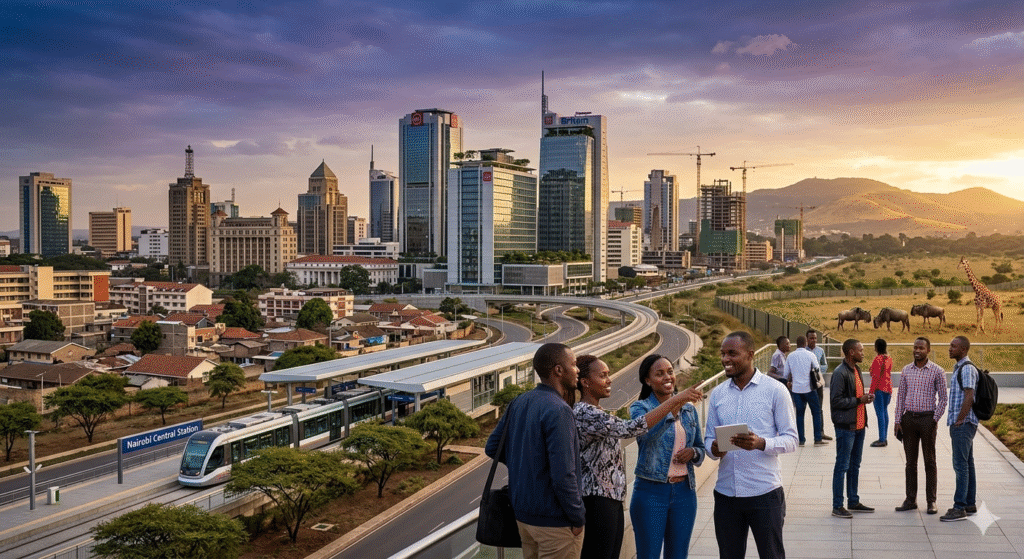
April 16, 2026 – On the surface, Nairobi remains East Africa’s undisputed powerhouse. The “Green City in the Sun” is a leading African emerging market, thriving in technology, finance, real estate, and infrastructure . The Nairobi Securities Exchange drives regional capital, tech hubs in Kilimani attract international investment, and the city’s entrepreneurial energy is undeniable.
But beneath this polished exterior, Nairobi is a city under siege. Record fuel hikes—triggered by a war 3,000 kilometers away—have sent transport fares soaring. Devastating floods have claimed dozens of lives and displaced tens of thousands. Gen-Z protesters have filled the streets, defying tear gas to challenge President William Ruto’s tax policies. And the government is racing to transform the city before it collapses under its own weight. This is Nairobi today.
Part 1: The Fuel Shock – Commuters at Breaking Point
The war between the United States, Israel, and Iran—which began on February 28—has delivered an economic body blow to Nairobi. On April 14, Kenya’s energy regulator raised the prices of super petrol and diesel by record margins: Ksh28.69 (approximately $0.22) per liter for petrol and a staggering Ksh40.3 per liter for diesel .
The effects were immediate. In the public transport sector, matatu operators raised fares by about 25 percent overnight. “We are simply adjusting to the current fuel situation,” said Albert Karakacha, chairman of the Matatu Owners Association. “The cost of fuel has risen beyond what operators can absorb” .
For ordinary Nairobians, the math is brutal. Moses Kalondu, an office worker commuting from Mlolongo to the city center, told reporters: “I paid $0.61 this morning instead of the usual $0.38. This hurts, and it has made commuting more expensive” .
Long-distance travelers are also feeling the pinch. Bus operators have increased fares by between $1.54 and $3.86. A ticket from Nairobi to Kisii now costs $13.15, while fares to the coastal city of Mombasa have climbed to $23.21 . Beyond transport, the ripple effects are spreading across the broader economy. Freight operators are adjusting their cost structures, and analysts warn that higher fuel prices could fuel inflation. Kenya’s inflation rate stood at 4.4 percent in March, with price pressures continuing to build .
The government has deployed $48 million in subsidies to ease the burden, but analysts warn of sustained economic pressure. “The global nature of this crisis means its effects will not disappear quickly,” said Macharia Munene, a professor of international relations .
Part 2: The Floods – A City Submerged
Just weeks before the fuel crisis, Nairobi woke up to a different nightmare. On the morning of March 7, streets turned to rivers, homes were submerged, and families were torn apart. At least 42 people lost their lives in a single night of rain—fathers, mothers, children swept away .
The hardest-hit communities were the informal settlements: Mukuru, Kibra, Mathare, Huruma, and Embakasi. These are areas that had already endured so much and deserved so much more protection than they received . Across 21 counties, the floods claimed 73 lives and displaced nearly 70,000 residents .
Scientists have confirmed that the climate crisis made the extreme rainfall behind the floods approximately 40 percent more intense. “These are not acts of God,” wrote Sherie Gakii of Greenpeace Africa. “They are the consequences of decades of unchecked emissions by the world’s wealthiest nations and corporations—consequences being paid, in lives, by communities who contributed almost nothing to this crisis” .
The crisis has also laid bare a painful truth: Kenya is actively dismantling the natural systems that protect its people. Forests like Karura in the heart of Nairobi and the highland water towers of the Mau Complex and the Aberdares are the country’s natural flood defenses. They absorb rainfall, regulate rivers, and protect communities downstream. Yet they continue to face encroachment, illegal logging, and weak enforcement .
Government Spokesperson Isaac Mwaura acknowledged the double burden the country faces. “Remember, we have been dealing with the issue of drought, and now we are having to deal with the issue of drought and floods at the same time,” he told Channel Africa . Kenya is bearing both faces of a broken climate system—deluge and dryness—simultaneously.
Part 3: The Tax Protests – Gen-Z Takes to the Streets
On April 9, thousands of mostly young demonstrators took to the streets across Nairobi to protest tax hikes. Blowing whistles and chanting slogans, they gathered near Parliament in a vivid show of anger dubbed “Occupy Parliament” .
Police fired tear gas and water cannon against groups of protesters, but apart from isolated scuffles, the action remained mostly peaceful. Led largely by young Kenyans, the demonstrations began in Nairobi before spreading nationwide .
The protests have galvanized widespread discontent over President William Ruto’s economic policies in a country already grappling with a cost-of-living crisis. Ivy, a 26-year-old job seeker dressed in a T-shirt and leggings, told AFP she was prompted to protest for the first time because she was “scared” for her future. “This bill cannot pass. This bill is going to finish us. We don’t have jobs. We can’t even open businesses. We can’t do anything in this country” .
Another first-time protester, Bella, a 22-year-old university graduate, said she showed up “to make sure the finance bill is rejected.” She was “not impressed” with the government’s concessions—which included removing proposed levies on bread purchases, car ownership, and mobile services. “They are just trying to lie to us. The taxes that they have removed on bread they have added somewhere else,” she said, describing it as a tactic to “blindfold” citizens .
The government has now targeted an increase in fuel prices and export taxes to fill the void left by the concessions—a move critics say will make life more expensive in a country where a third of the 51.5 million people already live in poverty .
Part 4: The Railway City – A $350 Million Gamble
Amid the crises, the government is pushing forward with an ambitious vision to transform Nairobi’s Central Business District into a gleaming, ultra-modern hub. The Nairobi Railway City (NRC) project—a Sh30 billion ($350 million) initiative—will occupy 438 acres adjacent to the CBD, revitalizing underutilized railway land .
Kenya Railways Corporation managing director Philip Mainga told the Star: “The railway city will be built. There is no turning back” .
The project’s goals are sweeping:
- Decongestion: Expanding and restructuring the CBD
- Jobs: 5,000 during construction and 5,000 in the initial phase
- Housing: 10,000 affordable housing units
- Transport integration: Commuter rail, Bus Rapid Transit, Light Rail Transit, and pedestrian walkways
- Climate resilience: Low-carbon buildings, green spaces, and sustainable infrastructure
The new Central Station, the project’s flagship development, is scheduled for completion by July 2027. It will accommodate an estimated 400,000 daily passengers by 2030, rising to 600,000 by 2045 .
The NRC is organized into six precincts with distinct functions: a MICE Core for conferences and exhibitions, a Central Station transport hub, sustainable housing zones, a cultural and innovation district, and an inclusive market precinct. A government precinct will comprise 500,000 square feet of modern office space to house ministries, departments, and corporate entities .
Part 5: The River Regeneration – Even State House Must Yield
In a striking symbol of the city’s transformation agenda, Nairobi Governor Johnson Sakaja on April 14 led a multi-agency team to mark a section of the State House perimeter wall for demolition. The offense? Encroachment on riparian land .
“I want to thank the President. He is the primary tenant here and has led by example. If this wall at State House can come down, then every other structure along the riparian land must also be removed,” Sakaja said .
The demolition is part of the Nairobi River Regeneration Programme, a joint initiative between national and county governments with a budget exceeding Sh50 billion. The program includes restoration of river channels, relocation of affected developments, and rehabilitation of surrounding infrastructure. Long-term plans include creating non-motorized transport corridors along the rivers—walkways where people can walk or cycle safely, with lighting and security .
Sakaja urged residents and property owners affected by the enforcement to comply, warning against resistance and political interference. “It is unfortunate that some politicians are misleading people against what is beneficial for all of us. This program is for the good of Nairobi,” he said .
Part 6: The Gikomba Transformation – A New Market Rising
For years, Gikomba Market has been synonymous with congestion, muddy pathways, and devastating fire outbreaks. That is finally changing. On April 13, Governor Sakaja broke ground on Phase One of the Gikomba Market redevelopment, a project that will transform one of the city’s busiest trading hubs .
The new market will feature improved infrastructure, including a better layout, reduced congestion, and enhanced movement for both traders and customers. Safety has been prioritized, with improved electrical systems, emergency exits, and expanded trading spaces .
“You elected me to protect your interests. This new market is a game-changer. It is modern and organized, and will improve business operations and the customer experience. In six months, the story will begin to change,” Sakaja told traders .
The redevelopment is part of the broader development agenda under the cooperation agreement between the Nairobi County Government and the national government, which injected Sh80 billion into key infrastructure projects in the capital .
Part 7: Security Challenges – Mathare’s Violent Encounter
The challenges facing Nairobi are not only economic and environmental. On April 3, three police officers were injured in a dramatic robbery incident and confrontation with a hostile crowd in the Mathare area .
Officers on patrol along Juja Road spotted a man being robbed by three men, one armed with a knife. When the officers moved in, the suspects fled toward Mathare slums. One suspect was arrested, but as officers escorted him out of the area, they were confronted by a group of rowdy men who began pelting them with stones in an apparent attempt to free the suspect. The officers were briefly overwhelmed, and the suspect escaped. Two shots were fired in the air to disperse the crowd .
The incident highlights the persistent security challenges in Nairobi’s informal settlements, where poverty, overcrowding, and limited police presence create volatile conditions.
Part 8: Africa’s Climate Voice – Nairobi Takes the Lead
Amid the crises, Nairobi is also positioning itself as a continental leader. On April 15, African climate negotiators convened in the city for a two-day meeting to establish a unified stance on financing the green transition .
Nana Antwi-Boasiako Amoah, chairman of the African Group of Negotiators Experts Support, said the discussions prioritized agriculture, food security, gender equality, and climate finance. “Agriculture must be a focal point of global discussions as it remains a top priority for Africa due to its vital role in economic development, GDP, employment, and food security,” he said .
Rose Mwebaza, director of the UN Environment Programme Africa regional office, told participants that the continent requires sustained financing and early warning systems to boost climate resilience. The forum called for enhanced coherence and coordination among parties overseeing the financial mechanism under multilateral climate treaties .
For a city that just experienced catastrophic flooding, the message was deeply personal.
Part 9: The Diplomatic Hub – Ruto Addresses the County
On April 9, police closed several roads in Nairobi’s CBD—including City Hallway, sections of Wabera Street, and the Supreme Court roundabout—to facilitate two simultaneous events: the Africa Urban Forum at the Kenyatta International Convention Centre and President William Ruto’s address to the Nairobi County Assembly at City Hall .
The security operation underscored Nairobi’s dual role as both a regional diplomatic hub and a city struggling with the logistical demands of hosting high-profile events. While the road closures caused temporary disruptions, they also highlighted the city’s continued importance as a venue for continental decision-making.
Part 10: The Transformation Agenda – A City at a Crossroads
Nairobi today is a city of stark contradictions. The Railway City promises a gleaming future of modern offices, integrated transport, and affordable housing. The River Regeneration Programme promises to reclaim the city’s waterways and create safe pedestrian corridors. The Gikomba redevelopment promises dignity and safety for thousands of traders.
But at the same time, families in Mathare are rebuilding after floodwaters swept away their homes. Commuters are paying double for matatu fares. Young protesters are facing tear gas outside Parliament. And a war on the other side of the world is dictating the price of a liter of fuel.
Conclusion: Resilience or Ruin?
The question facing Nairobi is whether its transformation agenda can outpace its crises. The Railway City will not be complete until 2027. The river regeneration will take years. The fuel shock, the floods, and the tax protests are happening now.
Governor Sakaja has staked his legacy on delivering tangible change. “Anyone opposing such a project is denying traders a chance to grow,” he said at the Gikomba groundbreaking . President Ruto has promised economic revival, even as his finance bill faces fierce opposition.
For the people of Nairobi, the daily calculus is simple: Can they afford the matatu to work? Will their homes be safe when the rains come? Will the government listen to their protests? The answers to these questions will determine whether Nairobi becomes the gleaming hub its leaders envision—or a cautionary tale of a city that tried to run before it could walk.
