

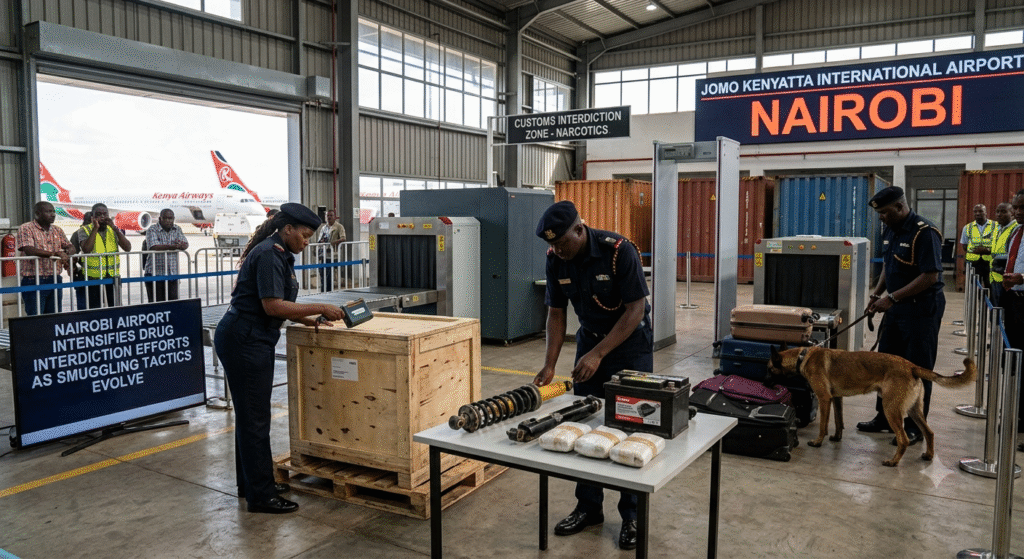
Jomo Kenyatta International Airport remains a critical frontline in Kenya’s fight against transnational narcotics trafficking
Nairobi’s Jomo Kenyatta International Airport (JKIA) has long served as East Africa’s premier aviation hub, connecting Kenya to major cities across Europe, Asia, and the Middle East. But this strategic position has also made it an attractive transit point for international drug trafficking syndicates seeking to move illicit narcotics across borders. In recent weeks and months, Kenyan authorities have intensified their interdiction efforts at the airport, employing multi-agency approaches to detect and disrupt smuggling operations that grow increasingly sophisticated by the day.
A Multi-Agency Approach to Airport Security
The challenge of securing JKIA against drug trafficking is not one that any single agency can tackle alone. Recognizing this, the Kenyan government has adopted a coordinated, multi-agency strategy that brings together the Directorate of Criminal Investigations (DCI), the Anti-Narcotics Unit, the Kenya Airports Authority, and customs officials. This collaborative framework has proven essential for sharing intelligence, conducting joint operations, and ensuring that suspected traffickers face the full weight of the law.
Interior Principal Secretary Raymond Omollo convened a high-level meeting in early September 2026 with Police Inspector General Douglas Kanja, Kenya Civil Aviation Authority officials, and JKIA management to review emerging security challenges at the facility. The meeting underscored the government’s recognition that JKIA represents one of the country’s most critical entry and exit points, requiring constant vigilance and adaptive security measures.
Recent Interceptions and Ongoing Challenges
While specific drug seizures at JKIA in recent days have not dominated headlines, the broader pattern of smuggling attempts through the airport paints a concerning picture. In April 2026, the Anti-Narcotics Unit seized methamphetamine bound for the Philippines in two separate packages: 1,730 grams hidden inside car pistons originating from Tanzania, and 1,020 grams traced from Juja. These cases illustrate the creative methods traffickers employ to conceal contraband within legitimate cargo.
The airport has also been exploited for smuggling other illicit goods. Just this month, two women were arrested at JKIA as they prepared to board an Emirates flight to Dubai, allegedly attempting to smuggle 658 grams of suspected gold out of the country. One suspect had concealed a 541-gram gold bar in her hair, wrapped with a hairband beneath her hijab, while her accomplice carried a 116.79-gram gold pellet inside her bra. The incident highlighted how traffickers exploit gaps in regulatory and border controls, raising concerns about lost government revenue and the potential for money laundering through illicit mineral trading.
The High Stakes of Airport Interdiction
The stakes at JKIA could hardly be higher. Kenya serves as both a destination and transit country for narcotics produced in Asia, Latin America, and the Middle East, destined for markets in Europe, North America, and other African nations. A 2025 SwissAid report estimated that more than two tonnes of gold could be leaving Kenya illicitly each year, a figure that dwarfs the 672 kilogrammes of declared gold exports in 2023. Similar discrepancies likely exist in the narcotics trade, where the shadow economy operates beyond official statistics.
The consequences extend far beyond the immediate seizure of contraband. Drug trafficking networks often intersect with other forms of organized crime, including money laundering, corruption, and even terrorism financing. The profits generated by illicit drugs fund criminal enterprises that undermine governance and stability across the region.
The Intelligence Imperative
Modern airport interdiction relies heavily on intelligence-driven operations rather than random searches. Effective screening requires identifying high-risk passengers based on travel patterns, behavior analysis, and advance passenger information systems. This intelligence-led approach enables authorities to focus resources where they are most likely to yield results.
A recent case in Malaysia demonstrated the value of following the money trail in drug investigations. Police arrested a second pilot believed to be linked to a drug-smuggling syndicate after a Malaysian second officer was detained at Jakarta’s Soekarno-Hatta International Airport with drugs worth approximately RM45 million. The second pilot was allegedly involved in managing proceeds from drug sales, highlighting how trafficking networks employ sophisticated financial structures to move money across borders. Investigations revealed the syndicate had international links, with the arrested pilot allegedly involved for about a year in transferring money linked to syndicate activities.
Such cases underscore that airport interdiction cannot focus solely on couriers and their luggage. Effective counter-narcotics strategies must also target the organizational infrastructure that enables trafficking operations, including financial facilitators, logistics coordinators, and corrupt officials who facilitate passage through security checkpoints.
Challenges and Limitations
Despite significant investments in security infrastructure and personnel training, airport interdiction faces inherent limitations. The sheer volume of passengers, baggage, and cargo moving through JKIA on a daily basis makes comprehensive screening impractical. Traffickers continuously adapt their methods, developing new concealment techniques and exploiting perceived weaknesses in security protocols.
The legal framework governing drug prosecutions also presents challenges. A recent Kenyan High Court decision overturned the convictions of three airline workers, including two Kenya Airways cabin crew members, who had been sentenced to 25 years in prison for trafficking heroin worth Sh 59.6 million. The court found that the state’s case was built on speculation, procedural blunders, and a broken chain of evidence. Justice Diana Kavedza noted that the police failed to fill out an official inventory form inside the aircraft, failed to preserve an unbroken chain of custody, and that witnesses contradicted each other regarding who searched which bag.
The judgment served as a stark reminder that successful interdiction requires not only detection but also meticulous evidence handling and adherence to legal procedures. “Suspicion, however strong, cannot substitute proof beyond reasonable doubt,” Justice Kavedza declared. The case highlighted the importance of proper documentation, witness coordination, and chain-of-custody protocols in securing convictions that withstand appellate scrutiny.
Looking Forward
The fight against drug trafficking through JKIA requires sustained commitment and continuous adaptation. Security agencies must invest in cutting-edge detection technology, expand intelligence-sharing partnerships with international counterparts, and enhance training for personnel at all levels. Equally important is addressing the root causes that make trafficking profitable, including poverty, unemployment, and limited economic opportunities that can make vulnerable individuals susceptible to recruitment by criminal networks.
The multi-agency approach championed by Kenyan authorities represents a solid foundation. But as traffickers refine their methods, so too must those charged with stopping them. The security of JKIA—and by extension, the nation—depends on remaining one step ahead of those who would exploit this vital gateway for illicit purposes.
