

Introduction: A Healthcare Sector in Transition
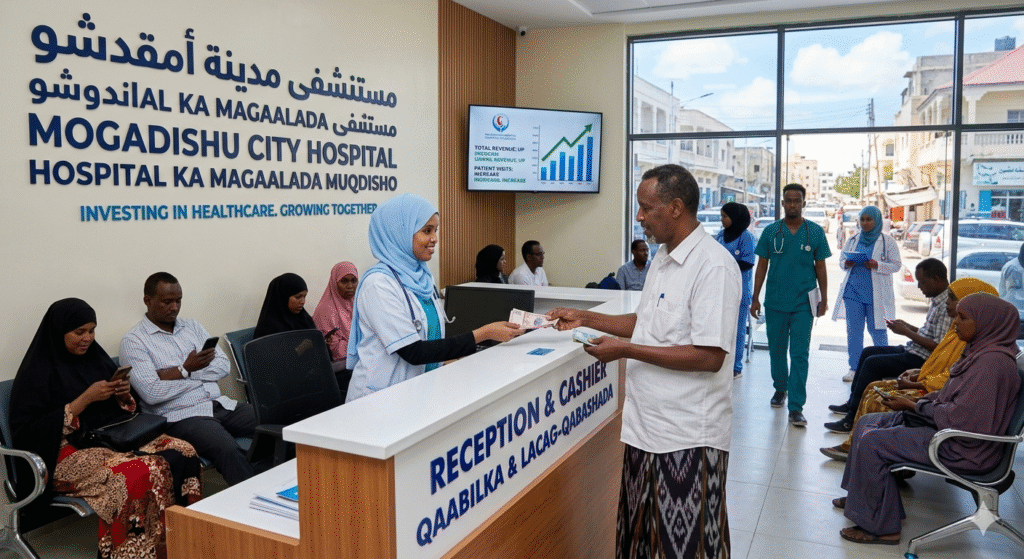
Today, Mogadishu presents a medical paradox. On one hand, decades of conflict have left much of Somalia’s health infrastructure in ruins. On the other, the capital is witnessing an unprecedented surge in private hospital revenues, driven by diaspora investments, international partnerships, and a growing middle class willing to pay for quality care. Leading hospitals in the city are now generating annual revenues exceeding $30 million—figures that would have been unimaginable just a decade ago. This article examines how Mogadishu’s hospitals are increasing their financial standing, the forces driving this growth, and what it means for the Somali people.
Part 1: The Revenue Leaders – Mogadishu’s Top-Earning Hospitals
The most concrete evidence of the sector’s financial expansion comes from industry data. According to comprehensive rankings compiled as of May 2026, Mogadishu’s top medical and surgical hospitals are generating substantial revenues, placing them among the city’s most valuable private enterprises .
At the pinnacle stands Aden Abdulle Hospital, reporting an estimated $32.8 million in annual revenue. This facility, which employs between 201 and 500 people, has positioned itself as the premier medical institution in the capital .
Close behind is the Somali Sudanese Specialized Hospital (SSSH) with $31.5 million in annual revenue. This hospital represents the growing trend of international partnerships in Mogadishu’s healthcare sector, combining Sudanese medical expertise with Somali operational presence .
Mogadishu City Hospital rounds out the top three with $29.3 million in annual revenue, also maintaining a workforce of 201-500 personnel. Other significant players include facilities generating $27 million, $22.9 million, $20.3 million, and $15.8 million respectively .
These figures represent a dramatic financial transformation. Just a few years ago, Mogadishu’s healthcare sector was almost entirely dependent on humanitarian aid and international NGOs. Today, these hospitals operate as profitable businesses, reinvesting revenues into equipment, staff training, and facility expansion.
Part 2: The Dominance of Private Sector Healthcare
The revenue growth of Mogadishu’s hospitals reflects a broader structural reality: the private sector now dominates healthcare delivery in Somalia’s urban centers. According to detailed assessments of the Banadir region (which encompasses Mogadishu), an estimated 80 percent of all curative health services in urban areas are now delivered by private facilities .
This privatization of healthcare has occurred largely by necessity rather than design. Following the collapse of the central government in 1991, the public health system effectively ceased to function. In the vacuum that followed, private clinics and hospitals emerged to meet community needs, often funded by the Somali diaspora or foreign investors .
Today, Mogadishu is home to approximately 205 healthcare facilities of all types, with a hospital bed density of 18.3 beds per 10,000 residents—significantly higher than the national average of just 7 beds per 10,000 . The physician-to-population ratio tells a similar story: there is roughly one doctor for every 1,400 residents in Mogadishu, compared to a staggering 20,000 residents per doctor in more remote regions like Galmudug .
This concentration of medical resources in the capital explains why Mogadishu’s hospitals are able to generate such substantial revenues. They serve not only the city’s residents but also draw patients from across the country who travel to the capital for specialized care unavailable elsewhere.
Part 3: International Investment and the Italian Connection
Beyond domestic private investment, significant international funding is flowing into Mogadishu’s health sector, further bolstering hospital revenues and capabilities. In a major development this month, Somalia and Italy signed a comprehensive agreement to implement the QEPHS-SOM (Quality and Equal Primary Health Services for all in Somalia) project .
The agreement, signed in Mogadishu by Somali Minister of Health Dr. Ali Haji Aden and Italy’s Ambassador Pier Mario Daccò Coppi, is fully funded by the Italian government through the Italian Agency for Development Cooperation (AICS) . The initiative specifically targets three key institutions that are central to Mogadishu’s medical landscape: De Martino National Referral Hospital, the National Blood Bank, and the National Health Professionals Council .
The project focuses on improving infrastructure, providing modern medical equipment, and supporting human resource development through targeted training for key personnel . These enhancements will directly improve the revenue-generating capacity of these institutions, allowing them to offer higher-margin specialized services while also serving more patients.
“This agreement is a major step toward strengthening the country’s health system, especially basic services that directly affect the community,” Somalia’s Ministry of Health stated following the signing . The program will focus on reducing disparities between urban and rural areas, though the immediate beneficiaries will be the institutions in the capital where these investments are concentrated .
Part 4: The World Bank’s “Damal Caafimaad” Initiative
The Italian investment is not the only international funding flowing into Mogadishu’s health sector. The World Bank has approved the Improving Healthcare Services in Somalia Project, known locally as “Damal Caafimaad” (which translates to “Health Touch” or “Care for Health”) .
Approved on April 9, 2025, this ambitious project has a total cost of $100 million, with an initial grant commitment of $5 million from the Global Financing Facility . The project’s development objective is to improve coverage of essential health and nutrition services in project areas while strengthening the stewardship capacity of the Ministries of Health .
Led by Bernard Olayo and active as of late 2025, the Damal Caafimaad project complements the Italian initiative by focusing on systemic strengthening rather than purely infrastructure investment. For Mogadishu’s hospitals, this means improved regulatory frameworks, better supply chain management, and enhanced capacity to manage expanded service delivery—all factors that contribute to sustainable revenue growth .
Part 5: Private Insurance and a New Pilot Program
One of the biggest barriers to healthcare access in Mogadishu has historically been the reliance on out-of-pocket (OOP) payments. The PSPH (Private Sector Partnerships in Health) programme has documented that this financial burden is especially severe for poor populations, with many Somalis foregoing or deferring treatment due to inability to pay .
Private health insurance coverage in Somalia remains extremely low, estimated at only two percent of the population . This has limited hospitals’ ability to generate predictable revenue streams and forced them to rely on cash payments, which in turn restricts access for lower-income patients.
However, a significant pilot program launched this month represents a potential breakthrough. The National Civil Service Commission (NCSC) has entered into a strategic partnership with Hodan Hospital in Mogadishu to provide subsidized healthcare for all registered government civil servants .
Under the agreement, civil servants and their immediate family members receive a 50 percent reduction on all medical services at Hodan Hospital . During the signing ceremony, NCSC Chairman Hassan Abshirow Mohamed characterized this as a historic advancement in healthcare provisions for government employees .
More importantly, health officials view this subsidy agreement as a critical administrative stepping stone toward the comprehensive implementation of a national health insurance system . Dr. Mohamed Ishaq Omar, Director General of Hodan Hospital, expressed enthusiasm for the collaboration and the medical center’s dedication to providing cost-effective healthcare services tailored to civil servants .
For Mogadishu’s hospitals, the development of a functioning health insurance market would be transformative. Predictable reimbursement from insurers would replace volatile cash payments, allowing hospitals to plan capacity expansions, invest in new equipment, and offer more sophisticated services with confidence in their revenue streams.
Part 6: Supply Chains and International Procurement
As Mogadishu’s hospitals increase their revenues and expand services, they have also become significant players in international medical supply chains. Recent tender documents reveal the scale of this procurement activity.
The Juba Foundation, a national non-profit organization operating in Mogadishu, issued an invitation to tender for the procurement of essential drugs in April 2026 . This tender, reference BID: JF/KIS/BID/003/2026, reflects the growing demand for pharmaceutical supplies in the capital .
Similarly, the International Organization for Migration (IOM) issued a call for Long-Term Agreements (LTAs) for the provision of medical services in Mogadishu in late March 2026, with a deadline of April 8, 2026 . This indicates that even international agencies operating in Somalia are increasingly contracting with local medical providers rather than flying in external teams or evacuating patients abroad.
The growth of local procurement and contracting represents a virtuous cycle: increased hospital revenues enable better purchasing power, which attracts more international suppliers and partners, which in turn improves service quality and drives further revenue growth.
Part 7: Challenges and the Affordability Question
For all the impressive revenue figures and international investment, significant challenges remain. The very factors that drive hospital revenues—private sector delivery and out-of-pocket payments—also create serious access problems for the poor.
The 80 percent private sector share of curative services, while indicating a vibrant market, also means that healthcare is largely treated as a commodity rather than a public good . Those who cannot afford private care often turn to underfunded public facilities or simply forgo treatment altogether.
The risk of financial burden on poor populations remains “especially severe,” according to the PSPH program assessment. Many Somalis still forego or defer treatment due to inability to pay . This creates a two-tier system where the wealthy and diaspora-connected have access to world-class care at facilities like Aden Abdulle Hospital, while the poor struggle to access even basic services.
The health market is further distorted by Somalia’s limited domestically generated tax base. The overall federal budget remains highly dependent on donor funding, leaving little room for public health spending or social health insurance subsidies . This is why the Hodan Hospital pilot for civil servants is so significant—it represents one of the first systematic efforts to move beyond the out-of-pocket model.
Part 8: The Road Ahead
Looking forward, several trends will likely shape the continued revenue growth of Mogadishu’s hospitals.
First, the expansion of health insurance remains the single most important variable. If the civil servant pilot proves successful and expands to other employers and eventually to a national scheme, hospitals could see their addressable market grow dramatically while also enjoying more predictable revenue streams.
Second, continued international investment in facilities like De Martino Hospital will raise the standard of care across the sector. The Italian and World Bank projects are focused on strengthening the public sector, which may eventually reduce the private sector’s dominance but will also create a more competitive and higher-quality overall market.
Third, medical tourism represents an untapped opportunity. As Mogadishu’s hospitals gain reputation for quality care at prices lower than Kenya or the Gulf states, they may begin attracting patients from neighboring countries. This would create entirely new revenue streams beyond the Somali market.
Finally, the ongoing role of the diaspora remains crucial. Many of Mogadishu’s leading hospitals were founded or are supported by Somalis living abroad who bring not only capital but also international standards and professional networks. Continued diaspora engagement will be essential for sustaining the sector’s growth trajectory.
Conclusion: A Sector at a Crossroads
Mogadishu’s hospitals today are generating unprecedented revenues, attracting significant international investment, and delivering better care to more people than at any point since the civil war began. Leading facilities like Aden Abdulle Hospital, with over $32 million in annual revenue, would be the envy of many cities on the African continent, let alone one emerging from three decades of conflict.
Yet this success comes with a cautionary note. The private-sector-dominated, out-of-pocket model that has driven revenue growth also leaves behind the poorest Somalis. The challenge for the coming years is not just to increase revenues further, but to ensure that the benefits of a growing health sector reach all of Mogadishu’s residents—not only those who can afford to pay.
The pilot program providing 50 percent subsidies for civil servants at Hodan Hospital represents a potential path forward: public-private partnerships that leverage private sector efficiency while using public resources to subsidize access for those who need it. If such models can be scaled and expanded, Mogadishu’s hospitals could achieve the holy grail of healthcare finance: rising revenues alongside improved access for all.
For now, the numbers tell an unambiguous story. Mogadishu’s hospitals are making more money than ever before. The question is what happens next with those resources—and who ultimately benefits .