

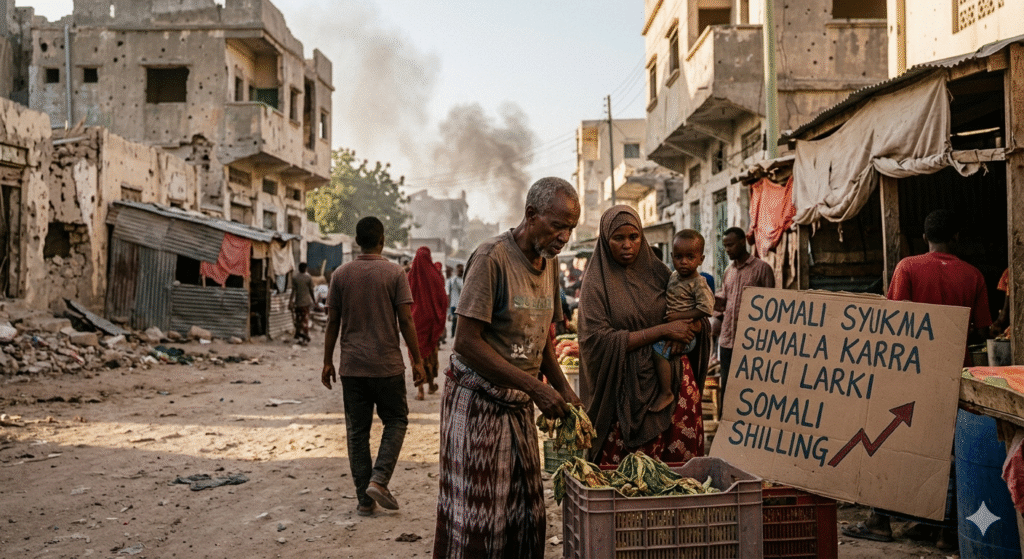
April 16, 2026 – On the surface, Mogadishu is a city of resilience. The white-washed buildings along the coastline catch the morning sun, the port handles ships from Turkey and the Gulf, and tuk-tuks weave through crowded markets. But beneath this fragile normalcy, Somalia’s capital is in crisis. A devastating drought has displaced hundreds of thousands into squalid camps on the city’s outskirts. A war 3,000 kilometers away in the Middle East has doubled fuel prices and disrupted food aid. Al-Shabaab militants continue to strike government buildings and hotels. And now, a political crisis with Israel threatens to destabilize the fragile federal government. This is Mogadishu today.
Part 1: The Drought Exodus – A City Bursting at the Seams
The most visible crisis in Mogadishu is the human one. Displaced families, having lost their livestock to the worst drought in four decades, are pouring into the capital at an alarming rate. They settle in sprawling, makeshift camps on the city’s periphery—places like Kahda district, where thousands now live in shelters made of plastic sheets and torn fabric .
The infrastructure cannot keep up. In Maqsud camp, Khadro Mohamed Hassan, a mother of five, describes a daily nightmare. “The biggest problem we have is lack of water,” she told Radio Ergo. “Some days we can’t even afford to buy any. The children bring dirt from outside into the house, and there is no water to clean” .
The price of a jerrycan of water has tripled in recent months, soaring from 2,000 to 6,000 Somali shillings. For families who earn just a few dollars a day washing clothes or scavenging, this is catastrophic. Sahro Mahmoud, a single mother of six who lost 100 goats to drought, now survives in the same camp. “Water is now a business,” she said. “If you ask for it without money, no one will give it to you” .
The health consequences are already visible. Children are suffering from diarrhoea and vomiting, diseases that thrive where clean water is a luxury. Local authorities admit they are overwhelmed. Yusuf Abdi Osman, director of humanitarian affairs in Kahda district, warned: “If this situation continues, we fear a humanitarian disaster” .
Part 2: The Fuel Shock – Tuk-Tuk Drivers on the Brink
The war between the United States, Israel, and Iran—which began on February 28—has delivered an economic body blow to Mogadishu. Somalia imports almost all of its fuel, and global oil prices have surged. In March alone, fuel prices in the capital jumped by 150 percent, from $0.60 to $1.50 per liter .
For the estimated tens of thousands of young men who drive three-wheeled tuk-tuks (known locally as bajaj), this is an existential crisis. Many do not even own their vehicles; they rent them for about $15 a day and keep whatever remains after fuel costs. That math has broken.
Ahmed Mohamud, a driver who rents his tuk-tuk, explained the collapse. “I used to earn $15 to $20 after paying fuel and rental fees,” he told Xinhua. “But now I make only $7 to $10. My daily fuel bill has doubled from $8 to $16. If this continues, I don’t think I will be able to carry on” .
Some drivers have already quit. In early March, hundreds of tuk-tuk drivers blocked Maka Al-Mukarama Road—a major artery leading to the presidential palace—demanding government intervention. The protest led to the arrest of a female driver, a university graduate who had turned to tuk-tuks after failing to find formal employment .
For ordinary residents, the fare increases are prohibitive. “A trip that used to cost one dollar now costs two to three dollars,” said Hassan Mohamed, a former regular user . As transport costs rise, so does the price of food, further squeezing families already on the edge.
Part 3: The Security Threat – Al-Shabaab Strikes Again
The militant group Al-Shabaab remains Mogadishu’s most persistent threat. Just last week, on April 10, a suicide car bomb exploded in a busy business center near the National Theatre, close to the heavily fortified presidential palace. At least five people were killed, with many cars left burning at the scene .
That attack came just days after an even deadlier assault. On April 6, Al-Shabaab stormed a government building housing the ministries of labour and works. A suicide car bomber detonated at the entrance, followed by a gun battle that left at least 15 people dead—including the Deputy Minister for Labour and Social Affairs, Saqar Ibrahim Abdalla .
Prime Minister Hassan Ali Khaire has vowed to intensify the fight against the militants. But on the ground, the situation is precarious. Earlier this week, government troops abandoned several defensive outposts on the outskirts of Mogadishu over lack of payment, allowing Al-Shabaab to retake strategic villages linking the capital to the fertile agricultural regions of Lower and Middle Shabelle .
The group, which was forced out of Mogadishu in 2011, continues to demonstrate its ability to strike at the heart of the city. For residents, the threat is a constant, grinding presence.
Part 4: The Aid Crisis – A Million Children at Risk
The combined effects of drought, war, and funding cuts are pushing Somalia’s health and nutrition systems to collapse. According to the Integrated Food Security Phase Classification (IPC), an estimated 1.84 million children under five in Somalia are expected to experience acute malnutrition in 2026 .
UNICEF has warned that the Iran war is a “shock to the system” for aid delivery. The agency has $15.7 million worth of essential supplies—therapeutic food, vaccines, mosquito nets—stuck in transit or awaiting shipment. The conflict has disrupted supply chains, and transportation costs are expected to rise by 30 to 60 percent, potentially doubling in some cases .
More than 400 health and nutrition facilities have closed across Somalia over the past year, primarily due to cuts in U.S. funding. In the displacement camps around Mogadishu, the effects are visible. At Ladan camp, nurse Abdimajid Adan Hussein described children arriving in “extremely critical condition—severely malnourished, weak, and in some cases almost skeletal” .
The hospital’s supplies for treating malnourished children are projected to last only until mid-April. “If new stock doesn’t arrive, more children will deteriorate and potentially die,” warned Liban Roble, a nutrition program coordinator .
Part 5: The Turkish Lifeline – Military Support Arrives
Amid the chaos, Mogadishu has found a powerful ally. Turkey has deepened its military and economic footprint in Somalia, and on April 12, Turkish F-16 fighter jets performed a flyover during a parade marking the 66th anniversary of the Somali National Armed Forces. Turkish T129 attack helicopters and AS-532 transport helicopters also participated .
The deployment is part of a broader Turkish naval task group that includes the frigate TCG Gaziantep, a corvette, and a landing ship tank. The Turkish oil drilling ship Çağrı Bey recently arrived in Mogadishu’s port, signaling Turkey’s long-term commitment to Somali energy exploration .
For Mogadishu’s government, the Turkish presence is a critical counterbalance to regional rivals and a symbol of international support. But it also highlights the capital’s dependence on foreign military backing to maintain even a semblance of security.
Part 6: The Political Earthquake – Israel and Somaliland
Just days ago, a political bombshell landed in Mogadishu. Israel appointed its first non-resident ambassador to Somaliland, the breakaway region that declared independence in 1991 but has never been recognized by the international community .
The Federal Government of Somalia was quick to condemn the move. In a statement, the Foreign Ministry called it a “direct breach of Somalia’s sovereignty” and reiterated that “Somaliland remains an integral part of the Federal Republic of Somalia” .
But Somaliland’s foreign ministry fired back, referring to Mogadishu’s administration as the “Somalian Government”—a deliberate rejection of the legitimacy of the federal state. “Somaliland’s independence predates the union of 1960,” the statement read, “which lacked a binding legal foundation” .
The diplomatic crisis comes at a delicate moment. Somalia already risks losing World Bank funding due to a bitter political dispute between the federal government and regional states over planned direct elections. The government’s 2026 budget projects more than $828 million in donor support, and any disruption could affect the government’s ability to pay salaries and maintain basic services .
Part 7: Glimmers of Hope – Farming on the Outskirts
Not all the news from Mogadishu is grim. Agriculture Minister Asir Maareeye has launched an ambitious campaign to reduce Somalia’s dependence on food aid. Speaking to TRT Afrika, he highlighted emerging success stories, particularly youth-led greenhouse farming initiatives around Mogadishu.
“These projects are already supplying a significant share of the city’s fresh produce,” Maareeye said. “A single greenhouse can sustain a family. This is not theory, it is already happening” .
The minister called for targeted investments in irrigation, livestock systems, and export-oriented crops such as bananas—which once formed a key part of Somalia’s economy. He also revealed plans to crack down on exploitative systems that profit from displaced populations, while encouraging farmers to return to productive land as security conditions improve .
“The opportunity is there,” Maareeye said. “Agriculture is not just survival, it is the future” .
Conclusion: A City Holding Its Breath
Mogadishu today is a city of contradictions. The port welcomes Turkish ships, the market stalls overflow with imported goods, and the government talks of self-sufficiency and greenhouse farming. But a few kilometers away, families in displacement camps boil water that isn’t clean, mothers watch their children waste away from malnutrition, and tuk-tuk drivers abandon their vehicles by the roadside, unable to afford the fuel to move them.
The war in the Middle East has delivered a shock that Mogadishu’s fragile economy cannot absorb. Al-Shabaab remains a deadly threat. And now, a political crisis with Israel threatens to unravel the delicate federal consensus that has kept the country from sliding back into civil war.
For the people of Mogadishu, the daily calculus is simple: find water, find food, find safety. The international community has the resources to help—UNICEF alone has $15.7 million in supplies waiting to move. But time is running out. As one mother in a displacement camp put it: “Some days I return home without any water because I cannot afford it” . In Mogadishu today, that is the sound of a city on the edge.
