

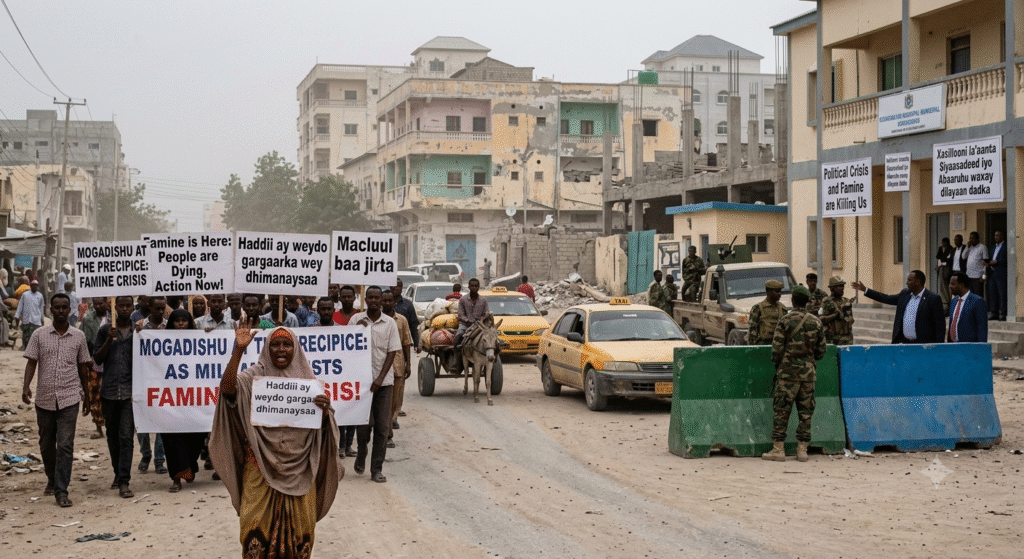
Mogadishu in September 2026 presents a stark portrait of a capital under immense strain. The city serves as the epicentre of a escalating humanitarian emergency that threatens to push parts of the country toward famine, even as it navigates a treacherous political landscape defined by a constitutional crisis and widening divisions between the federal government and regional states. A key visit from a UK minister this week has shone a spotlight on the severity of the crisis, revealing the bureaucratic and political hurdles that stand in the way of lifesaving aid .
🥘 The Hunger Crisis: A Humanitarian Calamity Unfolds
The most pressing and devastating issue in Mogadishu is the acute food insecurity gripping the nation. The United Kingdom’s Minister for Development and Africa, Kirsty McNeill, received a stark briefing during her visit: six million people—31 percent of Somalia’s population—are facing acute food insecurity at crisis level or worse . This includes 1.9 million people in emergency levels of hunger, and the UN’s famine early warning system (FEWS NET) assesses a credible risk of famine in five areas by late 2026, including the Bay, Bakool, Gedo, and Hiiraan regions . The situation in the Burhakaba district is particularly dire, with a confirmed famine risk .
This crisis is compounded by a catastrophic funding shortfall. WFP’s Executive Director Carl Skau, who also visited a nutrition centre in Mogadishu, warned that the agency has only a tenth of the resources it had in 2022 when it helped avert famine . “We can only do the bare minimum,” Skau said . The agency urgently requires USD 198 million for the next six months but faces a shortfall of USD 147 million .
The human cost is visible in Mogadishu’s health centres. At the Feynuus Health Centre in the Kahda district, women wait for hours with their malnourished children. One mother, Halima Mohamed Hassan, walked nearly 3 kilometres carrying her 4-year-old son, pregnant and having not eaten in two days . The centre’s director, Abdirahman Barkhad, said about ten nearby health and nutrition centres had closed due to a reduction in humanitarian funding, increasing pressure on the facilities that remain open .
A host of factors are driving this disaster. The Deputy Prime Minister, Salah Ahmed Jama, made a particular point to the UK minister that in the worst-affected districts, the crisis is not driven by conflict but by a succession of weather shocks: failed Gu rains in 2025, a devastatingly dry Deyr season, and the harsh Hagaa dry season of 2026 . This is compounded by global economic pressures, with the conflict in the Middle East causing food prices to surge by up to 70 percent in some regions and fuel costs to jump by 150 percent .
🏛️ Navigating a Political Minefield
The humanitarian crisis unfolds against a backdrop of profound political instability. The federal government, whose term ended in May 2026, is navigating a complex political crisis. An opposition representative has stated that the government and opposition are close to signing an agreement to establish a Democratic Transition Task Force (DTT) . However, this fragile process has been threatened by a drone attack on the residence of a former senior official, which the opposition sees as an attempt to derail the talks . The federal government has denied involvement and promised an investigation .
The government’s efforts to assert control have sparked violent clashes in the southwestern city of Baidoa, a major humanitarian hub hosting over half a million displaced people . Fighting erupted between government forces and militias loyal to a former regional president, leaving at least one civilian dead and 24 wounded . This highlights the volatile security situation that has shattered the fragile peace across the country.
Meanwhile, President Hassan Sheikh Mohamud is reportedly maintaining a hardline stance on the electoral process. He insists that discussions on a national election timeline should only begin after planned regional elections in Galmudug and Hirshabelle are concluded . This position has raised concerns among opponents that it will lead to further delays and a deepening of the constitutional crisis .
💡 A Glimmer of Hope
Amid these challenges, there are small signs of resilience. The Somali National Army (SNA) continues its counter-terrorism operations, with the elite Danab forces killing 14 suspected Al-Shabaab militants in a recent operation in the Bay region . The government is also taking steps to improve governance, holding the 2nd National Strategic Communication Forum in Mogadishu to modernise the media sector and strengthen cooperation between federal and state levels .
As the Deputy Prime Minister stressed to the UK minister, the humanitarian catastrophe in some of the most peaceful parts of the country is a direct result of climate shocks and a failure of international support, not just conflict . The coming months, as an El Niño threatens to bring devastating floods, will be critical . The fate of millions rests on whether the international community heeds the “alarm bell” and provides the resources needed to pull Somalia back from the brink of famine.
