

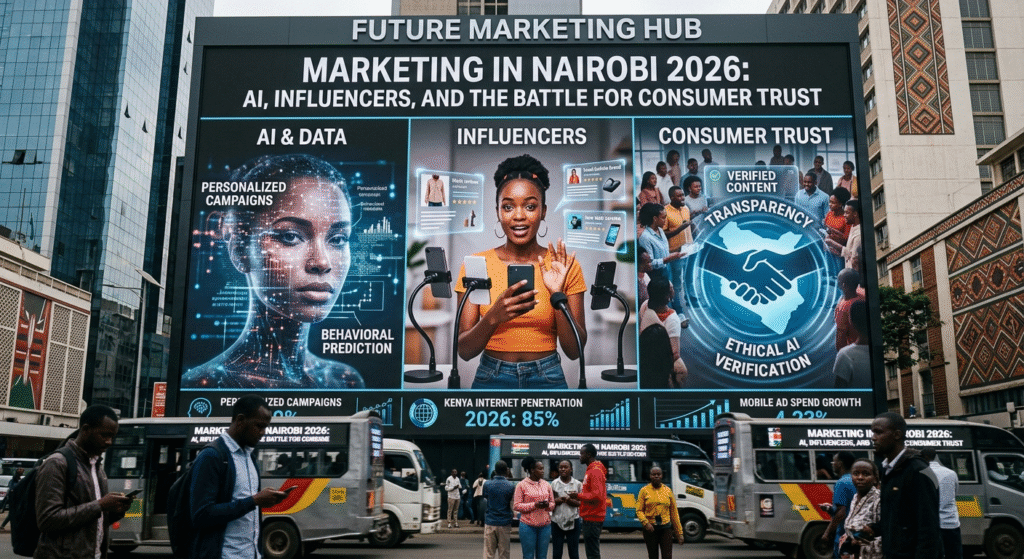
Nairobi has solidified its position as East Africa’s undisputed marketing powerhouse. As of mid-2026, the city’s marketing landscape is undergoing a profound transformation, driven by the explosive growth of digital advertising, the integration of artificial intelligence, and a dramatic shift from traditional mass media to influencer-led, community-driven campaigns. However, this dynamic growth is accompanied by fierce debates over data privacy, accountability, and the very definition of authenticity in an AI-driven era.
AI Takes Center Stage: From Future Concept to Present Reality
The 2026 Marketing Society of Kenya (MSK) Marketers Summit, held in Nairobi, sent a clear signal that artificial intelligence is no longer a future concept but a present-day force reshaping the profession . Speakers at the summit emphasized that AI is fundamentally changing how businesses understand consumers, build brands, deliver customer experiences, and create business value .
Broadcasting and Telecommunications Principal Secretary Stephen Isaboke, who addressed the summit, framed this transformation in stark terms, warning marketers that the growing value of consumer data demands stronger protection as the technology evolves . He argued that consumer data has become a strategic asset whose misuse amounts to theft, and referenced the establishment of the Office of Data Protection as evidence of the government’s commitment to safeguarding personal information .
With the Office of the Data Protection Commissioner having stepped up enforcement, entities handling personal data now risk fines of up to Sh5 million for failing to register as data handlers or processors, a development that has made data governance a critical priority for Nairobi’s marketing agencies and brands .
The Rise of Local AdTech: Challenging Global Dominance
One of the most significant stories in Nairobi’s marketing scene is the emergence of home-grown advertising technology (AdTech) firms challenging the dominance of global platforms. Kenya’s digital advertising market is the fastest-growing in the world, projected to expand at a 16% compound annual growth rate and reach $470 million (Sh60.82 billion) in revenue by 2029 .
Yet, despite this growth, global tech companies still command the lion’s share. Data from the Communications Authority of Kenya shows that in the third quarter of the 2025/26 financial year, Meta’s platforms—Facebook and Instagram—captured 52% and 27% of local digital advertising spending respectively, while YouTube and TikTok accounted for 23% and 10% . Industry players argue this dominance has left many businesses dependent on advertising systems designed for mature markets that don’t reflect African consumer behavior, internet connectivity patterns, or media consumption habits .
This gap has created space for local startups like Nairobi-based Suss Ads, which has spent the past five years developing advertising infrastructure for African markets . The company’s AI-powered platform allows advertisers to manage campaigns across multiple channels—including programmatic advertising, conversational commerce, digital out-of-home, connected television, and social media—from a single dashboard . Unlike global platforms that largely provide access to their own advertising ecosystems, Suss Ads is focusing on enabling businesses to plan, automate, and monitor campaigns across several channels while measuring whether advertising spend translates into customer engagement and sales .
The startup, which employs 22 specialists, now serves more than 30 organizations across sectors including banking, insurance, real estate, and fast-moving consumer goods .
The Influencer Revolution: “Human Billboards” Take Over
Nairobi’s marketing landscape has been fundamentally reshaped by what has been described as the “influencer-first” business model . Walk down any street in the city today, and you’ll see the same billboards from last year. But open your phone, and you’ll witness real-time marketing happening through creators who have become modern-day “human billboards” .
This shift is driven by a massive breakdown in traditional trust. Research shows that 90% of Kenyans trust a recommendation from someone they follow—even if they don’t know them personally—over a brand’s own advertisement . Influencers like Njugush, The Roaming Chef, and even niche “TikTok farmers” are perceived as friends offering genuine recommendations rather than paid spokespeople .
However, the relationship between brands and creators is increasingly tense. The honeymoon phase is over, and several conflict zones have emerged :
Creative Suffocation: Corporate marketing teams often hand influencers rigid scripts written in “officialese” that sound like government gazettes. When creators read dry scripts, their engagement tanks. Creators are now demanding creative freedom clauses in their contracts, insisting they know their audience better than the brand’s CEO .
The ROI Expectation Gap: Many Kenyan brands treat an influencer post like a vending machine, expecting immediate sales. Most consumer journeys, however, involve seeing an influencer post, thinking about it for a week, and purchasing the product later at a supermarket. Brands often fire influencers after one post for not delivering an immediate sell-out, failing to realize the creator actually built the long-term trust that will drive sales for months .
Rampant Fraud: The sector has been plagued by scandals involving influencers endorsing fraudulent overseas job agencies and “Wash-Wash” schemes . Brands are now losing millions to “Bot Influencers”—accounts with 500,000 followers that are 90% AI-generated bots. This has led to the emergence of specialized audit AI to vet an influencer’s “aura” before signing a check .
Regulatory Accountability: Under the Consumer Protection Act, influencers are no longer allowed to hide ads. Failure to clearly state a “Paid Partnership” can result in fines of up to Sh1 million or jail time. Influencers are now legally liable if they promote a scam without doing proper due diligence .
Premium Agency Growth and Specialization
Amid these changes, Nairobi’s major advertising and marketing agencies continue to expand their capabilities. Belva Digital, founded in 2013, has grown from approximately 52 employees in September 2022 to 91 by March 2026 . The agency specializes in using data, strategy, creativity, media, and technology to drive business growth across Africa .
Meanwhile, Dentsu Kenya launched Merkury, an identity and data platform designed to help brands unify customer data, improve audience understanding, and deliver more precise, measurable marketing campaigns . In test campaigns across banking and FMCG sectors, audience strategies using Merkury achieved a 57.2% increase in total interactions compared to regular campaigns, with programmatic advertising maintaining click-through rates above 5%—significantly outperforming the industry benchmark of 1-2% .
The city hosts over 250 advertising agencies, ranging from global giants like Ogilvy & Mather and McCann Erickson to specialized local firms, reflecting the diversity and maturity of Nairobi’s marketing ecosystem .
Conclusion
Marketing in Nairobi today is a story of transformation and tension. The city is embracing AI and local AdTech solutions to capture a larger share of its fast-growing digital advertising market . Influencer marketing has democratized the industry, allowing brands to reach consumers through trusted voices while also creating new challenges around fraud, creative control, and accountability . As companies like Unilever continue to hire marketing specialists in Nairobi to lead regional strategies , the city’s role as East Africa’s marketing hub is secure. The key question for 2026 is whether the industry can balance innovation with responsibility—protecting consumer data, fostering authentic creator relationships, and building marketing infrastructure that reflects the realities of African consumers rather than adapting systems designed elsewhere .
