

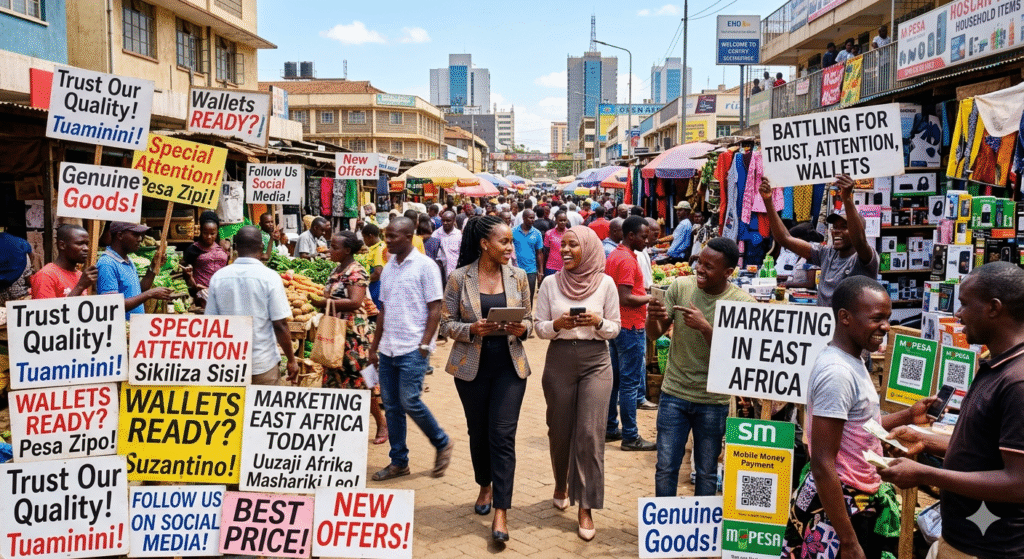
NAIROBI – Walk down any street in Nairobi, Kampala, or Dar es Salaam today, and the old billboards are still there—same brands, same faces, same slogans. But open your phone, and you will see where the real marketing is happening. In 2026, East Africa has become a living laboratory for some of the world’s most dynamic marketing trends: influencer-driven commerce, mobile-first brand building, Afro-centric identity, and a fierce battle for price-sensitive consumers. This article breaks down the state of marketing in East Africa into 12 critical dimensions.
Part 1: The Trust Collapse – Why Influencers Now Rule
The most profound shift in East African marketing is not technological but psychological. Research shows that 90 percent of Kenyans trust a recommendation from someone they follow—even if they don’t know them personally—over a brand’s own advertisement . This statistic has fundamentally inverted the marketing pyramid.
Influencers like Njugush, The Roaming Chef, and even niche “TikTok farmers” feel like friends to their followers. When they say “I use this soap,” it registers as a tip from a pal, not a sales pitch from a CEO. Traditional media—billboards, TV, radio—is expensive and increasingly hard to measure. With influencers, brands can track every click, “add to cart,” and share in real-time using AI-driven tools .
The result? Every brand in East Africa, from Safaricom and EABL to the small mtumba boutique in Nairobi’s CBD, is now an “influencer-first” business.
Part 2: The Authenticity Imperative – “Perfect Is Out, Real Is In”
In 2026, polished perfection has lost its power. Kenyan consumers are craving imperfection—they want to see the influencer trip over their words, show their messy house, and tell them the truth . This shift reflects a broader breakdown in trust across institutions. When people feel bombarded by AI-generated content and corporate messaging, the unpolished, human voice cuts through.
The most successful influencers today are those who show their struggles, their real opinions, and their daily lives. “Kila mtu akae kwa lane yake” (everyone stay in their lane) has become an unofficial motto: brands handle the product, creators handle the people . This division of labor respects the authenticity that audiences demand.
Part 3: The Bot Crisis and Accountability – Fraud Meets Regulation
But the influencer gold rush has brought problems. In 2026, many brands are losing millions to “bot influencers”—accounts with 500,000 followers that are 90 percent AI-generated bots . Brands are now using specialized audit AI to vet an influencer’s “aura” before signing a check.
Regulation has also caught up. Under Kenya’s Consumer Protection Act, influencers are no longer allowed to hide ads. Failure to clearly state that a post is a “paid partnership” can result in fines of up to Sh1 million or jail time . Influencers are now legally liable if they promote a scam without doing “due diligence.” This has made creators much more selective about who they work with and has professionalized the industry.
Part 4: The Inflation Consumer – Price Sensitivity Reshapes Everything
Beyond the influencer economy, a more fundamental force is shaping marketing strategies: inflation. According to a Kasi Insight survey of over 17,000 consumers across 21 African markets, “purchasing cheaper alternatives” has emerged as the single most common consumer response to rising prices . This trend is particularly dominant in East and Southern Africa, reflecting highly competitive retail environments where consumers have the flexibility to switch brands.
For marketers, this means one thing: brand loyalty is eroding. Consumers are becoming increasingly price-sensitive and brand-agnostic. Success in 2026 depends on understanding these localized coping strategies—whether it’s aggressive brand-switching or delaying non-essential purchases . Global giants like Unilever are responding by making their products more affordable and relevant to local realities.
Part 5: The Geisha Lesson – Afro-Centricity as a Marketing Strategy
The rebranding of Unilever’s Geisha soap offers a masterclass in modern East African marketing. Once wrapped in muted, generic packaging featuring lighter-skinned models, Geisha now appears in vibrant designs that foreground dark, moisturized African skin and local ingredients like shea butter and honey . For many Kenyan consumers, this rebrand feels less like a cosmetic tweak and more like recognition—a global FMCG giant finally speaking to African realities.
This evolution reflects a broader shift. Across East Africa, brands are adopting Swahili names, proverbs, and idioms to anchor themselves in everyday speech. Purpose-driven branding—linking corporate strategy to social and community goals—is no longer optional in contexts of historical inequity and institutional mistrust . Banks that brand around financial literacy, telecoms that champion rural connectivity, and FMCG companies that celebrate African beauty are repositioning themselves as development partners rather than mere service providers.
Part 6: Mobile-First Marketing – The Smartphone as Primary Channel
If the supermarket aisle is one frontline of branding, the smartphone screen is another—and in East Africa, it comes first. Consumers in Nairobi, Kampala, and Dar es Salaam often discover brands through TikTok videos, WhatsApp groups, or Instagram Reels long before they encounter formal advertising . For a new detergent, snack, or beauty line, a short clip of a Kenyan content creator demonstrating the product in Sheng (urban slang), shared across WhatsApp neighborhood groups, may outperform a polished TV spot in both reach and credibility.
This mobile-first behavior has democratized marketing. You no longer need a skyscraper in Upper Hill to run a successful campaign; you just need a smartphone, a ring light, and some “aura” . WhatsApp Business catalogues, Instagram shop tags, and TikTok “shop now” features allow micro-entrepreneurs to bypass traditional retail gatekeepers entirely.
Part 7: The Cashless Push – MTN MoMo’s Behavioral Campaign
In Uganda, MTN Mobile Money has launched one of the most sophisticated behavioral marketing campaigns in the region. Dubbed “The Power of MoMo,” the initiative signals a deliberate shift from awareness to active usage, positioning mobile money as an essential, everyday payment solution .
The centerpiece is a bold customer value proposition: all payments below Shs5,000 are processed free of charge. This pricing intervention directly addresses one of the biggest barriers to digital adoption—transaction costs. To drive engagement, MTN MoMo launched a “12-hour cashless challenge,” where influencers navigated an entire day without using physical cash, showcasing how mobile money seamlessly facilitates everything from boda boda fares to market purchases . This experiential marketing approach is designed to shift consumer behavior by illustrating practicality in real-time.
Part 8: Digital Trade – The Cross-Border Opportunity and Regulatory Hurdle
East Africa’s marketers are increasingly thinking regionally. The East African Community’s e-Commerce Strategy aims to create a seamless digital market across eight partner states. But significant friction remains: fragmented e-transaction laws, inconsistent licensing regimes, and overlapping compliance requirements make cross-border expansion expensive and unpredictable .
The biggest risk to East Africa’s digital trade ambitions is that regulations lag behind innovation. In 2026, harmonizing digital payments, standardizing Know Your Customer (KYC) frameworks across borders, and recognizing e-signatures are urgent priorities . Marketers who can navigate this fragmented landscape—or who partner with fintech platforms offering multi-currency settlement—have a significant competitive advantage.
Part 9: Unified Tourism Branding – “Visit East Africa, Feel the Vibe”
One of the most ambitious marketing initiatives in the region is the newly launched “Visit East Africa—Feel the Vibe” campaign, unveiled at ITB Berlin 2026. For the first time, eight partner states—Kenya, Tanzania, Uganda, Rwanda, Burundi, South Sudan, Somalia, and the Democratic Republic of the Congo—are being marketed not as competitors but as complementary components of a single travel circuit .
Tourism contributes approximately 10 percent of regional GDP and 17 percent of total export earnings. The unified branding effort seeks to increase the average stay from the traditional 10-day single-country safari to 21-day multi-country explorations . This approach recognizes that modern travelers seek depth and variety, and that marketing the region as a cohesive destination is more powerful than competing national campaigns.
Part 10: Social Commerce – From Awareness to Transaction
Influencer marketing has evolved beyond awareness to direct sales. Social commerce—the ability to complete a purchase without leaving a social media platform—is rapidly growing across East Africa. Instagram shop tags, TikTok’s “shop now” features, and WhatsApp catalogs allow consumers to move from discovery to transaction in seconds .
For marketers, this closes the loop between spending and return on investment. Every click, “add to cart,” and share can be tracked in real-time. The brands succeeding in this environment are those that understand the full customer journey: influencer discovery, social consideration, and frictionless mobile payment.
Part 11: The Creative Tension – Brands vs. Creators
The influencer economy has created a new source of tension. Corporate marketing teams often hand influencers rigid scripts written in “officialese” that sounds like a government gazette. When an influencer reads a dry script, their engagement tanks—their followers can smell the ad from a mile away .
Creators are now demanding creative freedom clauses in their contracts, insisting that they know their audience better than the brand’s CEO. The most successful brands have stopped being bosses and started being partners: they give the creator the product, explain the feeling they want, and then get out of the way .
Part 12: The Road Ahead – An African Marketing Playbook
An East African marketing playbook is taking shape, but it is still being written. Key principles recur across research and practice: embrace Afro-centric identity rather than disguising it; build with communities, not just for customers; design for mobile-first interactions; and scale through alliances that respect national specificities while leveraging regional synergies .
The transition of Geisha’s packaging, the rise of influencer-driven commerce, the expansion of mobile money marketing, and the unification of tourism branding are not isolated events. They are manifestations of these principles in action. Africa is moving from being branded by others to doing the branding itself—on supermarket shelves, in mobile wallets, and across social feeds. For marketers in East Africa today, the opportunity is enormous. But it belongs to those who understand that in this region, trust is earned not through volume, but through authenticity, relevance, and genuine partnership.
