

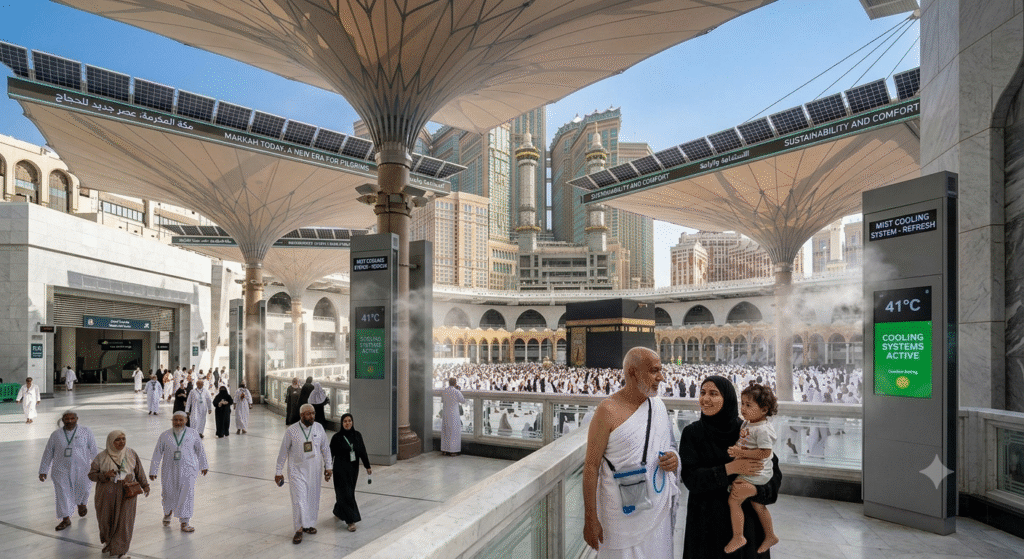
Makkah, the spiritual heart of Islam, is undergoing a profound transformation as of August 2026. The city is not only managing the legacy of a successful Hajj season but is also in the throes of a multi-billion-dollar urban redevelopment program aimed at modernizing its infrastructure and enhancing the experience for the millions of pilgrims who visit annually. However, this progress is taking place against a backdrop of extreme weather, regional geopolitical tensions, and a rapidly digitizing pilgrimage economy.
The Hajj Legacy and Regional Tensions
The recent Hajj season concluded successfully in May, with more than 1.7 million pilgrims from 165 countries participating in the annual pilgrimage . Saudi authorities marked the event as a triumph of crowd management and security . However, the pilgrimage took place under an ominous shadow. The war involving Iran, which began in February, led to fears of attacks targeting religious sites in the Kingdom . Saudi air defenses were put on high alert to protect the holy sites . This security backdrop led to a notable drop in Iranian pilgrims, with only about 30,000 attending compared to the 86,000 expected, a reduction attributed to the “wartime situation” .
Weather: Extreme Heat and Dry Conditions
Makkah’s climate in August is relentless. Forecasts from Saudi Arabia’s National Center for Meteorology (NCM) indicate that the summer of 2026 will be hotter than normal across most regions, including Makkah . Temperatures in the region are expected to be approximately 1.6°C above the historical average during the peak months of July and August . Adding to the harsh conditions, rainfall is forecast to be below average in parts of Makkah, a trend that contributes to the dry desert environment .
A $4.3 Billion Urban Transformation
Makkah’s physical landscape is rapidly changing. The Royal Commission for Makkah City and Holy Sites is driving a massive SR16.3 billion ($4.3 billion) urban development program . Announced in June, the program focuses on seven locations across five districts—Jarham, Al-Khalidiyah, Al-Hajlah, Al-Hindawiyah, and Al-Zohour—covering over 4.4 million square meters .
Redeveloping Informal Settlements
A major component of this urban renewal is the Makkah Informal Settlements Development Programme. In a significant move, a consortium led by Umm Al Qura for Development and Construction Company signed framework agreements to redevelop the Hindawiya West and Hindawiya South sites, which are adjacent to their flagship Masar Destination . This $1.6 billion project will transform a combined area of 1.15 million square meters into a mixed-use urban project . Similar agreements were signed for the Khalidiyah project, where a $1.07 billion real estate fund was established to finance the redevelopment of the Khalidiyah informal settlement . Additionally, Jadwa Investment launched two funds with a combined value of $2.67 billion for the East Hindawiyah and Al Hijla redevelopments .
Residential and Hospitality Growth
The city’s real estate sector continues to boom. In early August, Dar Al Majdiah Real Estate Company signed a $105.5 million agreement to develop two residential towers at the Masar Destination project . This project, covering a 6,614-square-meter site, signals strong investor confidence in Makkah’s long-term growth.
Heritage Preservation and a Digital Pilgrimage
Makkah’s identity is also being preserved. The Heritage Commission recently added 87 new archaeological sites in the Makkah region to the National Antiquities Register, bringing the region’s total to 1,306 . This is part of a national effort to preserve the Kingdom’s heritage.
Perhaps the most transformative change for the pilgrims themselves is the digital overhaul of services. Saudi authorities have introduced mandatory food vouchers for Umrah pilgrims from Pakistan, India, Bangladesh, and Egypt . Each pilgrim will receive a unique digital code linked to their Umrah visa, which can be used to redeem meals from approximately 10,000 approved restaurants in Makkah and Madinah through the Nusuk platform . The voucher is valued at around 20 Saudi riyals per day. This policy is part of a broader effort to modernize Umrah services, integrating hotel bookings, transport, and meals into a single digital system, although it is expected to increase the overall cost of Umrah packages .
Conclusion
Makkah in 2026 is a city of contrasts. As it navigates the threats of geopolitical instability and the harshness of its climate, its identity as the holiest site in Islam remains unshaken. The city is leveraging its wealth and technological ambition to create a more modern, efficient, and sustainable environment for pilgrims. The challenge lies in managing the delicate balance between preserving its sacred heritage while embracing a future of massive urban expansion and digital transformation.
