

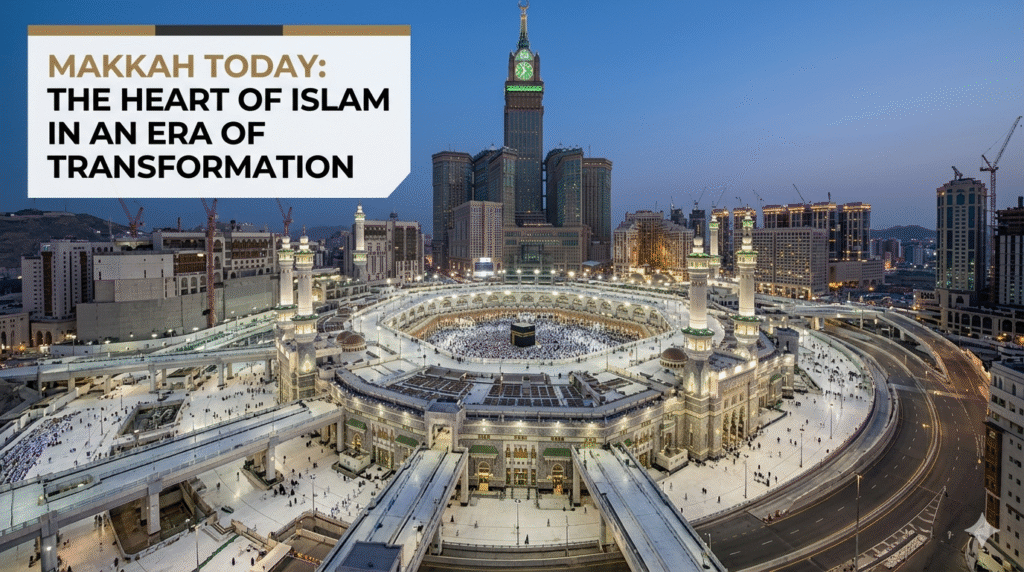
April 10, 2026 – In the sweltering heat of a Makkah spring, with temperatures soaring toward 36°C and the first rains of the season forecast to bring flash floods to the surrounding valleys, the holiest city in Islam is undergoing a transformation unlike any in its 1,400-year history. From the marble courtyards of the Grand Mosque to the soaring towers of Thakher City, Makkah today is a study in sacred continuity and relentless modernization. As millions of pilgrims prepare for the final days of Ramadan, this article examines the state of the Holy City across multiple dimensions.
Part 1: The Grand Mosque – An Architectural Marvel Expanded
The centerpiece of Makkah remains the Masjid al-Haram, the Grand Mosque that surrounds the Kaaba. Today, it is larger and more technologically advanced than ever before. The Third Saudi Expansion, one of the largest construction projects in the mosque’s history, now covers approximately 1.214 million square meters—equivalent to more than 170 football pitches.
This expansion is not merely about size. It is about creating a spiritually enriching environment equipped with a cooling capacity of 90,000 tons to maintain comfortable temperatures year-round. The facility includes more than 25,000 carpets, 17,000 Zamzam water dispensers, 11,436 restrooms and ablution areas, and 1,300 speakers to ensure the call to prayer and sermons reach every corner.
Worshippers move across the ground, first, second, mezzanine, and rooftop levels via 428 escalators, 28 elevators, and through 80 doors. The design accommodates millions during peak periods—a necessity for a city that hosts the largest annual human gathering on Earth.
Part 2: The Technological Revolution – AI Guides the Faithful
What truly distinguishes Makkah today is not its marble or minarets, but the invisible network of sensors and artificial intelligence that manages the movement of millions. The General Authority for the Care of the Affairs of the Two Holy Mosques has shifted from “traditional congestion response to a model of operational anticipation,” using real-time density analysis to act before bottlenecks form.
A central engineering command and control center monitors density indicators and crowd-flow speeds across the mosque complex. Interactive digital maps provide field supervisors with real-time visual data, allowing them to adjust entry and exit routes and deploy cleaning and emergency teams based on predicted patterns rather than waiting for calls.
This technology proved its worth during the first Friday prayer of Ramadan in February 2026, when the Grand Mosque witnessed a massive influx of worshippers from across the world. Comprehensive organizational measures ensured a smooth flow, allowing devotees to perform their rites with ease. As Dr. Fawwaz Al-Dahas, head of the Makkah History Center, observed: “What Makkah is witnessing today in terms of advanced operational systems reflects the depth of accumulated expertise that the relevant authorities have built up over generations”.
Part 3: The Weather Challenge – Heat, Rain, and Preparedness
April in Makkah is a month of extremes. Daytime temperatures typically reach 33-36°C with very high humidity, though nights cool to around 18-22°C. The sun shines for approximately 10 hours daily, and the UV index is extreme—requiring pilgrims to take serious precautions against sun exposure.
But this week, a different weather pattern has emerged. The Saudi National Center for Meteorology has forecast moderate to heavy rainfall across the Makkah region from Friday through Tuesday, with potential for flash floods, hail, and strong downdraft winds causing dust and reduced visibility. The General Directorate of Civil Defense has urged residents and pilgrims to exercise caution, avoid flood-prone areas and valleys, and follow official updates through the Anwaa app.
For a city where millions perform outdoor prayers and the tawaf (circumambulation) around the Kaaba, rain presents a significant logistical challenge. But Saudi authorities have prepared: drainage systems integrated into the expanded mosque complex are designed to handle heavy downpours, and covered walkways now connect major parking structures to the prayer halls.
Part 4: The Indonesian Expansion – A Hajj Village 600 Meters from the Mosque
Perhaps the most significant international development in Makkah today involves Indonesia, the world’s most populous Muslim nation. Indonesia’s sovereign wealth fund, Danantara, is aggressively expanding its footprint in the Holy City. After acquiring the Novotel Makkah hotel and real estate assets in the Thakher City complex (2.5 kilometers from the Grand Mosque), the fund has announced plans to purchase land just 600 meters from the mosque itself.
The project, known as the Hajj Village, will include a tunnel connecting directly to the Grand Mosque area. Danantara plans to construct 13 buildings in this complex, with a total capacity of approximately 6,000 rooms accommodating roughly 22,000 pilgrims—about 10 percent of Indonesia’s annual Hajj quota.
CEO Rosan Roeslani confirmed that the agreement was signed on December 14, 2025, and construction is moving forward. For Indonesian pilgrims, who have long faced challenges securing affordable, quality accommodations near the mosque, this represents a transformative development.
Part 5: The Future – A New Airport and Metro System
Makkah is not resting on its achievements. The Royal Commission for Makkah City and the Holy Sites has announced plans for a new international airport in Makkah, designed to serve millions of visitors to global standards. CEO Saleh Al-Rasheed confirmed that approval has been secured for strategic investments to develop the airport, with the Commission collaborating with the private sector to design viable investment models.
Equally significant is the Makkah Metro project. Feasibility studies and preliminary designs have been completed, promising to revolutionize transport within the congested city. These initiatives complement existing upgrades, including the “Makkah Taxi” service with modern, trackable, eco-friendly vehicles, and the Makkah bus network, which has served over 185 million passengers since its 2022 launch.
Together, these projects align with Saudi Arabia’s Vision 2030 goal of enhancing the Hajj and Umrah experience, with a target of raising satisfaction levels among residents and visitors to 90.5 percent.
Part 6: The Inclusive Pilgrimage – Serving the Visually Impaired
Amid the grand infrastructure projects, smaller stories of human compassion are unfolding. During the first week of Ramadan 1447H (February-March 2026), Malaysian travel agency In Saff Travel organized a special 12-day, 10-night Umrah program for visually impaired pilgrims.
The program, named PINTAR (Towards Piety, Excellence, and Divine Pleasure), involved 63 participants, including 27 visually impaired pilgrims. Over 12 days, they spent five nights in Makkah, performing Umrah three times and visiting historic sites including Hudaibiyah, before traveling to Madinah for the remaining five nights.
The group was accompanied by six dedicated guides, five special assistants, and two mutawifs (Umrah guides). They received spiritual lectures from special guests and enjoyed a camel meat dinner in Muzdalifah. For many participants, the program addressed a deep anxiety: the fear of joining regular pilgrim groups where their needs might not be accommodated.
“The physical limitations are not a barrier to achieving the perfection of worship,” the organizers noted. With structured support and collaboration between various parties, even those with visual impairments can experience a profound spiritual journey.
Part 7: The Ramadan Sermon – A Call to Active Devotion
On the first Friday of Ramadan 2026, Grand Mosque Imam Sheikh Abdullah Al-Juhani delivered a sermon that resonated with the millions of worshippers present. He reminded the faithful that the lives of Prophet Muhammad and his companions during Ramadan were defined not by passive observance but by “active devotion and good deeds”.
Sheikh Al-Juhani emphasized that the divine purpose of fasting is to attain piety—taqwa—and to safeguard one’s character from forbidden acts. He urged Muslims to adhere to Prophetic etiquette, including hastening the breaking of the fast at iftar and delaying the pre-dawn meal (suhoor).
“Ramadan is a unique period when supplications are answered and divine mercy abounds,” he concluded, calling on the faithful to seize the blessed season through diligent worship.
Part 8: The Pilgrim Experience – Comfort, Safety, and Spirituality
For the individual pilgrim arriving in Makkah today, the experience is radically different from even a decade ago. The combination of physical expansion, technological crowd management, and enhanced services has transformed what was once an arduous journey into a manageable—though still intensely demanding—spiritual exercise.
The 17,000 Zamzam water dispensers mean that no pilgrim need go thirsty. The 458 drinking fountains and 11,436 restroom units ensure that basic needs are met even at peak times. The 428 escalators and 28 elevators mean that elderly and disabled pilgrims can access upper levels without climbing stairs.
Yet challenges remain. The heat is relentless, the crowds are overwhelming, and the spiritual intensity of the experience can be exhausting. The authorities’ investment in air conditioning, shaded walkways, and real-time crowd guidance has made the experience safer, but it has not made it easy—nor should it, perhaps. The difficulty of the pilgrimage is part of its spiritual merit.
Part 9: The Economic Engine – Makkah as a Global Enterprise
Behind the spirituality, Makkah is also a massive economic engine. The Hajj and Umrah sectors contribute billions of dollars annually to Saudi Arabia’s economy, and the government has made clear its intention to expand this revenue stream. The new airport, the metro system, the hotel expansions, and the “Smart Makkah” initiative are all investments designed to increase capacity and improve the pilgrim experience.
Critics have raised concerns about the commercialization of holy sites, the displacement of long-standing neighborhoods for hotel developments, and the pricing-out of lower-income pilgrims. The Indonesian Hajj Village project, while beneficial for Indonesian pilgrims, is part of a broader trend of countries securing dedicated accommodations for their citizens—raising questions about equitable access for Muslims from poorer nations.
The Saudi government has acknowledged these concerns and has implemented programs to subsidize accommodations for pilgrims from least-developed countries. Whether these programs keep pace with rising demand remains an open question.
Part 10: Looking Ahead – The Hajj Season 2026
With Ramadan drawing to a close, attention in Makkah is already turning to the Hajj season, expected to take place in late June 2026. The Hajj is the largest annual gathering of Muslims in the world, and preparations begin months in advance.
The new technologies deployed during Ramadan—the real-time crowd monitoring, the AI-driven routing systems, the predictive deployment of cleaning and emergency teams—will be tested at unprecedented scale during Hajj. Authorities are confident that the lessons learned during Ramadan will translate into a smoother, safer Hajj experience.
For the millions of Muslims who dream of standing on the plains of Arafat, the improvements in Makkah today mean that the dream is more accessible than ever. But they also mean that the Holy City is changing—growing larger, smarter, and more connected to the world, even as it remains, in the hearts of believers, the unchanging center of the Islamic universe.
Conclusion: The Sacred and the Smart
Makkah today is a city of paradoxes. It is ancient and ultramodern, spiritual and commercial, welcoming and overwhelming. The Grand Mosque’s third expansion has made it possible to accommodate millions, but the crowds remain a test of patience and faith. The AI-driven crowd management systems work seamlessly, but they cannot eliminate the physical exhaustion of performing tawaf in 36-degree heat.
For the pilgrim arriving in 2026, Makkah offers an experience that would have been unimaginable to previous generations: air-conditioned prayer halls, escalators to the upper levels, real-time guidance on smartphone apps, and accommodations just minutes from the Kaaba. Yet the core of the experience remains unchanged: the sight of the Kaaba for the first time, the sound of the call to prayer echoing across the valley, the sense of standing among millions of brothers and sisters in faith.
As Imam Al-Juhani reminded worshippers on the first Friday of Ramadan, the ultimate purpose of coming to Makkah is not comfort or convenience, but piety—taqwa. The technology, the expansion, the infrastructure—all of it serves that higher purpose. And in that, Makkah today remains what it has always been: the beating heart of the Muslim world.