

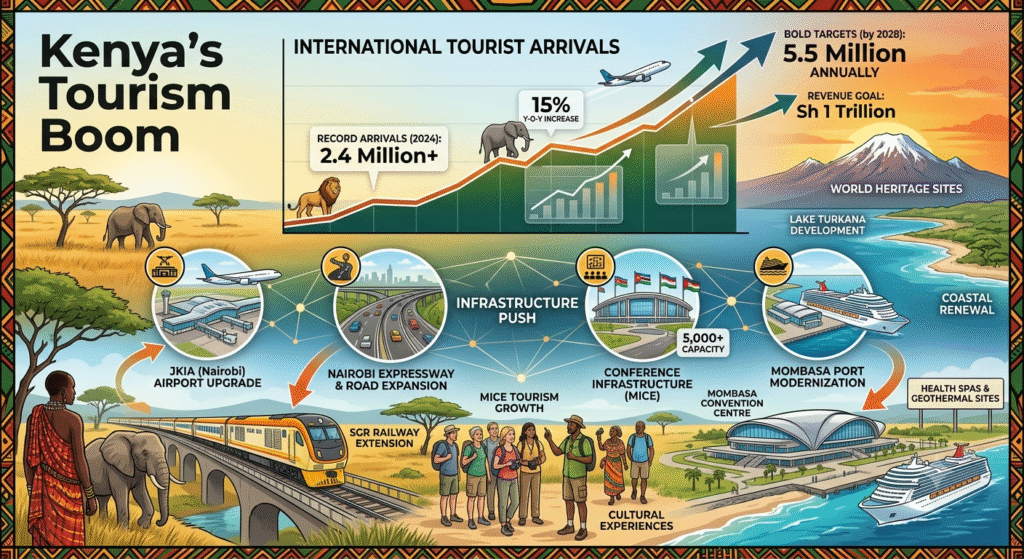
Kenya’s tourism sector is celebrating a historic milestone in September 2026, with official figures confirming the industry’s strongest performance in recent memory. As international visitor arrivals hit a record 2.76 million, the government is setting its sights even higher—aiming for 10 million annual visitors—while tackling infrastructure challenges and airport disruptions that threatened to derail the momentum .
📊 Record-Breaking Numbers
Kenya’s tourism revenue climbed to Sh564 billion in the 2025/26 financial year, more than doubling from Sh224 billion just four years earlier . Total tourism activity rose 51.8 percent over the same period, from 5.21 million in 2021/22 to 7.91 million in 2025/26 .
The growth in international arrivals has been consistent and impressive. Visitor numbers more than doubled from 1.21 million in 2021/22 to 2.76 million in 2025/26, a 9.8 percent increase from the previous year . This sustained upward trend, according to Tourism and Wildlife Cabinet Secretary Rebecca Miano, “demonstrates growing global confidence in Kenya as a preferred travel destination” .
The first quarter of 2026 saw arrivals rise 11 percent to 653,919, driven by increased connectivity from the Gulf region and new flight routes . Monthly data showed visitor arrivals remained elevated throughout early 2026, with 244,005 arrivals recorded in January alone .
🌍 Who Is Visiting Kenya?
The visitor profile is shifting, with regional African travel emerging as the fastest-growing source market.
Passengers arriving from East and Central Africa totaled 72,309 in January 2026, surpassing European arrivals in several months . Cities such as Addis Ababa, Kigali, Entebbe, Dar es Salaam, and Mogadishu generated substantial passenger volumes, reflecting expanding trade, investment links, and growing business travel across East Africa .
This regional shift is strategically important because African travellers often visit throughout the year, helping smooth the seasonal fluctuations associated with long-haul tourism .
Europe remains Kenya’s largest long-haul market, with London consistently generating more than 14,000 monthly arrivals. Paris, Amsterdam, Frankfurt, and Istanbul also contributed significant traffic . The Middle East played a major role too, with Dubai remaining the dominant route, while travel from the Far East continued its recovery .
🏗️ Infrastructure Push to Support Tourism
The government is investing heavily in infrastructure to sustain the tourism boom.
On September 3, President William Ruto commissioned the Sh15 billion Sultan Hamud-Loitoktok 132kV transmission line project, a 108-kilometre power line designed to improve electricity reliability for the tourism industry around Amboseli National Park . The project includes a new substation and expanded power transfer capacity, which is expected to benefit hotels, lodges, and other businesses serving tourists visiting Amboseli .
Principal Secretary for Energy Alex Wachira said the project would provide “stable and reliable electricity to the southern region of Kajiado County” through reinforcement of Kenya Power’s medium-voltage network, reducing outages that have affected residents and businesses .
✈️ Airport Disruption and Resolution
The sector faced a significant test in late August when aviation worker protests disrupted operations at Jomo Kenyatta International Airport (JKIA), Kenya’s main international gateway.
The disruption resulted in flight cancellations, with airlines including RwandAir cancelling services to and from Nairobi . Italian tourists were among those stranded, with reports describing nearly three days of total flight suspension .
An agreement was reached on September 1 following high-level talks chaired by Transport Cabinet Secretary Davis Chirchir and involving Labour CS Alfred Mutua, aviation officials, and union representatives . The deal addressed the Collective Bargaining Agreement between KCAA and the Kenya Aviation Workers Union, as well as the Recognition Agreement with Jambojet .
Prime Cabinet Secretary Musalia Mudavadi apologised for the disruption, acknowledging its significant impact on passengers, airlines, businesses, and Kenya’s international connectivity . Kenya Airways said its teams were “proactively working through the flight backlog to restore normal operations” .
🎯 Ambitious Targets and Strategic Reforms
Despite the record numbers, Tourism Principal Secretary Julius Bitok has acknowledged the sector’s slow growth over the past two decades and is pushing for ambitious expansion .
Bitok has set a target of 10 million annual international arrivals in the coming years, arguing that Kenya can achieve this by harnessing its local, regional, and global competitiveness . Key interventions include easing visa processes, with the government having already introduced the Electronic Travel Authorisation (ETA) and abolished visa requirements for all African arrivals .
Parliament is also considering major tourism reforms through the Tourism (Amendment) Bill, 2026, which proposes merging state agencies with overlapping functions . The Bill would dissolve the Tourism Research Institute and Tourism Finance Corporation, transferring their functions, assets, and liabilities to the Kenya Tourism Board .
Kenya Tourism Board CEO Jude Kepkemoi said the ambitious target was achievable through attracting visitors from key source markets, including the United States, the United Kingdom, Uganda, Tanzania, and India .
🔮 Conclusion
Kenya’s tourism sector is experiencing an unprecedented boom, with record arrivals and revenues, strategic infrastructure investment, and ambitious expansion targets. The sector’s recovery is increasingly broad-based, supported by traditional European markets, growing regional travel, and expanding Middle Eastern connectivity . While challenges remain—including the need for product knowledge training among operators, with a recent survey indicating 85 percent require additional support—the momentum is unmistakable . As the government pushes forward with reforms and infrastructure development, Kenya is positioning itself to transform its tourism industry from record-breaker to market leader.
