

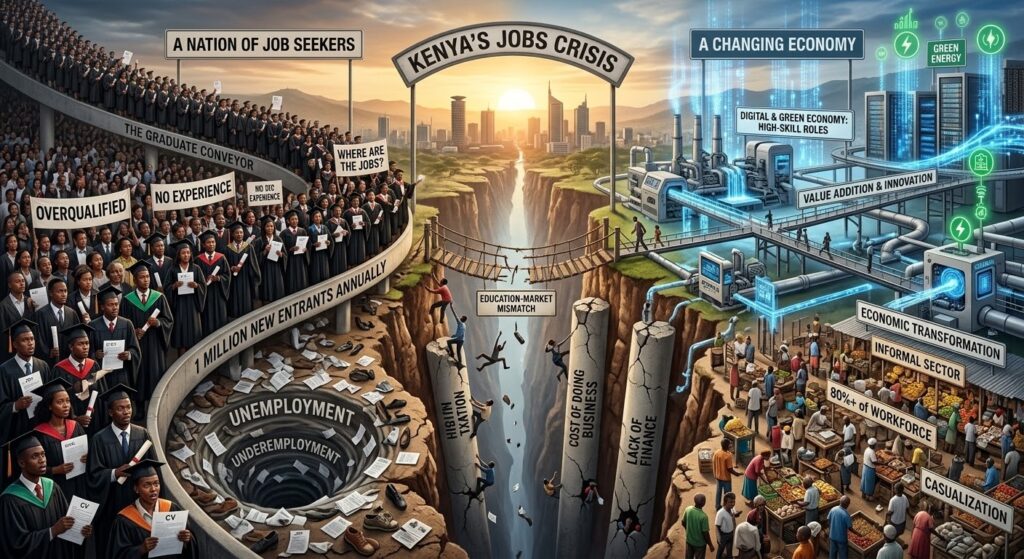
As Kenya marks the midpoint of 2026, the country’s employment landscape presents a stark paradox. While the economy continues to grow on paper, the quality of jobs being created and the ability of the labor market to absorb the country’s rapidly expanding workforce are at crisis levels. With nearly one million young people entering the job market annually and only a fraction securing formal employment, Kenya is facing what experts describe as a “deeper crisis of job quality and productivity”.
The Numbers: A Grim Reality
The scale of Kenya’s unemployment challenge is staggering. According to data from the Federation of Kenya Employers, a staggering 67 percent of individuals aged 15 to 34 are unemployed, while more than one million young people enter the job market each year. Of those who do find work, only 8.6 percent of employed Kenyan youth hold formal jobs.
The 2026 Economic Survey reveals a persistent structural reality: while overall employment continues to grow, the bulk of new jobs are being generated in the informal economy rather than in formal employment. The informal sector now employs approximately 18.1 million people, while the formal sector accounts for roughly 3.3 million people. This means informal employment accounts for approximately 84 percent of total employment, with nearly 60 percent concentrated in wholesale and retail trade, hotels, and restaurants.
This imbalance, while acting as a short-term social buffer by offering youth and low-skilled workers opportunities to earn wages, has profound long-term consequences. Informal activities are often underreported in GDP statistics, contribute minimally to the tax base, and are characterized by low and volatile earnings. This limits fiscal space, undermines social protection coverage, and constrains long-term productivity growth.
The Skills Mismatch: Educated but Unemployable
A critical dimension of the crisis is the growing disconnect between what graduates are taught and what employers need. A study released by Swisscontact on July 21, 2026, found that companies are struggling to recruit industry-ready workers because many young people lack the hands-on experience required in today’s workplaces. The problem is not simply unemployment but stems from “a growing disconnect between training institutions, industry needs and the skills employers expect from job seekers”.
This disconnect is visible in the struggles of graduates. During the Kiambu Employability Summit 2026, a student from Jomo Kenyatta University of Agriculture and Technology articulated the frustration of many: “We have gone through school and acquired certificates and diplomas but there are no jobs. When you look for jobs, they require two to five years of experience and as someone who has just completed school, where do you get that experience?”
The government has acknowledged this imbalance, with Permanent Secretary for Youth Affairs Fikirini Jacobs noting that “for far too long, we have had about one million university students and only about 20,000 students in our technical institutions. That imbalance has contributed to the unemployment crisis because the economy needs more technical skills”. Enrolment in Technical and Vocational Education and Training institutions has now risen to about 900,000 students, but challenges remain in ensuring these graduates are equipped with market-driven skills.
Nearly 722,511 candidates from the 2025 KCSE class did not qualify for university, making TVET not a fallback option but the primary bridge to a professional future for nearly three-quarters of a million young Kenyans. However, simply expanding TVET capacity without linking it to industry demand risks graduating students “into a vacuum that is disconnected from the pulse of industry”.
Good News: Apprenticeships Show Promise
Amid the gloom, there are examples of what works. The PropelA Dual Apprenticeship Programme, an industry-led initiative combining 75 percent workplace learning with 25 percent classroom instruction, has demonstrated measurable success. Since its launch, PropelA has partnered with more than 70 companies, trained over 400 young people, and achieved an employment rate of more than 80 percent.
Businesses participating in the programme recorded an average 30 percent Return on Training Investment, generated approximately Sh2 million in net value per company, and recovered their investment within three years. Nearly 87 percent of the value created came directly from productivity gains made by apprentices while working within participating companies.
Swisscontact Kenya Country Director Sharon Mosin captured the significance: “The findings challenge us to rethink how we view skills development. Skills are not simply a social investment. They are economic infrastructure. Just as roads connect markets and energy powers industry, skilled people drive productivity, competitiveness and growth”.
The Economic Squeeze: Debt, Casualization, and Eroding Wages
The employment crisis is compounded by broader economic pressures. The World Bank has downgraded Kenya’s growth forecast to 4.3 percent for 2026 from 4.6 percent in 2025, partly due to the Middle East conflict intensifying inflationary and external pressures. The Bank projects that between one million and 2.4 million Kenyans could fall below the poverty line in 2026.
The structure of formal employment is also changing. Official statistics from the Kenya National Bureau of Statistics show that individuals engaged in casual employment grew from 416,900 in 2020 to 582,900 in 2025, accounting for 17.6 percent of formal sector workers. Firms are increasingly turning to contract staff and short-term hires to control costs, particularly in response to new obligations like the Affordable Housing Levy and increased NSSF contributions.
Workers’ purchasing power has been severely eroded. While inflation-adjusted earnings grew marginally to Sh56,566 last year, they remain lower than in 2020, when they stood at Sh62,256, meaning workers’ earnings have suffered an erosion of Sh5,690 compared with six years ago. Public employees have fared even worse, with their real wages falling further to Sh50,041.
The Structural Challenge: Debt and Private Investment
The World Bank has identified Kenya’s debt-driven economic growth model as a fundamental obstacle to job creation. Years of heavy public borrowing have crowded out private investment, leaving the economy struggling to absorb hundreds of thousands of young people entering the job market each year.
While Kenya recorded solid economic growth averaging 4.5 percent annually between 2001 and 2025, that growth has been driven largely by government spending, construction, and services rather than labour-intensive sectors such as manufacturing and agribusiness that typically create large numbers of formal jobs. The government’s ambitious infrastructure program was financed through sustained borrowing, pushing public debt to 71.3 percent of GDP by the end of 2025 while reducing fiscal space for productive investment.
The result is that highly skilled workers continue to find opportunities in public administration and specialized service industries, but those sectors have limited capacity to absorb the growing workforce. Meanwhile, labour-intensive industries capable of employing large numbers of low- and middle-skilled workers have lagged behind because of weak productivity, declining competitiveness, and subdued private investment.
Conclusion
Kenya’s jobs crisis is not simply about unemployment numbers—it is about the quality, dignity, and sustainability of the work available to millions of citizens. With 800,000 to one million young people entering the labor market each year and the economy creating fewer than 100,000 formal jobs, the structural gap is vast. No amount of training alone can close a gap of that size.
As experts have argued, “skills alone cannot deliver prosperity”. Real progress will come when investment in skills is matched by investment in job creation, stronger institutions, and policies genuinely designed to help young people find dignified, secure, and productive work. The question is whether Kenya’s policies, institutions, and economy are designed and resourced to meet the challenge. For a nation where a majority of the population is under 35, the answer will determine not just economic prosperity but social stability for generations to come.