

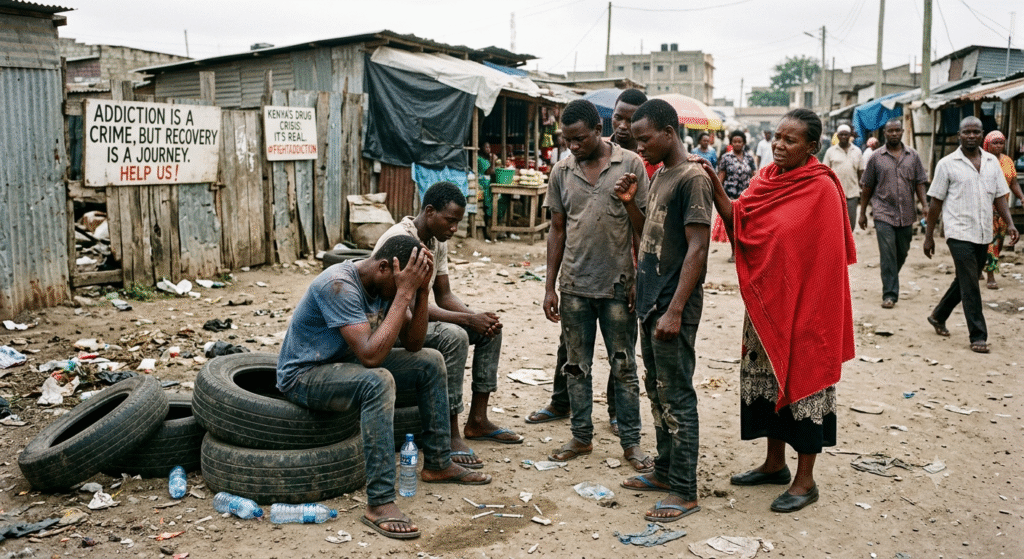
As of July 2026, Kenya finds itself in the grip of a deepening drug crisis that has escalated from a public health concern to a national security emergency. With nearly one in every six Kenyans using drugs and alarming trends showing children as young as six beginning substance use, the East African nation is scrambling to respond through enhanced law enforcement, international cooperation, and rehabilitation efforts . The latest data paints a sobering picture of a country that has become not just a transit route for international narcotics but a growing consumer market for dangerous substances.
The Scale of the Crisis: 4.7 Million Kenyans Affected
The most comprehensive picture of Kenya’s drug problem comes from the National Authority for the Campaign Against Alcohol and Drug Abuse (NACADA), which released its latest survey in June 2026. The findings reveal that an estimated 4.7 million Kenyans aged between 15 and 65 years are currently using at least one drug or substance of abuse, representing approximately one in every six people in that age bracket .
The Coast region has emerged as the epicenter of the crisis, with a staggering 29.3% prevalence rate. Mombasa County carries the heaviest burden at 34.4%—meaning more than one in every three residents uses drugs or other substances . This concentration in coastal areas reflects Kenya’s position as a regional transport and commercial hub, making it vulnerable to international trafficking networks operating along the East African coast .
The United Nations Office on Drugs and Crime (UNODC) has reinforced these findings, reporting that one in every five Kenyan young adults uses khat (miraa), while heroin, cocaine, ecstasy, and other hard drugs have established a measurable presence among the youth . With Kenya’s youth population standing at 13.7 million, this translates to nearly 2.7 million young people hooked on miraa, with measurable numbers also consuming heroin and cocaine .
Emerging Threats and Changing Trends
The drug landscape in Kenya is becoming increasingly complex and dangerous. The UNODC’s 2026 World Drug Report reveals that among Kenyans aged 17 to 23 years, 3.0% reported non-medical use of tranquillisers or sedatives, 1.8% used heroin, 1.6% used cocaine, and 1.5% used ecstasy . The presence of synthetic drugs such as ecstasy and ketamine signals a shift from traditional substances to more potent and dangerous narcotics.
Perhaps most alarming is the declining age of initiation. The 2025 NACADA report shows that children as young as six years old are beginning to use tobacco, followed by alcohol at age seven. By age eight, some have experimented with cannabis or prescription drugs, with khat use starting around age nine . Polydrug use is particularly concerning, with roughly 267,000 young people aged 15–24 using multiple substances simultaneously .
An emerging threat is the circulation of cannabis-infused edible products, which authorities describe as “an emerging concern due to their appeal to young people and the difficulty in distinguishing them from ordinary food products” . In July 2026, NACADA conducted a raid in Ruiru that seized 34 cookies and six cakes suspected to have been laced with narcotics, highlighting the evolving tactics of traffickers .
Law Enforcement and Government Response
President William Ruto has taken a hardline stance on drug trafficking, calling for the introduction of the death penalty for drug traffickers. Describing the trade as a national threat that “cannot be ignored,” Ruto argued that existing fines and penalties have failed to deter dealers, stating: “People who are selling heroin and cocaine are destroying our children” . The President has also announced plans to establish a strengthened Anti-Narcotics Unit within the DCI, with operational capacity comparable to the elite Anti-Terrorism Police Unit .
The government’s enforcement efforts have yielded significant results. Coast Regional Police Commander Ali Nuno reported that between April and June 2026, police arrested 27 suspects and seized narcotics worth an estimated Sh51.5 million. The haul included 10,700 kilograms of cannabis sativa, 7,000 grams of heroin, 1,330 grams of cocaine, and 205 grams of methamphetamine . In one notable bust, a 67-year-old man was arrested at Moi International Airport in Mombasa attempting to board a flight to Dubai with 60 pellets of cocaine swallowed and concealed in his stomach .
In a major breakthrough, authorities recently seized 1,024 kilograms of 98% pure crystal methamphetamine, valued at approximately Sh8.2 billion, in the Indian Ocean—one of the country’s largest narcotics interceptions . Police have identified Ethiopia, through the Moyale border point, as a key entry route for narcotics trafficked into Kenya, alongside supply lines from the western region .
International Cooperation and Modernization
Kenya’s fight against drugs has received significant international support. In July 2026, the United States Drug Enforcement Administration (DEA) donated specialized operational vehicles to Kenya’s Directorate of Criminal Investigations through the US Embassy in Nairobi. DCI Director Mohamed Amin described the donation as a “significant boost” to the Anti-Narcotics Unit, enhancing surveillance, intelligence-led operations, and rapid response capabilities across the country .
Kenya is also modernizing its approach through technology. NACADA has introduced wastewater analysis technology to monitor drug consumption trends in near real-time, enabling faster, evidence-based interventions. NACADA Board Chairman Bishop Dr Stephen Mairori emphasized: “If the drug problem is changing, our responses must change with it” .
Health and Rehabilitation Efforts
Recognizing that enforcement alone cannot solve the crisis, the government is expanding prevention, treatment, rehabilitation, and reintegration programs. Principal Secretary for Internal Security Dr Raymond Omollo stressed the need for a comprehensive strategy: “While enforcement remains critical, it is only one part of the solution. Sustainable success can only be achieved through a balanced and comprehensive approach that prioritises prevention, early intervention, treatment, rehabilitation, and social reintegration” .
The International Day Against Drug Abuse and Illicit Trafficking commemorations in June 2026 at the Miritini Treatment and Rehabilitation Centre in Mombasa underscored the government’s commitment to this balanced approach. Leaders called for stronger collaboration among regulators, law enforcement agencies, county governments, healthcare professionals, and the public .
Challenges Ahead
Despite intensified efforts, significant challenges remain. The UNODC assessment exposes a major weakness in Kenya’s drug surveillance system: while recent youth prevalence estimates are available, national data covering the general adult population remains fragmented, with many estimates dating back more than a decade. This makes it difficult to establish whether drug use is rising or falling across the wider population .
The government also faces the challenge of dismantling organized supply chains rather than simply targeting street-level peddlers. As NACADA stated in announcing its renewed strategy: “We are not just chasing peddlers—we are systematically crushing supply and distribution networks that poison our communities” .
As Kenya continues its war on drugs, the nation stands at a critical juncture. With 4.7 million people affected, children starting substances at shockingly young ages, and traffickers becoming increasingly sophisticated, the crisis demands sustained commitment from government, communities, and international partners. The lives of future generations hang in the balance.
