

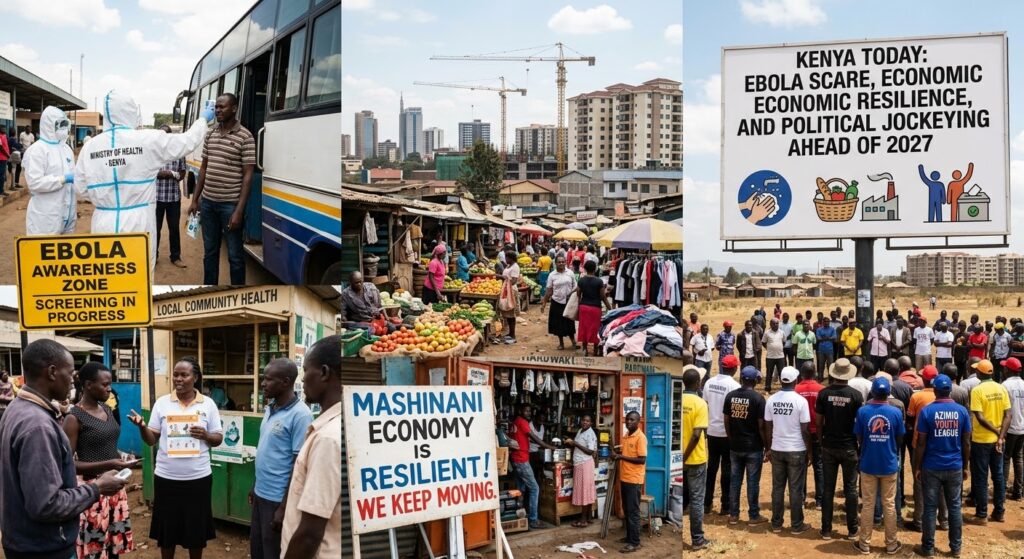
NAIROBI — Kenya enters mid-October 2026 navigating a complex landscape of public health emergency, economic optimism, and intensifying political maneuvering. The confirmation of the country’s first imported Ebola case has triggered a nationwide health mobilization, even as the Central Bank raises growth forecasts and President William Ruto embarks on a major development tour of the North Rift. Meanwhile, the political temperature is rising, with defections from the ruling party and fresh attacks on former President Uhuru Kenyatta signalling that the 2027 election campaign is already underway.
Ebola Confirmation Triggers National Response
Kenya’s health authorities are in emergency mode following the confirmation of the country’s first imported case of Bundibugyo Ebola virus disease. A Kenyan man who had been living in the Democratic Republic of Congo for seven years tested positive for the virus after traveling through Uganda and arriving in Nairobi on October 3. He died on Monday night at Nairobi Hospital and was buried Tuesday in accordance with safe and dignified burial protocols .
President William Ruto has directed the National Security Council Committee to assess the situation and recommend additional measures. Eight family members of the deceased have been placed under quarantine and are undergoing daily symptom monitoring. Twenty-one healthcare workers who attended to the patient have also been quarantined. Authorities have extended contact tracing to passengers who traveled on the same flight, with 27 passengers identified and contacted so far .
As of October 6, Kenya had screened 652,584 travelers and tested 267 samples across five laboratories, including the National Virology Reference Laboratory, KEMRI Nairobi, KEMRI Kisumu, and two mobile laboratories deployed at the Busia and Lwakhakha border points. Of the samples tested, only the deceased patient returned a positive result, with no additional positive cases detected .
Health Cabinet Secretary Aden Duale sought to reassure the public, stating that Kenya is not experiencing an Ebola outbreak despite the confirmed imported case. The Ministry of Health has intensified screening at points of entry, particularly at Jomo Kenyatta International Airport and the Malaba border crossing. Temporary isolation centers have been identified at Malaba and Kocholia, while Alupe is undergoing renovation .
National Assembly Speaker Moses Wetang’ula urged residents along the Kenya-Uganda border to remain vigilant, calling for truck drivers to be prioritized in screening due to their frequent cross-border movements. “There is no cause for worry over the spread of Ebola in Kenya but strict adherence to precautionary measures will help the country avoid devastating situations,” he said .
The Africa CDC has deployed a high-level multidisciplinary team to Kenya to provide support, with Director-General Jean Kaseya pledging to personally travel to the country to assess response needs. China has also provided a $1 million grant specifically for Ebola preparedness infrastructure in high-risk counties .
Economic Outlook Brightens Despite Inflation Pressure
The Central Bank of Kenya has revised upward its economic growth projection for 2026 to 5 percent from an earlier forecast of 4.9 percent, citing stronger industry and services sector performance. This follows growth of 4.6 percent in 2025, with the bank projecting 5.3 percent growth in 2027 .
CBK Governor Kamau Thugge said the agriculture sector is expected to expand by 3 percent this year, industry by 5.2 percent, and services by 5.6 percent. The bank maintained its benchmark interest rate at 8.75 percent for a fourth consecutive meeting, balancing rising domestic inflation against a stable exchange rate and stronger economic growth .
Inflation rose to 6.8 percent in September from 6.6 percent in August, remaining within the government’s target range of 2.5 to 7.5 percent. Core inflation accelerated to 4 percent from 3.4 percent, driven mainly by higher prices of processed foods including milk, wheat products, and edible oils. Thugge noted that milk inflation alone contributed significantly to the overall increase .
Kenya’s foreign exchange reserves have surged to $14.7 billion, equivalent to approximately 5.9 months of import cover. Thugge stated that the country is in a strong position to manage its balance of payments without immediate IMF assistance, with reserves projected to reach $15 billion by year’s end. The current account deficit stood at 3.1 percent of GDP in the 12 months to August .
Security Challenges Persist
Kenya continues to face security threats on multiple fronts. In Garissa County, two police officers were killed on October 9 when their vehicle struck an improvised explosive device along the Saretho-Dadaab Main Supply Route. The victims were the Officer Commanding Police Division in Hagadera and his driver. The attack is suspected to have been carried out by al-Shabaab militants .
Interior Cabinet Secretary Kipchumba Murkomen told Parliament that security operations have been intensified in Samburu, Meru, and Isiolo counties to curb banditry and cattle rustling. Between June and September 2026, security agencies recovered 3,221 livestock out of 4,306 reported stolen, and recovered 2,395 illegal firearms between September 2025 and September 2026. However, 14 fatalities and 17 injuries were reported across the affected region during the same period .
Murkomen acknowledged that difficult terrain, inadequate roads, poor communication networks, and limited resources continue to hamper security operations. He emphasized that “security operations alone cannot provide a permanent solution to inter-community conflict,” stressing the importance of dialogue and peacebuilding initiatives .
Political Realignments Intensify
The political landscape is heating up ahead of the 2027 General Election. President Ruto launched a fresh attack on retired President Uhuru Kenyatta, accusing his predecessor of sponsoring opposition figures to undermine his administration. Speaking in Likuyani, Ruto claimed Uhuru was uncomfortable with his development record and warned that he would “deal with” those seeking to derail his government .
In a significant political defection, Nakuru Senator Tabitha Karanja announced she was leaving the ruling United Democratic Alliance for the Democracy for the Citizens Party (DCP), associated with former Deputy President Rigathi Gachagua. Karanja will seek the Nakuru governorship on the DCP ticket, setting up a contest with incumbent Governor Susan Kihika .
The DCP has been attracting defectors from UDA, including Murang’a Governor Irungu Kang’ata. Gachagua has set an ambitious target for his party: at least 130 MPs, 20 senators, 20 governors, and 720 MCAs in 2027 .
Meanwhile, Nandi Senator Samson Cherargei revived his controversial proposal to extend presidential term limits, suggesting he could return with a plan to keep Ruto in power beyond 2032 if the opposition fails to organize. The proposal, which previously sought to extend terms from five to seven years, faced overwhelming public opposition in 2024 .
Development Drive in North Rift
President Ruto has begun a 10-day development tour of the North Rift region, covering Nandi, Uasin Gishu, Baringo, Elgeyo-Marakwet, Trans Nzoia, and West Pokot counties. The tour includes inspections of road projects, commissioning of modern markets, flagging off of last-mile electricity connectivity projects, and inspections of hospitals and affordable housing projects .
The tour comes ahead of Mashujaa Day celebrations on October 20, which will be co-hosted by Uasin Gishu, Nandi, and Elgeyo-Marakwet counties .
A Nation Managing Multiple Fronts
Kenya today is a country managing multiple simultaneous challenges with varying degrees of success. The Ebola response has been swift and comprehensive, drawing on systems built during previous outbreak scares. The economy is showing resilience, with growth revised upward and reserves at comfortable levels. But security threats persist in the border regions, and the political temperature is rising as the 2027 election approaches.
For ordinary Kenyans, the immediate concern is the Ebola scare and whether the government’s containment measures will hold. For the political class, the focus is already on 2027. And for the country as a whole, the coming months will test whether Kenya can maintain its economic momentum while managing the health and security risks that lurk at its borders.