

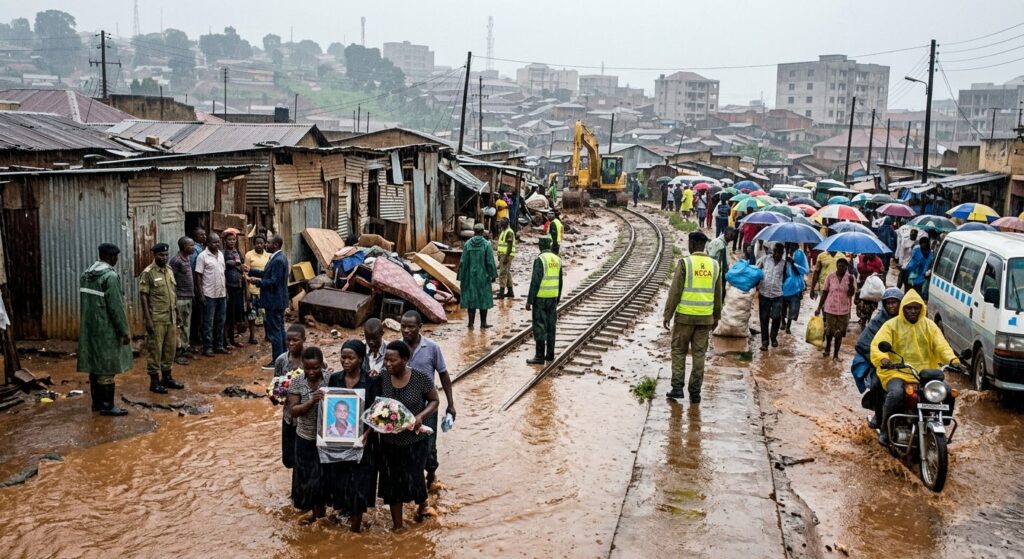
KAMPALA — Uganda’s capital entered mid-October 2026 grappling with the familiar but no less painful rhythms of urban life in East Africa: deadly rains that expose the fragility of informal settlements, a government eviction drive that pits railway rehabilitation against the livelihoods of thousands, and the steady accumulation of smaller controversies—a barracks fire, a disputed village election, a court case that turns on a torn uniform—that together paint a portrait of a city managing pressure on multiple fronts.
Two Deaths as Rains Pound the Capital
The rains came overnight on October 11, and by morning, Kampala’s police were confirming two deaths and widespread property damage across the metropolitan area . In Bulabira Zone, officers recovered the body of an unidentified man, estimated to be between 22 and 28 years old, from a drainage trench. He is believed to have been swept there by floodwater. In Ttuba Zone, Kyanja Parish, 25-year-old Jalia Nameere died when a perimeter wall collapsed onto her rented room as she slept .
Police also recovered a motorcycle from floodwater in Kireka and documented a destroyed wall and damaged vehicle in Mbalwa. The force issued a public advisory urging residents to avoid flooded roads and drainage channels, to stay away from unstable walls, and for property owners to inspect their structures for weakness . The deaths are a grim reminder that for many Kampala residents, the rainy season is not an inconvenience but a mortal threat—one that repeated warnings and infrastructure improvements have yet to eliminate.
The Railway Eviction Standoff
On September 29, Works and Transport Minister Fred Byamukama directed the Uganda Railways Corporation to evict all encroachers and demolish illegal structures within the railway reserve. By October 14, the matter had reached Parliament, where MPs pressed the minister on the scale of the operation and the fairness of its terms .
Byamukama told the House that of the 20,807 acres within the URC network, 9,823 acres comprise reserve land. Approximately 28,486 encroachment cases have been identified along railway corridors, station land, and isolated properties. The rehabilitation of the meter-gauge railway, he said, has been compromised by the encroachments .
The controversy hinges on the width of the reserve. The minister cited the National Physical Planning Act, which requires a 60-metre reserve corridor—30 metres on either side of the centre line. But Hon. Hussein Muyonjo (NUP, Jinja North Division) challenged the figure, saying a previous minister had stated it was 15 metres on either side, for a 30-metre corridor. “When was the new survey of 60 metres taken? Did they engage the community?” he asked .
Speaker Jacob Marksons Oboth referred the matters to the Committee on Physical Infrastructure, directing it to investigate the contradiction and visit the Busoga loop railway line to interact with locals, with a 30-day deadline . For the thousands of households and businesses that have grown up along the railway over decades, the question of whether their land is legally theirs—and whether they will be compensated or simply removed—remains unresolved.
A Barracks Burns, and Officers Count Their Losses
On the evening of October 15, fire gutted Wandegeya Police Barracks, destroying more than 10 makeshift housing units and spreading across a fence to damage part of the offices of the Food and Agriculture Organization . Police Constable Didan Nuwaleba managed to rescue his two-year-old child, but told reporters all his household property was reduced to ashes. “I was lucky to rescue my baby whose mother had left with me,” he said .
Assistant Superintendent of Police Myers Byonanebye, who commanded the fire rescue operation, said the cause was not yet confirmed but did not rule out an electrical fault. “There was no life lost,” he said. “We have been able to put it out, but it was too much” . The fire is not the first in a Kampala police barracks; similar outbreaks have occurred at Nsambya and Ntinda, raising questions about the state of accommodation for officers tasked with keeping the city safe .
Small Disputes, Larger Questions
Beyond the headline events, Kampala’s courts and council offices were busy with the granular disputes that define civic life. In Katabi Town Council, Wakiso district, a repeat election for the Abayita Ababiri village chairperson was suspended on October 15 after fresh allegations of voter irregularities—people queuing who were not on the register, and others holding old voter slips. The poll had already been ordered by the Electoral Commission following complaints about the July 28 election, and its postponement prolongs a leadership vacuum in a busy trading centre along the Kampala-Entebbe highway .
At Buganda Road Chief Magistrate’s Court, a 26-year-old businessman named Ssenyange Mugaga, alias Reference, was charged with assaulting a police officer at Kajja Market. According to the charge sheet, PC Gerald Isabirye approached Mugaga while he was allegedly pulling women and trying to persuade them to support him as a street vendor. When the officer asked for identification, Mugaga allegedly replied that he was “new at Mini Price Police” and that Isabirye had no right to question him. A scuffle ensued; the officer’s pants were torn. Mugaga remains in custody until October 20 .
And in a case that drew wider attention, two men charged with rape and cyber harassment—initially described in some reports as KCCA enforcement officers—were remanded to Luzira. The KCCA later distanced itself from the accused, stating they were not on its staff list . The case, involving a first-year university student who was allegedly lured from a green belt, assaulted, and then blackmailed with nude images, has highlighted the vulnerabilities of young women navigating the city’s public spaces .
A City Holding Together
Kampala’s challenges are not unique among East African capitals, but they are acute. The city’s drainage systems cannot absorb the rains that climate change is intensifying. Its railway reserves have been encroached upon for decades, and the government’s determination to reclaim them collides with the reality of people who have nowhere else to go. Its police officers live in barracks that catch fire. Its village elections are disputed, its markets are policed unevenly, and its courts are clogged with cases that take months to resolve.
Yet the city continues to function. The markets open, the boda bodas weave through traffic, the ministries issue statements and the committees investigate. On October 18, the forecast called for light rain and a high of 25 degrees Celsius—typical for Kampala in October, when the second rainy season settles over the city . The rains will continue. The eviction schedules will proceed. The courts will hear their cases. And Kampala will hold together, as it always has, through the accumulated patience of its people and the stubborn persistence of ordinary life.