

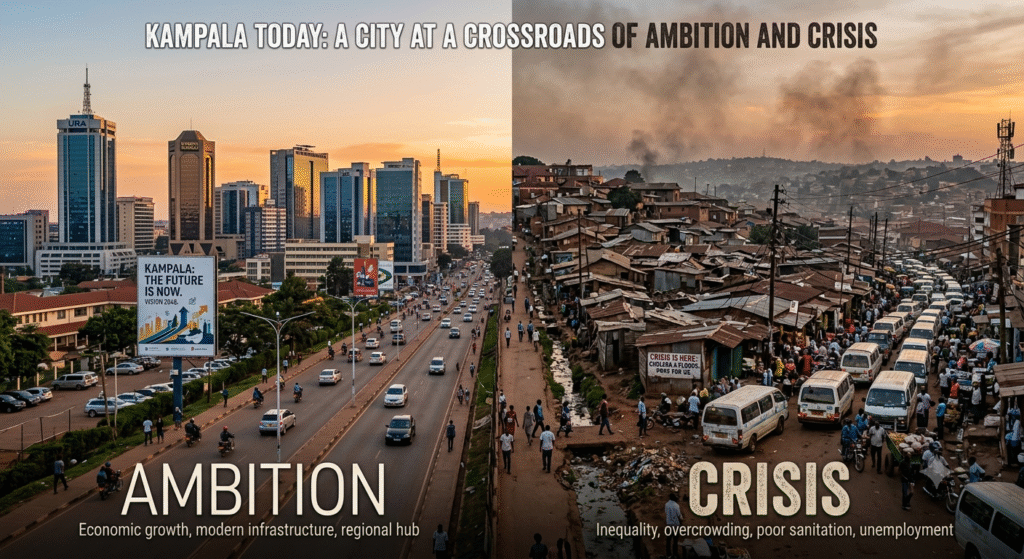
As of late July 2026, Kampala, the bustling capital of Uganda, finds itself at a critical juncture. The city is undergoing what its leaders describe as a “deliberate transformation” into a modern, clean, and orderly metropolis, yet this ambition is being severely tested by entrenched governance challenges, environmental crises, and a growing accountability crisis within the city authority . From the halls of Parliament to the flooded markets and contested construction sites, the narrative of Kampala today is one of high-stakes action, intense scrutiny, and a complex balancing act between development and regulation.
The Flood Crisis and Governance Scrutiny
The most pressing issue dominating Kampala’s current affairs is the persistent and devastating flooding that has become a recurring nightmare for its residents and businesses. The Kampala Capital City Authority (KCCA) attributes this crisis to large-scale encroachment on drainage channels, unauthorized construction, and blocked drainage systems, with a staggering more than 90 per cent of the 295-metre Nakivubo drainage channel having been encroached upon .
This issue came to a head in a dramatic confrontation before Parliament’s Committee on Physical Infrastructure in July. At the center of the storm is the Ham Shopping Centre, owned by prominent businessman Hamis Kiggundu, which was constructed over the crucial Nakivubo Channel . KCCA officials admitted to the committee that while the structure now has an approved plan, the approval was granted after construction through what is termed an “as-built” process . KCCA Deputy Executive Director Benon Kigenyi described it as an “immature development” where the authority had to regulate after the fact, a practice that ignited sharp criticism from lawmakers .
The controversy highlights a troubling pattern where “presidential letters” appear to carry more weight than established laws and technical advice . Committee Chairperson Hon. Mwine Mpaka issued a stark warning: “A presidential letter is not law. It is an instruction that must be implemented within the confines of the law” . Parliament, having inspected flood hotspots, has now issued a seven-day ultimatum for KCCA to submit a detailed report explaining its management of the city’s drainage infrastructure . With the human and economic cost of flooding estimated at US$50 million annually by the UNDP, the pressure on KCCA to act and be held accountable is immense .
A Two-Pronged Strategy: Enforcement, Innovation, and Public-Private Action
In response to the multi-faceted urban crisis, KCCA is aggressively pursuing a two-pronged strategy: strict enforcement and innovative public-private partnerships. On the enforcement front, the authority is intensifying efforts to restore order and compliance with planning regulations. This includes the demolition of illegal structures, such as a restaurant in Naguru and structures in Centenary Park, to enforce the rule of law and prevent further encroachment on public spaces . Furthermore, a radical new regulation is set to take effect: developers who fail to plant trees on their properties risk losing their occupancy permits under the Building Control Act 2026 . This measure is a key part of a strategy to curb the city’s environmental degradation.
In a significant action to professionalize urban spaces, MTN MoMo and KCCA launched a major transformation initiative in June to revitalize Busega Market and five major transport parks . The clean-up and rebranding exercise aims to create cleaner, safer, and more business-friendly environments while promoting financial inclusion and digital payments .
Smart City Vision and Environmental Leadership
Beyond crisis management, Kampala is also striving for recognition and sustainability on the international stage. The city is showcasing its progress in clean air action, a key pillar of its “Smart City” vision . KCCA Executive Director Sharifah Buzeki presented the city’s success story at the Africa Clean Air Forum in July, highlighting a massive expansion of air quality monitoring from one station in 2018 to 134 stations and a target of halving the city’s average air pollution by 2030 . The strategy focuses on green transport and community-led solutions. This ambition is also evident in the bold plan to transform the Buyala Waste Management Facility, which receives up to 2,000 tonnes of waste daily, into a digitally managed “smart hub” complete with waste-to-energy plants and material recovery centers .
Personnel Changes and the Political Dimension
The changing of the guard in key government positions has also been an important theme. Parliament approved Juma Witonze Kisekka as the new Minister of State for Internal Affairs, filling a vacancy in a crucial ministry that oversees the police, prisons, and immigration . His predecessor’s rejection over citizenship concerns underscores the stringent legal requirements for high office .
Conclusion
Kampala in July 2026 is a city in the grip of a profound transformation, but one fraught with contradictions. The KCCA’s ambitions for a clean, green, and orderly city clash with the harsh realities of uncontrolled development, political influence, and a failing infrastructure . While the city earns accolades for its environmental initiatives and engages in groundbreaking partnerships, the flooding crisis and parliamentary investigations reveal deep-seated governance failures . The coming weeks, as KCCA reports back to Parliament and enforcement drives continue, will be crucial in determining whether the city’s leaders can bridge the gap between their vision of a modern Kampala and the pressing needs of its citizens.
