

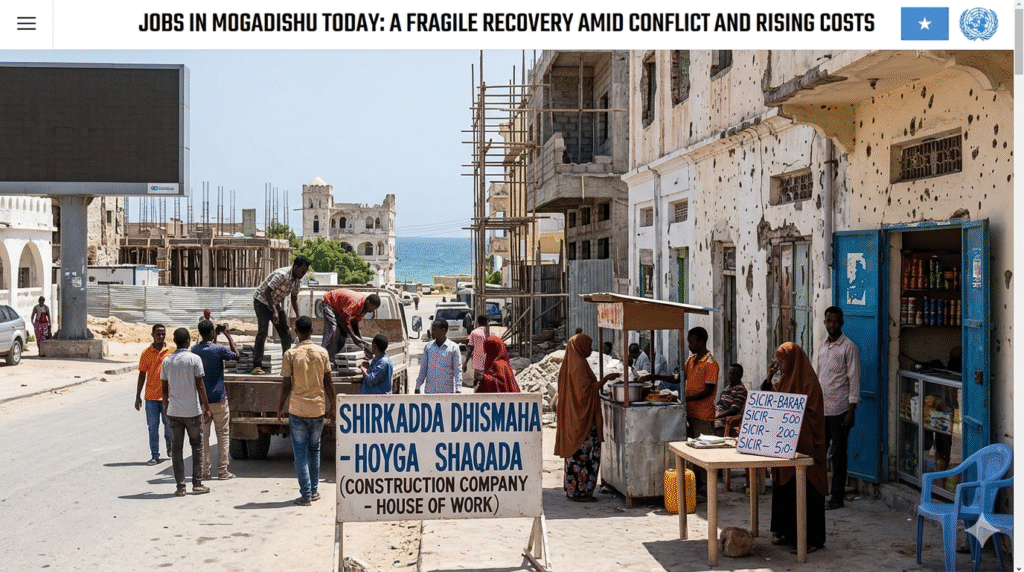
Mogadishu, Somalia’s coastal capital, is a city striving to rebuild after three decades of civil war. The job market reflects this painful transition: pockets of modernization and international investment exist alongside widespread informal labor and growing economic pressures. For the city’s young population—where nearly 70% of people are under 30—finding stable work remains a daily struggle shaped by clan networks, government reforms, and global crises .
This article examines the complex landscape of employment in Mogadishu across eight critical dimensions.
The Informal Economy: Tuk-Tuks and the Fuel Crisis
Perhaps the most visible employment sector in Mogadishu is the three-wheeled taxi, or “tuk-tuk.” With official youth unemployment hovering around 34 percent, these vehicles have become one of the few available sources of livelihood for young men in the capital .
The job is simple: rent a tuk-tuk, drive passengers, and pay the owner a daily fee, keeping whatever remains. For many, it means the difference between feeding a family and going hungry. “The tuk-tuk needs fuel, and I need to provide for my family from what it earns. We are in a very bad condition,” Jamal Omar, a 55-year-old driver, told Reuters .
Today, that fragile livelihood is collapsing. Since the US-Israeli airstrikes against Iran began on February 28, 2026, global oil prices have surged. In Mogadishu, fuel prices skyrocketed by 150 percent in March alone, rising from $0.60 to $1.50 per liter . For tuk-tuk drivers, the math no longer works. Higher fares have driven passengers away, and many drivers have simply parked their vehicles.
“I see two to three tuk-tuks every day that have run out of fuel and are parked along the roadside,” said Abdulkadir Sharif, a driver in Mogadishu. “There are no passengers. People stay home or walk on foot. We raised fares because fuel prices went up,” added Hasan Suleiman, a 21-year-old driver .
The crisis in the tuk-tuk sector is a microcosm of Mogadishu’s broader employment vulnerability: a city where global geopolitics directly determines whether a young man can work.
The Digital Shift: Somalia’s National Job Portal
Amid the informal chaos, a formal digital solution is emerging. On March 15, 2025, the Somali government launched the Somali National Job Portal for Employment Opportunities, a centralized platform designed to consolidate the country’s fractured recruitment culture .
For decades, applying for jobs in Mogadishu meant navigating silos. Ministries handled recruitment independently. Vacancies were posted on office gates, shared on Facebook and WhatsApp, or announced over the radio. Without connections—often clan-based—the system felt impenetrable.
The new portal, hosted by the National Data Agency under the Ministry of Posts and Telecommunications, aims to change this. It serves as a centralized database where employers post vacancies and applicants upload CVs. Employers must verify their licenses before posting, a safeguard intended to prevent fraud. The service is free for both job seekers and employers .
As of February 2026, 1,976 job seekers were registered, with 15 active employers listing vacancies . The numbers remain modest, but the direction is significant.
Abdirahim Ali Mohamud Shuriye, a 23-year-old SIMAD University graduate, represents the portal’s potential. After months of scrolling through LinkedIn, Telegram, and Facebook with no success, he found a business grant competition advertised on the portal. He applied, pitched his idea to a panel of private-sector judges, and won one of ten $2,500 grants.
“I was told that the money I received was not a loan but a grant,” he said. “I was happy that I found that opportunity through the Somali National Job Portal” .
The portal’s director, Zakariye Abdi Hashi of the Ministry of Labor and Social Affairs, describes it as a response to structural gaps. “It came from a need to connect talent with opportunity. With youth unemployment at a high percent, we needed a centralized employment service” .
Yet the homepage’s numbers tell a quieter story: nearly 2,000 registered job seekers and, on that day, just two vacancies. The portal exposes scarcity even as it attempts to manage it.
Public Sector Expansion: 12,000 Teachers by 2026
The most ambitious government-led job creation effort is in education. In February 2026, Prime Minister Hamza Abdi Barre announced plans to recruit 12,000 teachers by the end of 2026 as part of a sweeping education reform .
The scale of progress is striking. When the current administration took office, only about 900 teachers were on the federal payroll. In less than two years, the government has recruited and deployed 6,000 trained teachers—a sixfold increase .
“In just two years, we recruited and deployed 6,000 trained teachers on the path to reaching 10,000 across our nation, from bustling cities to the most remote communities,” Barre said. “We are pressing forward to reach 12,000 government-employed teachers by 2026” .
Crucially, Barre emphasized that teacher salaries are now fully financed through domestic revenue for the first time in Somalia’s history. “That is not just policy, it is pride. It is sovereignty in action,” he said. “Our teachers are no longer overlooked; they are honored as the heartbeat of our country” .
The results are visible beyond hiring statistics. National Grade 12 examination candidates have risen from 7,000 to 39,000. Students in Las’anood sat national exams for the first time in three decades. Nearly 250,000 graduates and 200,000 current students are now registered within Somalia’s higher education system .
Yet the need remains staggering. Barre acknowledged that Somalia will ultimately require an estimated 120,000 teachers to fully meet national demand—ten times the current target.
Industrialization: Adding Value to Local Resources
A longer-term strategy for job creation involves moving Somalia beyond raw commodity exports. The Minister of Commerce and Industry, H.E. Jamaal Mohamed Hassan, announced in March 2026 that the ministry is developing a comprehensive policy to boost domestic production .
“We can add value to our livestock exports—processing animals into meat, utilizing hides for leather products, and even making use of bones. This will generate jobs and stimulate economic growth,” Minister Jamaal said .
Somalia currently imports a wide range of goods that could be produced locally. By expanding industrial output, the government aims to reduce import dependency while creating significant employment opportunities. The country’s recent accession to the East African Community (EAC) provides access to broader regional markets .
For Mogadishu’s job seekers, this industrialization push could eventually mean factory work, logistics positions, and supply chain roles—a shift from the informal economy toward formal manufacturing employment.
International Organizations: High-Skill, High-Barrier Jobs
Mogadishu hosts a significant presence of United Nations agencies, international NGOs, and foreign embassies. These organizations offer some of the city’s most stable and well-compensated positions, though they require advanced qualifications.
Recent job postings illustrate the demand. The United Nations Population Fund (UNFPA) advertised a Programme Specialist position requiring an advanced university degree in population studies or related fields, plus five years of relevant experience . The British Embassy seeks a Health Adviser with over 12 years of professional experience and a master’s-level qualification .
UNICEF posted an Emergency Health Consultant role requiring a master’s degree in public health or epidemiology, with at least three years of relevant experience . World Vision seeks a Logistics Officer in Mogadishu offering an annual salary between $32,000 and $56,000, requiring a degree in supply chain, business administration, or health logistics .
These positions, while limited in number, are significant. They provide formal employment for educated Somalis, often with opportunities for career advancement and international networking. They also channel substantial salaries into the local economy.
Labour Migration: Protecting Workers Abroad
Not all job seekers find opportunities within Somalia. Labour migration remains a key part of the economy, with Somali workers traveling to Gulf states, Kenya, and beyond for employment. However, migrant workers face serious risks: contract substitution, unpaid wages, poor working conditions, and exploitation by informal labor intermediaries .
In response, the Somali government adopted a National Labour Migration Policy and a Private Employment Agencies Regulation in July and August 2025. These frameworks aim to protect workers and ensure fair recruitment practices .
In March 2026, the Federation of Somali Trade Unions (FESTU), with support from the International Labour Organization (ILO), convened trade union leaders in Mogadishu to strengthen implementation of these policies. The workshop resulted in a concrete action plan to enhance coordination and safeguards for migrant workers .
FESTU has organized approximately 30,000 workers in Somalia and abroad, providing a voice for those who might otherwise face exploitation alone. Migrant Resource Centres (MRCs) in Mogadishu and Puntland offer support services, including information on legal recruitment channels and assistance for workers in distress .
The Structural Constraints: Scarcity Despite Centralization
For all the innovation in digital platforms and policy frameworks, the fundamental constraint remains: Mogadishu does not have enough formal jobs.
The national job portal’s homepage displays a stark imbalance. On a typical day in February 2026, the site showed 1,976 registered job seekers and only two active vacancies . Centralization organizes access to jobs; it does not create them.
The Ministry of Labor has pledged to create opportunities for more than 40,000 youth in the coming months, and more than 1,000 youth have been empowered through business skills development programs . But these numbers, while positive, represent a fraction of the need.
Most economic activity in Mogadishu remains informal. The tuk-tuk driver, the market vendor, the construction laborer—these workers are not captured in official statistics, and they lack the protections of formal employment. They are also the most vulnerable to shocks like the fuel price crisis.
The Future: Between Reform and Reality
Mogadishu’s job market stands at a crossroads. On one hand, the government is building infrastructure that did not exist a decade ago: a national job portal, teacher recruitment at scale, labor migration policy, and industrialization strategy. These are genuine achievements.
On the other hand, the city’s workers are acutely exposed to global forces beyond their control. A war in the Middle East doubles fuel prices and strands tuk-tuk drivers. A drought in the hinterland sends displaced families to the capital, competing for scarce informal work. Donor funding cycles determine whether NGO positions are extended or eliminated.
For a 23-year-old graduate like Abdirahim Ali Mohamud Shuriye, the job portal offered a path forward—a grant, a business idea, a chance. For a 21-year-old tuk-tuk driver like Hasan Suleiman, the path has closed, at least for now .
The contrast captures Mogadishu today: a city where the future is being built, but the present remains a daily negotiation with scarcity.