

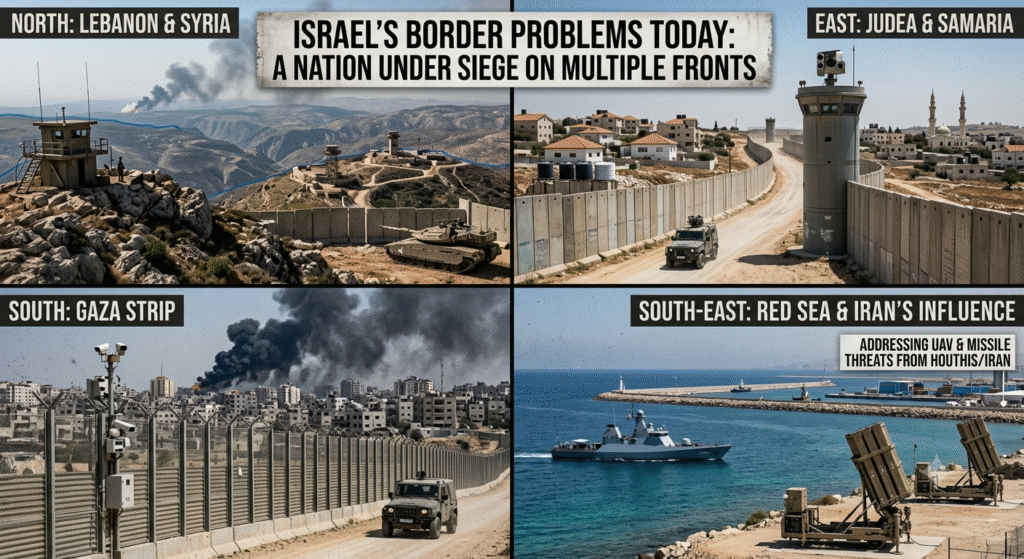
September 2026 has brought Israel’s border security challenges to a critical inflection point. From the volatile Lebanese frontier to the tense Syrian border and the entrenched confrontation in Gaza, Israel is simultaneously managing multiple conflicts that threaten to spiral into a broader regional war. Recent days have witnessed deadly airstrikes, controversial military deployments, and a dramatic public rift with the United States that has exposed deep strategic fissures.
🔴 The Lebanese Front: A Dangerous New Phase
The northern border with Lebanon remains the most active and deadly front. Despite a framework agreement signed by Lebanon and Israel in late June and several rounds of talks on security arrangements along the border, tensions have continued to escalate with devastating consequences .
On September 6-7, Israeli airstrikes in southern Lebanon killed at least 13 people, including two infants and two medics. A three-story residential building in Kfar Roummane was destroyed, while a separate strike on a vehicle killed medics from the Islamic Risala Scouts . The Israeli military said the strikes were in response to Hezbollah launching explosive drones toward soldiers operating in the Ali al-Taher Ridge area, with the military subsequently striking infrastructure sites and killing several Hezbollah members .
The previous day, Israeli airstrikes had already claimed at least five lives and wounded 23 across multiple towns . Lebanon’s health ministry reported that since March 2 alone, Israeli attacks on Lebanon have killed 4,358 people and wounded 12,359 .
Strategic Recalibration: From “Yellow Line” to “Grey Line”
In a significant tactical shift, Israeli media reported that the military is preparing to partially withdraw from southern Lebanon and establish a smaller “security zone” . The new deployment line, dubbed the “Grey Line,” would replace the current “Yellow Line” and reduce the Israeli-controlled area from approximately 10 kilometres in depth to just 3-4 kilometres .
This recalibration follows the completion of operations to destroy Hezbollah tunnels beneath the Ali al-Taher Heights in the Nabatieh region . The Heights, which overlook the strategically vital city of Nabatieh and key transportation routes, has become the focal point of recent fighting. While Israel claimed to have destroyed the tunnel network, Hezbollah has denied losing control of the area, stating its fighters remain deployed .
The plan, however, remains conditional on government approval and requires the construction of new military positions within the reduced zone to protect northern Israeli communities . Israeli intelligence also warns that Iran is attempting to coordinate a more synchronized multi-front attack involving Hezbollah, Hamas, and the Houthis .
🇸🇾 The Syrian and Turkish Flashpoint
A highly sensitive development has been the Israeli airstrike on the Abu al-Duhur military airbase in Syria’s Idlib province on August 18—a site approximately 80 kilometres from the Turkish border . The strike has triggered a diplomatic firestorm and exposed an unprecedented rift between Israel and the United States.
The American Intervention
U.S. Ambassador to Turkey and Syria Envoy Tom Barrack openly accused Israel of attempting to “lure” Turkey into a conflict, telling an interviewer that the strike appeared to be a “very aggressive but potentially effective pre-election strategy” designed to benefit Prime Minister Netanyahu’s electoral prospects . Barrack also claimed Israel did not inform Washington beforehand—a break from long-standing operational practice .
The Israeli response was immediate and fierce. Defence Minister Israel Katz and Foreign Minister Gideon Sa’ar both publicly rejected Barrack’s characterisation, insisting the strike was approved at the highest levels and communicated to both Damascus and Washington . Sa’ar, however, reiterated Israel’s red line: “We do not accept Turkey establishing a military base in Syria” .
Israeli officials argue that Iran’s penetration of Lebanon and Gaza sets a precedent that cannot be repeated with Turkey in Syria . With Israeli elections approaching and Netanyahu’s approval ratings under pressure, the confrontation has become entangled in domestic politics .
🇵🇸 Gaza and the West Bank: The Entrenched Front
Gaza remains the longest-running border confrontation, with Israel firmly controlling territory beyond the “Yellow Line” demarcated under ceasefire agreements . Prime Minister Netanyahu visited Gaza on September 2, declaring that Israeli forces would hold the line “until Hamas is disarmed” .
Currently, Israeli forces control over 60% of Gaza’s territory, having expanded beyond the original 53% set under the ceasefire . Israeli Defence Minister Israel Katz has also vowed that Israeli forces will maintain defensive positions even after Hamas’s military infrastructure is dismantled . In recent operations, Israeli forces detained a senior Hamas commander in Gaza City with air support from an allied Palestinian militia .
Nearly 70% of the Gaza Strip is now described as destroyed, with an estimated 1,326 Palestinians killed since the ceasefire was announced in October 2025 . Violence persists along the eastern edge of the Yellow Line, with Israeli forces striking northern Gaza in response to fire directed at soldiers .
🔮 Conclusion
Israel’s borders are under sustained pressure from multiple directions. In Lebanon, the military is seeking to consolidate gains while managing an increasingly deadly tit-for-tat with Hezbollah . In Syria, a confrontation with Turkey threatens to open a new front . In Gaza, Israel is determined to maintain permanent security control .
The situation is further complicated by the involvement of the United States, whose envoy has publicly criticized Israeli strategy, and Iran, which Israeli intelligence believes is working to coordinate its regional proxies . For Israel, managing these border problems requires balancing military pressure with diplomatic de-escalation—a precarious equation that will define the coming months.
