

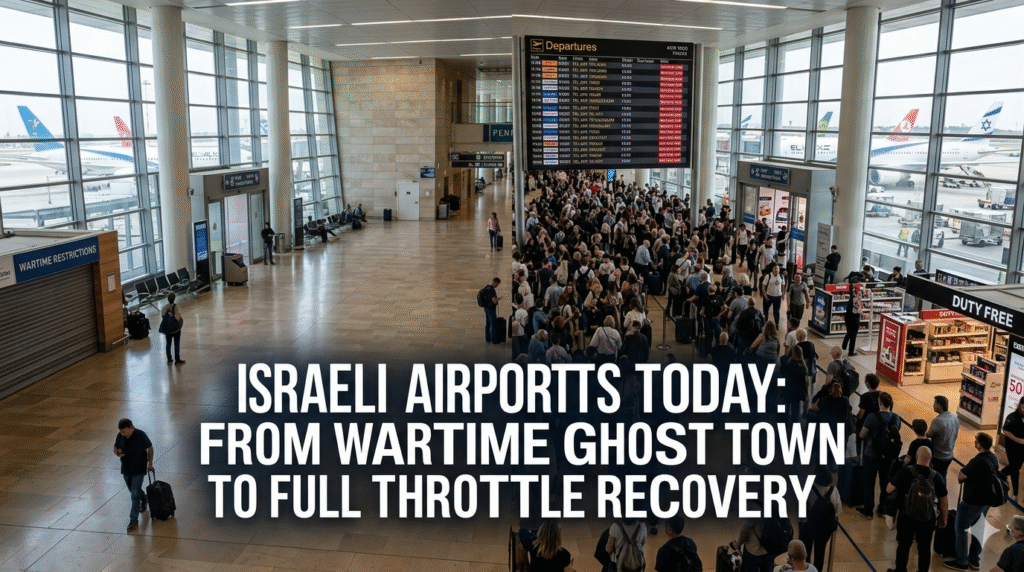
April 10, 2026 – Just three days ago, Ben Gurion Airport was a shell of its former self. The terminals echoed with emptiness. Departing flights carried no more than 100 passengers, and the hourly takeoff rate was capped at one. Today, after a ceasefire between Israel, the United States, and Iran took effect on April 8, the country’s main international gateway is roaring back to life. This article examines the current state of Israeli aviation across 12 critical dimensions.
Part 1: The Ceasefire That Changed Everything
The two-week ceasefire, announced late Tuesday, April 7, after 40 days of war, triggered an immediate shift in Israel’s aviation posture. The Transportation Ministry announced that Israel would fully reopen the country’s airspace and resume regular operations at Ben Gurion Airport starting at midnight Wednesday-Thursday .
The decision followed a formal reassessment by the Home Front Command. As one aviation official explained to The Times of Israel, the sequence is critical: first, the Home Front Command must ease civilian protection guidelines; only then can Ben Gurion Airport resume normal operations . That sequence was completed within hours of the truce.
For the first time since February 28, the skies over Tel Aviv are open for business.
Part 2: Ben Gurion’s Wartime Restrictions – What They Were
To understand the significance of the reopening, one must appreciate how severely Ben Gurion was restricted during the conflict. The war with Iran, which began on February 28, forced the government to implement unprecedented limitations :
- Passenger cap: Outbound flights were initially limited to just 50 passengers before being gradually raised to 100 near the war’s end .
- Hourly flight cap: Only one takeoff and one landing were permitted per hour .
- Foreign airline ban: All foreign carriers were barred from operating, leaving only Israeli airlines (El Al, Arkia, Israir, and Air Haifa) to manage limited repatriation flights .
For travelers, this meant weeks of uncertainty, canceled vacations, and desperate overland escapes through Jordan and Egypt.
Part 3: The Immediate Reopening – What’s Happening Now
As of April 10, Ben Gurion Airport is operating at full capacity. The passenger quota on outbound flights has been lifted entirely. The hourly flight quota has returned to normal levels. Duty-free shops and all terminal services have reopened .
The Transportation Ministry has issued formal announcements to foreign airlines and leading regulators regarding the return to normal flight operations . Herzliya Airport resumed operations on Thursday morning, and Eilat’s Ramon Airport is scheduled to reopen on Sunday . A decision on Haifa Airport in the north is expected later this week, pending security assessments—particularly given that Israel has stated the Iran ceasefire does not cover Lebanon .
Part 4: The Airlines – Who’s Flying and Where
Israeli airlines are leading the charge back to normalcy.
El Al, the flag carrier, is gearing up to return to a regular schedule by gradually increasing flight frequencies and destinations. Starting next week, El Al plans to expand flight operations from eight gateways to approximately 30 destinations . The list includes Athens, Amsterdam, Barcelona, Paris, Berlin, Rome, London, New York, Los Angeles, Miami, Bangkok, Tokyo, and Moscow, among others .
However, El Al has cautioned that “due to operational complexity and the reorganization of flight schedules, the return to routine operations cannot happen all at once. As a result, some flights may still be subject to changes or cancellations in the coming period” .
Arkia announced it will begin operating flights to Athens, Larnaca, Rome, Vienna, London, Amsterdam, Paris, Bangkok, New York, and Budapest. The airline is prioritizing passengers whose flights were canceled during the war and plans to fully reopen operations by May 3 .
Israir expects to operate flights to Athens, Larnaca, Budapest, Tbilisi, Batumi, Rome, Berlin, and Rhodes .
Part 5: The Foreign Carrier Question – A Gradual Return
While Israeli airlines are ramping up quickly, foreign carriers are taking a wait-and-see approach. Most will likely wait to determine whether the two-week truce with Iran evolves into a permanent agreement before resuming operations .
Wizz Air, the Hungarian low-cost giant, has extended its suspension of flights to and from Israel through April 27, citing the safety of passengers and crew as its top priority .
Historical precedent from previous conflicts suggests that even after a ceasefire, foreign airlines return slowly. After Operation Rising Lion, some carriers resumed within days, but others—including United, Wizz Air, and Lufthansa—took weeks or even months to return . British Airways took four months .
Additionally, US military aircraft are still occupying space at Ben Gurion Airport, including refueling planes that take up parking positions needed for civilian aircraft. For foreign airlines to return fully, those military assets will need to relocate .
Part 6: The Ramon Airport Factor – Eilat’s Strategic Role
Ramon Airport, located near the Red Sea resort city of Eilat in southern Israel, has emerged as a critical secondary hub. Flight operations at Ramon are scheduled to resume on Sunday .
Before the war, Wizz Air had announced plans to open a new base at Ramon Airport in spring 2026, launching routes to Budapest and other European destinations . That expansion was intended to double the number of destinations and enhance passenger capacity for flights to and from Israel .
During the war, Ramon was not immune to threats. On April 8, the Israeli ambulance service reported receiving a report of drone parts falling near Ramon Airport . The drones were launched by Iran-backed Houthi forces in Yemen and were intercepted before causing significant damage .
Part 7: The Overland Escape – What’s No Longer Necessary
One of the most dramatic aspects of the war was the necessity for thousands of travelers to exit Israel by land. The US State Department’s Overseas Security Advisory Council (OSAC) issued guidance during the conflict noting that “the security situation in Israel makes departures difficult” and that “the fastest option to depart Israel is by land to Egypt or Jordan” .
The US Embassy even organized bus service to Amman, Jordan, via the Jordan River Sheikh Hussein crossing, and travelers were advised to carry cash for visas and fees .
With Ben Gurion’s reopening, these extreme measures are no longer necessary. Travelers can once again book direct flights from Tel Aviv.
Part 8: The Wartime Military Strikes – Airports as Targets
The reason for the airport restrictions was not abstract: Israeli airports were directly targeted during the war. On April 6, the Israeli Air Force struck three airports across Tehran—Bahram Airport, Mehrabad Airport, and Azmayesh Airport—destroying dozens of Iranian aircraft and helicopters .
The IDF stated that Mehrabad Airport “was used by the IRGC’s Quds Force and served as a central hub for arming and financing the regime’s terrorist proxies” .
Meanwhile, Iran and its allies struck back. On April 8, drones launched from Yemen were intercepted near Eilat, with debris falling near Ramon Airport . The Houthis claimed responsibility for multiple ballistic missile and drone attacks on southern Israel throughout the conflict .
Part 9: The Home Front Command’s Role – The Final Arbiter
Throughout the war, the Home Front Command held ultimate authority over airport operations. Its guidelines determined when schools could reopen, when gatherings could resume, and crucially, when Ben Gurion could return to full activity .
As one analysis noted, “As long as the home front remains under missile threat and restrictions on gatherings are in place, Ben Gurion Airport is no exception, especially given that it is one of the most heavily targeted locations” .
The current reopening reflects the Home Front Command’s assessment that the missile threat has sufficiently diminished—at least for the two-week duration of the ceasefire.
Part 10: The Passenger Experience – From 50 Seats to Full Planes
For passengers, the change is night and day. During the war, flying out of Israel meant navigating a complex web of restrictions: 100-passenger caps, single hourly departures, and only Israeli carriers. The experience was described by one traveler as “like trying to board a lifeboat from a sinking ship.”
Now, passengers can expect normal check-in procedures, full planes, and a return to the duty-free shopping and terminal amenities that were shuttered during the conflict. The Israel Airports Authority has confirmed that all terminal services, including cafes and retail outlets, have reopened .
El Al has stated that it will reach out to customers whose flights were canceled during the war to confirm whether their travel plans are still relevant. Once all affected customers have been reassigned, remaining available seats will be opened for sale to the general public .
Part 11: The Lingering Threat – Lebanon and Yemen
The ceasefire with Iran does not cover all fronts. Israel has explicitly stated that the pause in fighting does not include Lebanon . Hezbollah forces in southern Lebanon remain engaged with the IDF, and the northern border remains active.
Additionally, Houthi forces in Yemen have continued their attacks on southern Israel. On April 9, Israel detected a missile launch from Yemen, and interceptions over Eilat have been reported in recent days . A senior Iranian source told Reuters that “if the situation gets out of control, Iran’s allies will also close the Bab El-Mandeb Strait” .
These lingering threats mean that while Ben Gurion has reopened, the overall security environment remains volatile. The two-week ceasefire is a pause, not a permanent peace.
Part 12: The Outlook – What Comes Next
The next two weeks will determine whether the current reopening becomes permanent or proves to be a brief interlude. Key factors to watch include:
- The success of negotiations: US and Iranian delegations are scheduled to meet in Islamabad on Friday. If those talks collapse, the ceasefire may end, and airports could be restricted again.
- Foreign carrier behavior: Most international airlines are watching the situation closely. Their return will signal confidence in the durability of the ceasefire.
- The northern front: Continued fighting in Lebanon could draw Israel back into a broader conflict, potentially affecting air travel even if the Iran front remains calm.
- US military presence: As long as American military aircraft occupy space at Ben Gurion, civilian capacity will be constrained.
For now, however, the message is clear: Israeli airports are open for business. After 40 days of war, the terminals are filling again, the planes are taking off, and the country is reconnecting to the world—one flight at a time.
Conclusion: A Fragile Recovery
Israeli airports today stand at a crossroads. After more than a month of wartime restrictions that reduced the country’s main international gateway to a ghost terminal operating a single flight per hour, Ben Gurion has roared back to life. The passenger caps are gone. The foreign airline ban has been lifted. The duty-free shops are open.
But this recovery is fragile. The ceasefire with Iran lasts only two weeks. Hezbollah and the Houthis remain active. Foreign airlines are watching cautiously before committing to a full return. And US military aircraft still occupy space that civilian planes need.
For the millions of Israelis and foreign nationals who rely on air travel, the reopening is a desperately welcome relief. But everyone involved knows the truth: in the Middle East, normalcy is always provisional. For now, the skies are open. Tomorrow, no one can say.