

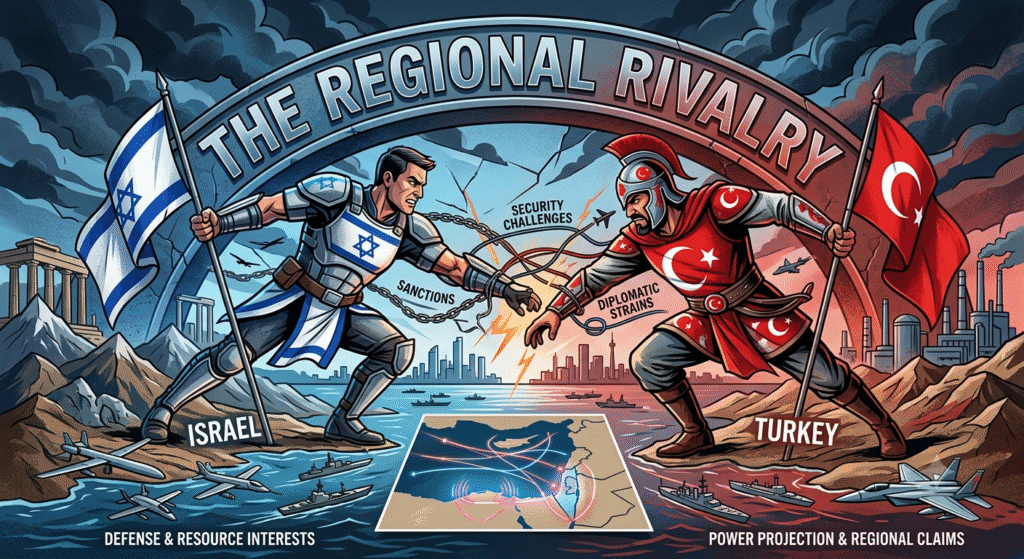
Over the past two weeks, the relationship between Israel and Turkey has entered a new and deeply confrontational phase. While global attention has been focused on the declining threat from Iran, a rapid and alarming geopolitical realignment has taken place . Turkey is emerging as Israel’s principal long-term strategic challenger. The recent actions by both nations—ranging from high-stakes diplomatic lobbying to military exercises and deep economic decoupling—paint a picture of two regional powers on a collision course.
Military Maneuvers: The Golden Eagle and Anatolian Eagle Drills
In a move that has triggered immediate alarm in Jerusalem, Turkey and Egypt have quietly launched a massive joint military exercise codenamed Golden Eagle . This drill, which features elite paratroopers, special forces, and commando units from both nations actively practicing synchronized operations on Egyptian soil, represents a formalization of a relationship that was considered impossible just a few years ago .
This is not a one-off event. The special forces drill follows a major air force exercise in late June 2026, where American-made F-16 jets from both Turkey and Egypt practiced advanced command and control procedures, coordinated strikes, and complex electronic warfare tactics . The speed of this military convergence suggests that technical and operational barriers are being systematically dismantled, fundamentally altering the traditional balance of power in the Eastern Mediterranean . Analysts warn that a deepening military nexus between Cairo and Ankara upends the delicate strategic assumptions that Israel has relied upon since its peace treaty with Egypt .
The Battle Over the F-35 Fighter Jets
The most high-profile action of the past week has been Prime Minister Benjamin Netanyahu’s public and aggressive campaign against a potential U.S. sale of F-35 fighter jets to Turkey . At the NATO summit in Ankara, U.S. President Donald Trump signaled an openness to reinstating Turkey into the F-35 program, from which it was removed in 2019 after purchasing the Russian S-400 missile defense system .
Netanyahu has gone on the offensive, utilizing American television networks to argue against the sale. He warned that “Turkey is a great country, but it is governed by a man who openly calls for the annihilation of Israel,” and that giving them F-35s would “destroy the power balance” in the Middle East . In a significant diplomatic escalation, Israel has coordinated with Greece to lobby against the sale . Israel is reportedly seeking, should it fail to block the sale entirely, to ensure Ankara receives a downgraded version of the aircraft with reduced capabilities .
The Diplomatic War: Genocide Recognition and Harsh Rhetoric
The diplomatic front has been equally active. In a deliberate counter-strike against Ankara, the Israeli cabinet recently voted to recognize the mass killings of Armenians under the Ottoman Empire as genocide . This move, which Israel had avoided for decades, is widely seen as “weaponizing history” to align Israel with powerful Greek and Armenian lobbying communities in Washington that also oppose strengthening Turkey militarily .
Turkey, for its part, has responded with harsh rhetoric. Foreign Minister Hakan Fidan recently stated that Israel is “not only a problem for Turkey, it has become a problem for the whole world” . The Turkish Foreign Ministry has also dismissed Netanyahu’s criticism as a “disinformation campaign” designed to divert attention from its actions in Gaza .
The Economic Decoupling
The actions on the battlefield and in the diplomatic arena are mirrored by a near-total economic decoupling. In May 2024, Turkey imposed a complete trade embargo on Israel . The impact has been staggering: Israeli imports from Turkey fell from about $2 billion in 2024 to just $924 million in 2025, while Israeli exports to Turkey plummeted from $598 million to only $10.9 million . Israeli companies are shutting down operations in Turkey, with sanitaryware company Hamat being the latest to close its Turkish subsidiary .
Conclusion: The Dawn of a Post-Iran Rivalry
As one Israeli analyst noted, “complaining is not a work plan” . The events of the last week indicate that Israel is moving beyond complaint to action, taking the fight directly to Washington and preparing for what could become its defining strategic competition over the next decade. The emerging axis between Turkey and Egypt presents a “strategic nightmare” for Israel, threatening to transform the fragile regional order into a heavily armed, synchronized challenge on its borders .