

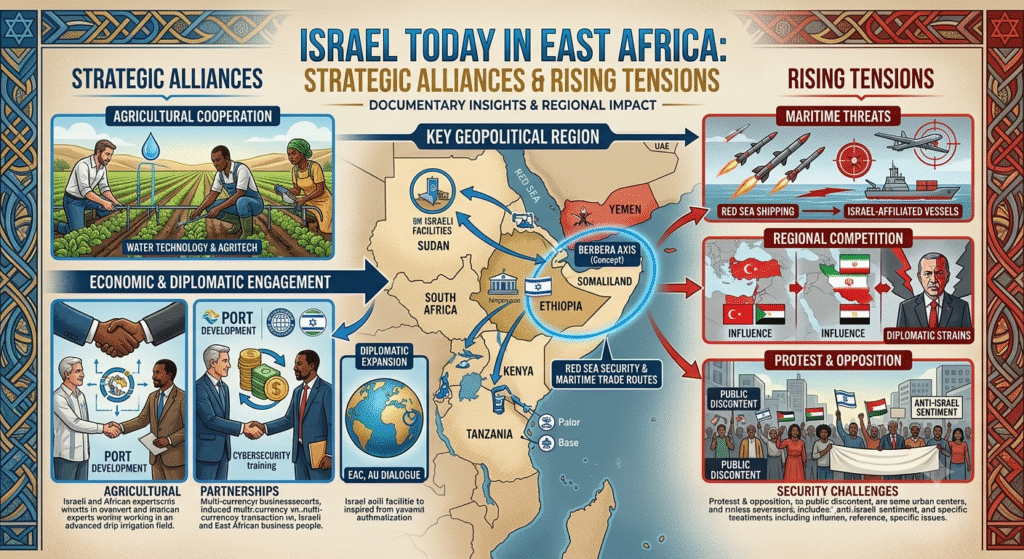
As of August 2026, Israel’s engagement in East Africa is rapidly intensifying, marked by a complex mix of deepening military alliances, high-level diplomatic visits, and a controversial foray into the region’s complex internal politics. These actions are reshaping geopolitical dynamics and drawing sharp criticism from local and international actors alike.
A Monumental Tribute to a Brotherhood
The week began with a significant and symbolic act of friendship in Uganda. On August 1, Uganda’s military unveiled a statue of Yonatan Netanyahu, the older brother of Israeli Prime Minister Benjamin Netanyahu, at the airport in Entebbe . The ceremony was presided over by Ugandan military chief Gen. Muhoozi Kainerugaba, who commissioned the monument as a tribute to the Israeli commander’s “courage in the face of danger” during a hostage rescue mission in 1976 .
The monument is a powerful testament to the enduring bond between the two nations. Yonatan Netanyahu was the only Israeli commando killed in the Entebbe raid, a mission that is considered one of Israel’s greatest military successes and profoundly shaped the life of his brother, the current prime minister . The move also signals a significant political statement from Gen. Muhoozi, who is the son of Ugandan President Yoweri Museveni and is widely viewed as his heir apparent .
Somaliland: A Diplomatic Gambit and Geopolitical Flashpoint
The most consequential and contentious Israeli action in East Africa remains its December 2025 recognition of the breakaway region of Somaliland. This move has turned the region into a new front for geopolitical rivalry, with recent developments heightening tensions.
The Embassy Opening and Strategic Declaration
In June 2026, the President of Somaliland, Abdirahman Mohamed Abdullahi, visited Israel to inaugurate the region’s embassy in Jerusalem . The opening ceremony was attended by Israeli Prime Minister Benjamin Netanyahu and Foreign Minister Gideon Saar, and a “strategic declaration of cooperation” was signed between the two sides . This follows Israel’s formal recognition of Somaliland in late 2025, making it the only UN member state to do so .
A Threat to Bab al-Mandab?
The driving force behind Israel’s diplomatic move is widely seen as strategic, not humanitarian. Somali officials have publicly stated that Israel’s objective is to expand its influence near the Bab al-Mandab Strait and the Gulf of Aden, a critical global maritime chokepoint . The official argued that the move is part of a broader Israeli strategy to “monitor developments and threats from Yemen” and control this vital waterway . This perspective is shared by Somali President Hassan Sheikh Mohamud, who has accused Israel of “taking advantage of the long-standing dispute between Mogadishu and Hargeisa” .
Somalia’s Firm Resistance
Somalia has vehemently rejected Israel’s recognition and the opening of the embassy, calling it a “flagrant violation of international law” and an attack on its sovereignty and territorial integrity . In a recent address to parliament, President Mohamud asserted that Somalia would use a combination of “force and wisdom” to prevent Israel from gaining a permanent foothold in the region . He has also emphasized that he will not allow the conflicts of the Middle East to be transferred to the Horn of Africa .
Strengthening Core Partnerships: Ethiopia and Kenya
Away from the controversy surrounding Somaliland, Israel is quietly but effectively reinforcing its longstanding partnerships with key East African nations.
Ethiopia: A 70-Year Partnership
The deep bond between Israel and Ethiopia was on full display earlier this year. In February, Israeli President Isaac Herzog made a state visit to Ethiopia, meeting with Prime Minister Abiy Ahmed and President Taye Atske Selassie . The visit, which focused on strengthening ties in “innovation and trade” , was a significant show of commitment from Israel’s highest office. This is part of a relationship that was further celebrated in June, as the Israeli Embassy in Addis Ababa marked both Israel’s 78th Independence Day and the 70th anniversary of modern diplomatic cooperation between the two nations . The history between the two countries is extensive, with Ambassador Avraham Neguise noting that the partnership builds on “3,000 years of shared heritage” .
Kenya: A Crucial Security Partner
Security cooperation is a defining feature of the Israel-Kenya relationship. Recent meetings between Kenyan Defence Cabinet Secretary Aden Duale and the Israeli Ambassador to Kenya, Michael Lotem, have focused on deepening defence ties, with specific discussions involving the Israeli Aerospace Industry (IAI) . The partnership is built on mutual counter-terrorism interests and intelligence sharing, making Kenya a vital hub for Israeli influence in the region.
Conclusion
Israel’s presence in East Africa today is not a single, monolithic project but a multi-layered strategy. In Uganda, it is expressed through historical commemoration and strong military ties . In Ethiopia, it is a deep, multi-generational partnership . In Kenya, it is a crucial security alliance . However, in the strategic Red Sea corridor, the recognition of Somaliland represents a high-risk diplomatic gambit that has drawn international condemnation and threatens to destabilize the region . Israel’s actions are creating a new geopolitical fault line, with Somalia and the wider Arab world opposing its ambitions, even as its traditional partnerships deepen and evolve.
