

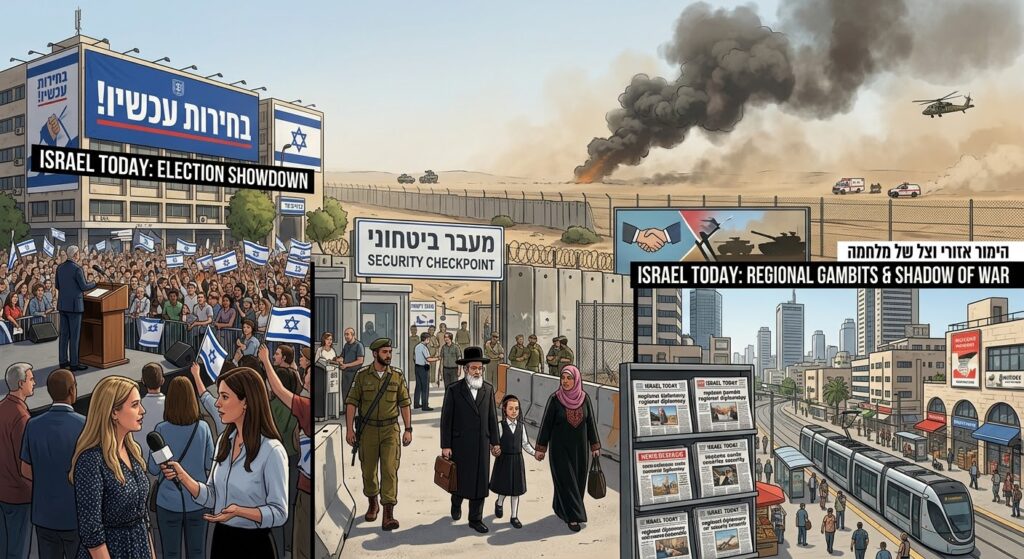
JERUSALEM — With less than two weeks remaining before Israel’s general elections on October 27, the country finds itself at a critical juncture. Prime Minister Benjamin Netanyahu is fighting for his political survival against a surging opposition led by former military chief Gadi Eisenkot, while simultaneously pursuing a high-stakes diplomatic gambit to join Saudi Arabia’s war against the Houthis. On the northern border, a deadly explosion has killed a teenager during a school hike, and in the south, the rubble of Gaza remains a silent testament to a war that never truly ended.
The Election: Netanyahu Trails as Blocs Remain Deadlocked
The latest polls paint a grim picture for the Prime Minister. A survey released by Israeli public broadcaster KAN on Sunday showed Eisenkot leading Netanyahu 43 percent to 38 percent as the preferred candidate for prime minister . Eisenkot’s Yashar party is projected to win 22 seats in the 120-member Knesset, compared to 20 for Netanyahu’s Likud .
More troubling for Netanyahu is the bloc arithmetic. His right-wing and religious coalition is projected to secure only 53 seats—eight short of the 61-seat majority needed to form a government . Eisenkot’s bloc, meanwhile, is projected at 50 seats, with the remaining 17 going to parties outside both camps .
A separate poll by The Times of Israel‘s sister site found the anti-Netanyahu bloc regaining its lead, with Yashar winning 24 seats to Likud’s 20 . According to that survey, Netanyahu’s bloc would win just 47 seats—14 short of a majority—while the opposition bloc would reach 55 .
What makes the situation particularly volatile is the high level of voter uncertainty. Thirty percent of respondents said they had yet to decide which party to support, and 21 percent said they were considering not voting at all . With neither bloc close to a majority, the possibility of a second election—or of post-election defections that could swing the balance—looms large .
The Saudi Gambit: Netanyahu Seeks Permission to Strike the Houthis
In a move that reveals both strategic ambition and political desperation, Netanyahu is reportedly seeking Saudi Arabia’s approval to launch Israeli airstrikes against Yemen’s Houthi rebels, according to Israeli daily Haaretz .
The strategy, mediated by the United States, is described as an effort to advance Israel’s relations with Riyadh and lay the groundwork for a normalization agreement . The calculation is that Saudi Arabia, under pressure from Houthi attacks on its territory and infrastructure, might be willing to accept Israeli military assistance.
But Saudi Crown Prince Mohammed bin Salman is reportedly reluctant to grant permission, fearing that Israeli military intervention would inflame domestic public opinion . The Crown Prince, who also serves as Prime Minister, has maintained that Saudi Arabia can only normalize relations with Israel once an independent Palestinian state is established—a position Netanyahu has repeatedly rejected .
The episode underscores a broader tension in Netanyahu’s foreign policy: his desire to expand the Abraham Accords to include Saudi Arabia, the leader of the Sunni Islamic world, is constrained by his refusal to countenance Palestinian statehood. With Saudi Arabia currently embroiled in a war with the Houthis that has reached its own territory, the opportunity may be tempting—but the political cost, for both Riyadh and Jerusalem, remains high.
Northern Border: A Deadly Explosion and the Lebanon Question
On Monday, a school hiking trip near Israel’s northern border with Lebanon turned to tragedy when an explosion killed a 15-year-old student and injured at least 24 others, including students and teachers . The Israeli military’s preliminary investigation concluded that the explosion was likely caused by an abandoned Hezbollah cluster bomb dating back to previous fighting . According to reports, one of the students picked up the munition and placed it in a backpack before it detonated .
The incident occurred on the Ramim Ridge in the Naftali Mountains, an area that has been the scene of repeated clashes between Israel and Hezbollah . Israel’s Education Minister Yoav Kisch ordered a two-day suspension of school trips in the area to assess safety .
Meanwhile, diplomatic efforts to stabilize the northern front continue fitfully. Israel and Lebanon held their first direct civilian talks in decades earlier this month, described by an Israeli spokesperson as an “initial attempt to establish a basis for a relationship and economic cooperation” . Lebanese Prime Minister Nawaf Salam was more cautious, saying Lebanon was “far” from normalization but that the talks aimed at “defusing tension” .
The core issues remain unresolved: Hezbollah’s disarmament and Israel’s withdrawal from southern Lebanon. Netanyahu has stated that even after a ceasefire, Israel will maintain a 10-kilometer security zone in southern Lebanon . Hezbollah has refused to disarm unless Israel ends its attacks and withdraws . A U.S.-brokered framework agreement from June provides for a phased Israeli withdrawal and Lebanese army deployment, but no timeline has been set, and Hezbollah has rejected the agreement’s terms .
Syria: Rising Incursions
Israel’s military operations extend beyond Lebanon. The UN Human Rights Office reported roughly 280 incidents involving armed Israeli incursions into Syria in September—the highest monthly figure recorded this year . On Monday alone, Israeli forces abducted a young man in the village of Bariqa in Quneitra province, blew up an abandoned military barracks near Beit Jinn in the western Damascus countryside, and entered areas in Daraa province . At least 49 Syrians remain in Israeli custody .
Syria has demanded that Israel withdraw from territories it occupied and reaffirmed its commitment to the 1974 disengagement agreement .
West Bank and Negev: Demolitions and Displacement
Inside Israel and the occupied territories, Palestinian communities continue to face displacement. On Monday, Israeli authorities demolished around 80 homes in the unrecognized Bedouin village of Al-Dhahiya in the Negev, displacing approximately 400 people . The demolitions were carried out on claims that the homes were built without permits—permits that residents of unrecognized villages cannot obtain because the state has never approved planning for them .
The timing has drawn sharp criticism. Israel’s general elections are scheduled for October 27, and critics accuse National Security Minister Itamar Ben-Gvir of using demolitions as election propaganda. United Arab List leader Mansour Abbas sent an urgent letter to the Attorney General demanding a freeze on demolition orders until the elections are over, warning against using home demolitions for “political and electoral purposes” .
In occupied East Jerusalem, Israeli bulldozers demolished three Palestinian homes in the Ashqariya neighborhood on Sunday, and authorities issued an eviction order for a family in Qalandiya . According to the Jerusalem Governorate, 427 demolition and dismantling operations were carried out in the Jerusalem governorate from the beginning of the year through the end of September 2026 .
A Nation Holding Its Breath
Israel today is a country suspended between multiple unresolved conflicts. The election is less than two weeks away, and the polls suggest no clear winner. The northern border remains volatile, with a deadly explosion serving as a grim reminder of the unexploded ordnance that litters the landscape. In the south, Gaza remains under an uneasy truce, with Israeli forces holding significant territory and a political plan for the Strip that has yet to materialize . In the West Bank, settlement expansion and settler violence continue unabated, drawing international condemnation and threatening to foreclose any possibility of a two-state solution .
For Netanyahu, the coming days will determine whether he can defy the polls and assemble a governing coalition, or whether his long tenure as Israel’s longest-serving prime minister will come to an end. For Israelis, the election represents a choice not just between leaders, but between competing visions of the country’s future: one defined by perpetual conflict and territorial expansion, the other by a precarious hope for normalization and withdrawal. For the Palestinians living under Israeli control—in the Negev, in East Jerusalem, in the West Bank, and in Gaza—the election will likely change little. The demolitions, the displacement, and the uncertainty continue regardless of who sits in the Prime Minister’s office.