

The Somaliland Gambit: A Diplomatic Earthquake
The most significant and contentious development has been Israel’s formal recognition of the breakaway region of Somaliland as an independent state in December 2025 . This move made Israel the first country in the world to extend such recognition, triggering immediate condemnation from Somalia and reverberating across the region.
The diplomatic fallout has been severe. In June 2026, the Intergovernmental Authority on Development (IGAD), the East African regional bloc, issued a strong statement reaffirming its commitment to Somalia’s “sovereignty, unity, and territorial integrity” . The bloc cautioned that actions undermining Somalia’s sovereignty “risk raising tensions and damaging regional peace and cooperation” .
The tensions escalated further when Somaliland opened a new embassy in Jerusalem, prompting Somalia to denounce Israel’s recognition as a “deliberate attack” on its sovereignty . The Arab League also condemned the move, with Secretary-General Ahmed Aboul-Gheit describing it as “legally null and void and an unacceptable provocation to both the Arab and Islamic world” . He warned that such efforts aimed at expanding influence in the Horn of Africa “risk exacerbating tensions and instability in the region” .
Strategic Significance: The Red Sea Corridor
The interest in Somaliland is not coincidental. The region’s Berbera port, located near the strategic Bab el-Mandeb strait—a chokepoint for global maritime trade—has become a focal point of geopolitical competition . Analysts suggest that Israel may be exploring security cooperation near Berbera, drawn by its unique geographic position for monitoring one of the world’s most critical maritime channels .
Political analyst Mohamed Abdi Hassen warns that making Berbera a platform for external security actors “may expose Somaliland to retaliatory pressure from Iranian-backed groups active in the wider Red Sea region” . The debate highlights the dilemma facing many Red Sea states: how to benefit from external partnerships without becoming entangled in broader geopolitical conflicts .
Israel-Ethiopia: A Strategic Reset
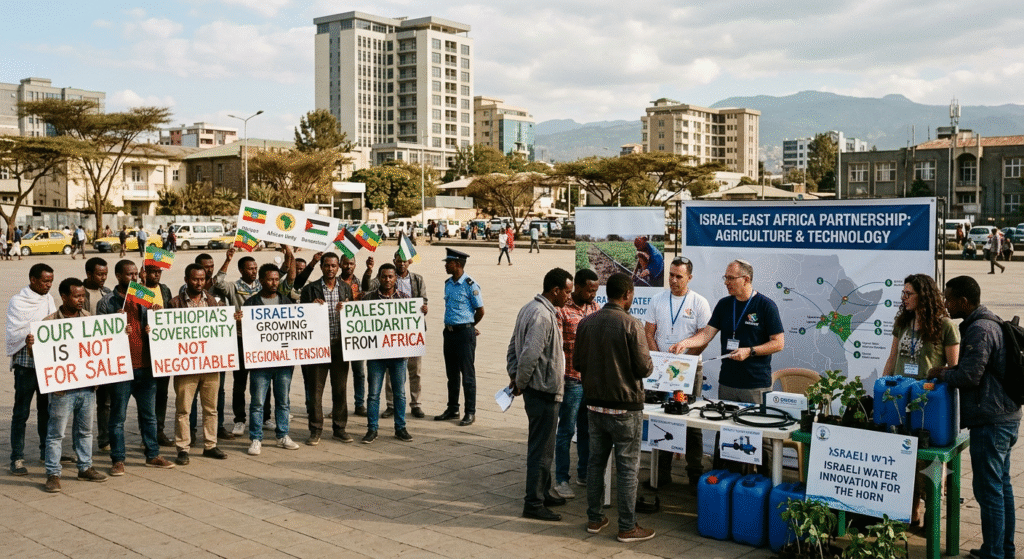
Beyond Somaliland, Israel is deepening ties with Ethiopia, a relationship described as “one of the oldest international connections rooted in history, tradition, and cultural exchange” . In early 2026, President Isaac Herzog’s expected visit to Addis Ababa signaled a “strategic reset” focused on economic and infrastructure cooperation .
The partnership has expanded into multiple sectors. Israeli companies are showing increasing interest in Ethiopia’s manufacturing, infrastructure, agriculture, logistics, technology, and industrial development . A major new airport under construction near Addis Ababa has attracted Israeli interest, particularly for cybersecurity and digital infrastructure solutions .
Investment forums and direct visits have been organized to connect Israeli business leaders with Ethiopian opportunities . The relationship is being described as entering a “new golden era,” moving beyond traditional diplomacy toward commercial and technological collaboration .
Security Fears: The Shadow of Conflict
The broader security environment has cast a long shadow over Israel’s regional engagement. Experts have warned that the joint U.S.-Israel airstrike campaign on Iran, which began in February 2026, could “upend peace and stability in the volatile East and Horn of Africa region” .
Abraham Kuol Nyuon, dean of the School for Social and Economic Studies at the University of Juba, noted that “the Horn of Africa region could experience proxy conflicts amid regional militarization as a result of spillover effects from the aggression on Iran” . He also warned that the escalation “raises serious questions about the effectiveness of the international rules-based order” and “encourages nuclear proliferation” .
For fragile states like South Sudan, the risks are especially acute. Nyuon explained that “fluctuations in oil prices driven by Middle East instability can affect South Sudan’s economy, which is heavily dependent on oil exports” . Edmund Yakani, executive director of the Community Empowerment for Progress Organization, went further, stating that by attacking Iran, the United States “has demonstrated an arrogant attitude of bullying countries it perceives to be weaker into submission on the global stage” .
The Broader Diplomatic Picture
Israel’s outreach in East Africa is part of a larger strategic shift. Since 2016, Israel has actively pursued engagement with the African continent, positioning it as a “key priority within its broader foreign policy framework” amid the “new scramble for Africa” . Israeli ambassador to Kenya and Ambassador-Designate to several East African nations, Gideon Behar, has been actively engaging in regional forums, including the AISA 2026 climate summit in Kenya, emphasizing the power of international cooperation in advancing climate solutions .
However, Israel’s actions have also drawn coordinated criticism. In late July 2026, eight countries—Jordan, the United Arab Emirates, Indonesia, Pakistan, Turkey, Saudi Arabia, Qatar, and Egypt—issued a joint condemnation of Israeli actions regarding Al-Aqsa Mosque tensions, reflecting the broader Arab and Islamic world’s unease with Israeli policies .
Conclusion
Israel’s deepening involvement in East Africa represents a major geopolitical shift with far-reaching consequences. The recognition of Somaliland, strategic partnerships with Ethiopia, and growing security interests in the Red Sea corridor are reshaping regional dynamics. However, these moves have also sparked diplomatic crises, alarmed regional bodies like IGAD and the Arab League, and raised fears that East Africa could become entangled in broader Middle Eastern conflicts. As 2026 unfolds, the region stands at a crossroads—benefiting from Israeli investment and technology while grappling with the political and security risks that come with closer alignment.
