

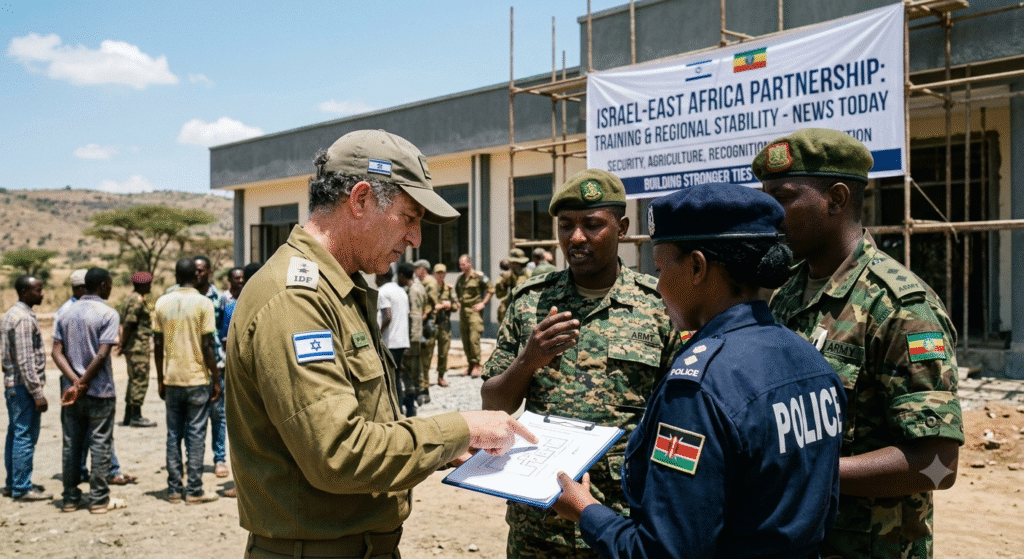
Israel’s presence in East African news today is dominated by two major stories: the historic diplomatic breakthrough with Somaliland and a swift diplomatic reversal over Ebola travel restrictions affecting Kenya. Together, they paint a picture of deepening engagement, strategic rivalry, and the complex geopolitics of the Horn of Africa.
The Somaliland Breakthrough: A Historic Visit
The most significant development is the first-ever official state visit by Somaliland’s President Abdirahman Mohamed Abdullahi to Israel, which took place from June 14 to 17 . This visit came five months after Israel became the first country in the world to formally recognise the breakaway region as an independent state in December 2025 .
Prime Minister Benjamin Netanyahu, meeting President Abdullahi in Jerusalem, emphasized the historic nature of the moment: “This is a historic moment. It’s the first official visit by the President of Somaliland after the official recognition of Somaliland. We are proud, and I am proud that my government is the first government on the planet to recognize Somaliland. Others will follow” .
President Abdullahi opened Somaliland’s embassy in Jerusalem’s Malha Technology Park during the visit, making it the eighth embassy located in the city . Addressing the significance, he stated: “For thirty-five years, the people of Somaliland have built a peaceful, democratic and resilient nation. We asked the world: Do you see us? Israel answered first” .
Military Training, Not a Base
The military dimension of the new relationship has drawn particular attention. Reports emerged that Israel had dispatched approximately 50 servicemen to Somaliland, with Somali intelligence suggesting the soldiers were selected for their African heritage—particularly Ethiopian Jews—to blend in more easily with local communities .
However, Somaliland’s Defence Minister Mohamed Yusuf Ali, part of the visiting delegation, firmly denied reports of an Israeli military base in the territory. Speaking to Reuters, he stated: “There is no Israeli military presence or military bases in Somaliland. But Israel is helping Somaliland … they are supporting to train some of our police and military” .
Regional Backlash: Somalia Protests, Houthis Threaten
The engagement has triggered strong reactions. Somalia condemned Israel’s recognition of Somaliland as a “deliberate attack” on its sovereignty and territorial integrity . The Federal Government of Somalia stated: “Somalia remains a sovereign and internationally recognised state, and the Federal Government is the sole legitimate authority empowered to represent the country in international relations” .
The Intergovernmental Authority on Development (IGAD), the regional bloc, also voiced concern. In a statement on June 18, IGAD reaffirmed its commitment to Somalia’s sovereignty, unity, and territorial integrity, cautioning that actions undermining Somalia’s sovereignty risk “raising tensions and damaging regional peace and cooperation” .
More alarmingly, Yemen’s Houthi movement warned that any Israeli military or intelligence presence in Somaliland would be viewed as a legitimate target . Analysts say the Houthis fear Israel could use Somaliland’s strategic location near the Bab el-Mandeb Strait to strengthen surveillance and military capabilities near Yemen—a waterway critical to global maritime trade .
Economic Ambitions: ‘Somaliland is Open for Business’
Beyond security and diplomacy, the visit focused on economic cooperation. President Abdullahi touted Somaliland’s “vast natural resources” and strategic position as a maritime gateway to Africa, expressing interest in Israeli expertise in agriculture, water management, renewable energy, healthcare, and cybersecurity .
“Somaliland is open for business, and Somaliland is ready for Israeli investment,” he declared at a business conference in Tel Aviv . Eden Bar-Tal, Israel’s Foreign Ministry director general, said becoming the first country to recognise Somaliland put Israeli entrepreneurs at a “significant and unique advantage” .
The visit also concluded with the signing of a Joint Declaration on strengthening cooperation between the two states, with Netanyahu highlighting potential collaboration in “water, agriculture, technology, security—and in many other areas” .
The Ebola Travel Controversy: A Diplomatic U-Turn
Alongside the Somaliland breakthrough, Israel found itself embroiled in a diplomatic dispute with Kenya over Ebola-related travel restrictions. On June 10, Israel’s Population and Immigration Authority issued a directive barring foreign nationals from Kenya, Uganda, Rwanda, South Sudan, and the Democratic Republic of Congo from boarding flights to Israel .
The directive also applied to any foreign national who had visited those countries within 21 days prior to their flight, regardless of citizenship . Israeli citizens and residents were exempted .
Kenya reacted with immediate and forceful protest. Foreign Affairs Principal Secretary Dr. Korir Sing’oei publicly decried the decision, describing it as “unfortunate” and “unjustified” given Kenya’s robust public health record . He stated: “With over 80,000 tests, no case of Ebola has been reported in Kenya” .
Health Cabinet Secretary Aden Duale echoed this sentiment: “What they have done is very unfair. Kenya is not in the epicenter of Ebola. We have no case” .
The diplomatic pressure paid off within days. The Israeli Embassy in Nairobi announced that Kenya—along with Rwanda—had been removed from the restricted list following a review by Israel’s Ministry of Health . Sing’oei welcomed the reversal, stating: “Israel’s decision to lift this restriction shows that science, dialogue and mutual trust work; that facts can beat fear; that partnership beats barriers. This is how friends must act” .
Ethiopia: 70 Years of Partnership and Evacuation
The news also highlighted ongoing engagement with Ethiopia. Israel marked 78 years of independence and 70 years of modern partnership with Ethiopia at a celebration in Addis Ababa, attended by Ethiopian government representatives, diplomats, and religious leaders . Ambassador Avraham Neguise emphasized the unique nature of the celebration: “seven decades of modern bilateral cooperation, adding on to 3,000 years of shared heritage between the two nations” .
In a separate development, Israel successfully evacuated over 200 of its citizens and members of the Ethiopian Jewish community from two cities in the Amhara and Oromia regions affected by recent violence. Prime Minister Netanyahu directed the evacuees to be moved to Addis Ababa, from where they would be transported to Israel . The Amhara region is home to thousands of members of the Ethiopian Jewish community .
Looking Ahead: A New Era of Tensions?
Israel’s deepening engagement in East Africa carries significant strategic and political implications. The recognition of Somaliland represents a bold diplomatic gambit that has already delivered concrete results—a state visit, an embassy in Jerusalem, and discussions of economic cooperation. But it has also drawn condemnation from Somalia, concern from IGAD, and threats from the Houthis.
The resolution of the Ebola travel dispute with Kenya demonstrates that diplomatic friction can be quickly resolved when both parties are willing to engage. It also underscores Kenya’s growing diplomatic weight and its ability to influence decisions affecting its citizens.
As Israel continues its efforts to expand its influence in Africa—part of a broader strategy to counter Iran’s presence in the region—the coming months will reveal whether this new relationship with Somaliland becomes a model for deeper engagement or a flashpoint for broader conflict.
