

June 15, 2026
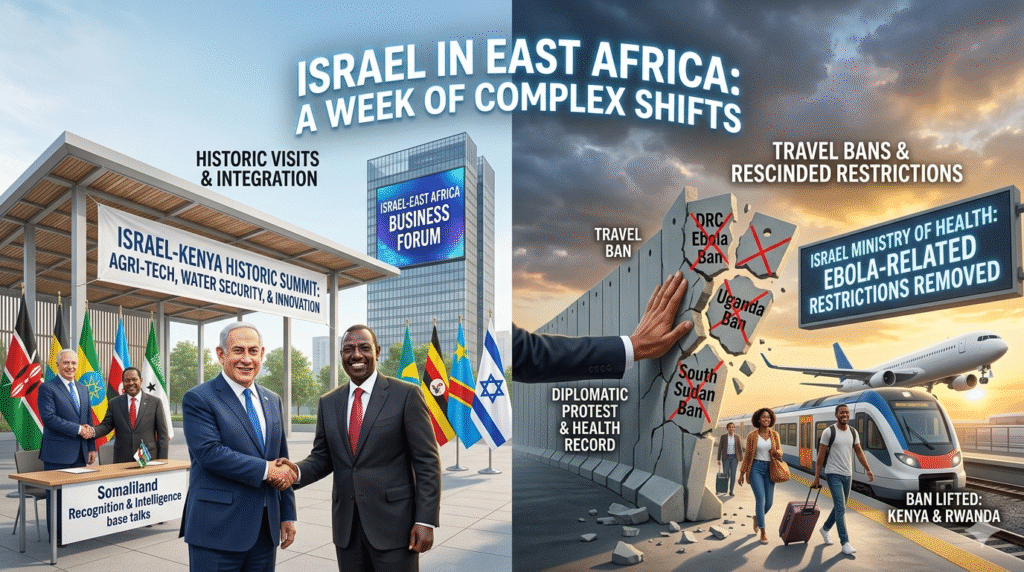
Over the past seven days, Israel’s engagement with East Africa has been marked by dramatic highs and lows. A landmark state visit by the President of Somaliland and the opening of its diplomatic mission in Jerusalem represented a historic diplomatic milestone. However, this was overshadowed by a diplomatic spat when Israel imposed—and within days rescinded—a travel ban on Kenyan travelers over Ebola concerns. Amidst this, Israel also conducted a significant evacuation operation for its citizens and members of the Ethiopian Jewish community from conflict zones in Ethiopia.
Part 1: The Diplomatic Breakthrough with Somaliland
The headline-grabbing development of the week was the first-ever state visit by Somaliland’s President Abdirahman Mohamed Abdillahi to Israel. This historic visit, which took place on Sunday, June 14, marked a major step in solidifying the new relationship between the two nations .
President Abdillahi, accompanied by First Lady Fardowsa Mohamed Roble, was received with an official welcome ceremony at the President’s Residence in Jerusalem by President Isaac Herzog and First Lady Michal Herzog . During the visit, the two leaders held a private meeting and addressed the media, highlighting their shared strategic interests. President Herzog emphasized their common challenges: “We both face the threat of radical extremism. We both seek security and stability in the region and in the Horn of Africa. We both see the importance of protecting maritime freedom” .
The significance of this visit was immense. President Abdillahi noted it was “the first state visit by a President of the Republic of Somaliland to another country” and that Israel had chosen to receive them with such an honor . This official visit came shortly after the opening of Somaliland’s diplomatic mission in Jerusalem on June 14, making it the eighth embassy to be located in the city . This follows Israel’s historic decision on December 26, 2025, to become the first country in the world to recognize Somaliland’s sovereignty .
Part 2: The Kenyan Travel Ban Controversy
While the diplomatic ties with Somaliland flourished, relations with Kenya hit a snag. On June 10, Israel’s Border Control Department issued a memo instructing airlines to deny boarding to foreign passengers from Kenya, Uganda, Rwanda, South Sudan, and the Democratic Republic of Congo over concerns about the Ebola outbreak in the region . The directive also applied to travelers who had visited these countries within 21 days of their flight .
This decision sparked immediate and sharp protests from the Kenyan government. Kenya’s Foreign Affairs Principal Secretary, Dr. Korir Sing’oei, formally protested the decision, calling it “unfortunate” and “unjustified” given Kenya’s robust public health record . He pointed out that Kenya had conducted over 80,000 Ebola tests without reporting a single case . “Kenya strongly protests the decision by Israel to include the country amongst those whose travellers it will restrict,” he stated, arguing the move did not reflect the facts on the ground .
Part 3: Israel’s Rapid U-Turn and Friendly Resolution
The diplomatic pressure paid off. Just days after the initial ban, the Israeli Embassy in Nairobi announced that Kenya—along with Rwanda—had been removed from the restricted list . The Israeli Health Ministry made the decision following a review of the situation .
The reversal was a swift victory for Kenyan diplomacy. PS Sing’oei warmly welcomed the decision, seeing it as a vindication of Kenya’s public health efforts and a testament to the strength of the bilateral relationship. In a post on X, he remarked, “Israel’s decision to lift this restriction shows that science, dialogue and mutual trust work; that facts can beat fear; that partnership beats barriers. This is how friends must act” . The episode highlighted both Israel’s cautious health policy and the effective diplomacy that can resolve disputes between allies.
Part 4: Securing Ethiopian Jews Amid Conflict
In a separate but significant operation, Israel successfully evacuated more than 200 of its citizens and members of the Ethiopian Jewish community from two cities in the Amhara and Oromia regions of Ethiopia, which were affected by recent violence .
Prime Minister Benjamin Netanyahu confirmed he had directed the evacuees to be moved out of combat zones and to Addis Ababa, from where they would be brought to Israel . The Amhara region is home to thousands of members of the Jewish community, and the operation underscores Israel’s commitment to their safety amidst deteriorating security in parts of Ethiopia .
Part 5: Strengthening Ties Beyond the Headlines
Beyond the dramatic events, deeper, long-term cooperation continues to underpin Israel-East Africa relations. A recent interview with Ethiopian Ambassador Tesfaye Yitayeh highlighted the growing partnership between the two nations, particularly in technology and agriculture . Ethiopia, seeking to emulate Israel’s “Start-Up Nation” model, is looking to strengthen its cooperation in artificial intelligence and is planning to establish an AI-focused university .
Despite the regional instability and the negative economic impacts of the broader Middle East conflict, including skyrocketing fuel prices and disruption to airlines like Ethiopian Airlines, both countries view the relationship as resilient and vital . This week’s events, from the grand diplomatic gestures to the practical humanitarian operations and the quick resolution of a travel dispute, demonstrate the multifaceted and evolving nature of Israel’s engagement with East Africa today.
