

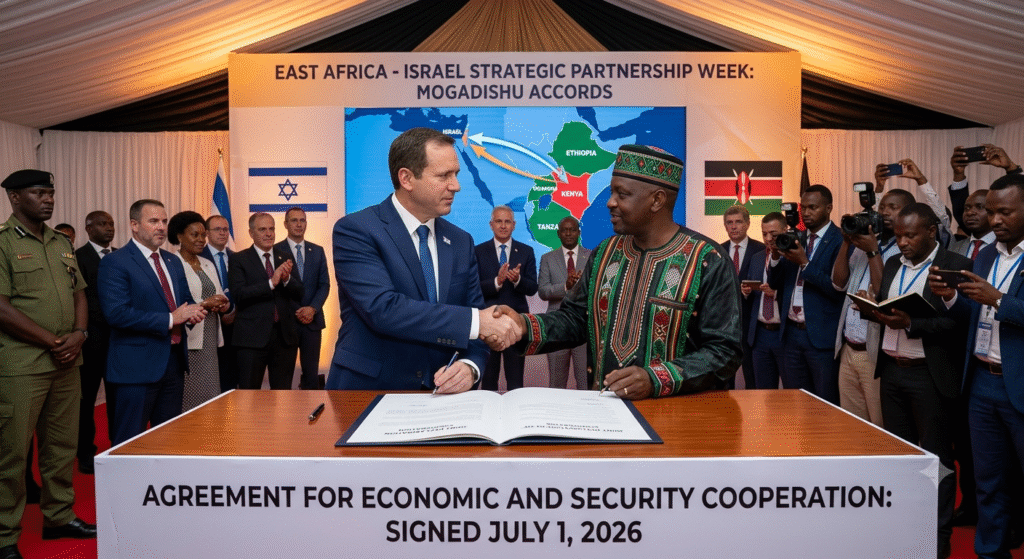
The past week has underscored Israel’s deepening and increasingly assertive engagement across the Horn of Africa. Events have moved beyond diplomatic gestures into the realm of tangible security and economic cooperation, marking a significant phase in Israel’s strategic pivot toward the region.
A central theme of the week has been the continued fallout from Israel’s recognition of Somaliland, coupled with Israel’s perceived role in a changing regional order. This recognition has created friction with the broader Somali government, which has viewed the move as a direct challenge to its sovereignty. Despite this, the collaboration between Israel and Somaliland appears to be solidifying, drawing attention from other regional actors. As the United States reduces its direct military footprint in Africa, Israel is seen as stepping into a niche, offering advanced military technology and training to local forces.
Advancing the Berbera Port and Security Partnership
Reports from the region indicate that defense cooperation is a primary driver of the recent high-level contacts between Israel and the Somaliland administration, with the focus expanding to include the strategically vital Berbera Port complex . Discussions are believed to have advanced on plans for the port, which is a key asset for landlocked Ethiopia and a critical Red Sea foothold . These meetings also reportedly explored the “extent and nature” of a potential Israeli military presence in the region, specifically to secure the port facilities .
Berbera represents a crucial node in Israel’s broader security calculus. Access to the port and its associated airport would significantly reduce Israeli response times for operations in the Red Sea and the Bab el-Mandeb strait compared to bases further north . This strategic value is particularly pertinent given the threat posed by Iran-backed Houthi forces in Yemen.
Navigating Regional Tensions
Israel’s engagement is unfolding against a backdrop of heightened regional volatility. Simultaneously with reports of deepening ties with Somaliland, the Ethiopian National Defense Forces (ENDF) were reportedly placed on alert due to an emerging threat from Eritrean and other forces on the northern border . Israel appears to be carefully navigating these complex dynamics, engaging with Ethiopia while also strengthening its ties with Somaliland and neighboring entities .
The evolving security landscape also comes amid broader talks involving international stakeholders. Saudi Arabia, the U.S., and Israel have reportedly engaged in preliminary discussions regarding the future of the Red Sea and the management of the straits . While this agenda remains complex, it suggests that Israel’s engagement with African Red Sea states is part of a wider recalibration of maritime security.
Economic Infrastructure and Broader Diplomacy
Beyond security, the week has also seen a focus on economic infrastructure . Israeli interest in the Berbera corridor aligns with ambitions to develop it into a major regional logistics and trade artery, one that could serve as an alternative to the congested Port of Djibouti . This economic dimension forms a crucial part of the long-term strategy, creating a web of mutual interests that support Israel’s security objectives.
The developments of the past week illustrate a clear trend: Israel is actively pursuing a multi-layered strategy in East Africa. By formalizing ties with Somaliland, exploring strategic maritime footholds, and engaging with the region’s economic hubs, Israel is building influence while seeking to counter adversarial narratives in the region.
