

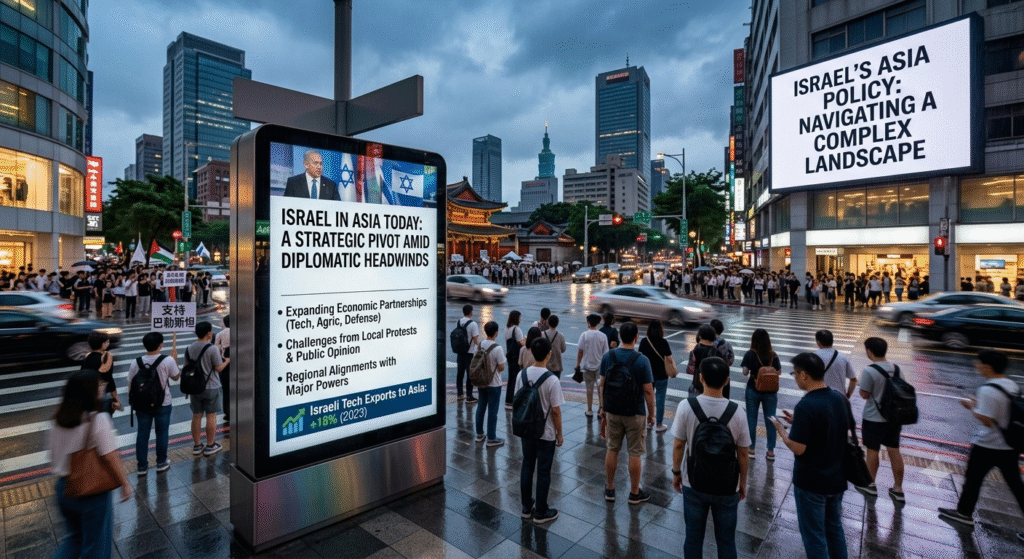
Israel’s strategic focus on Asia has reached a pivotal moment in August 2026. Faced with a tightening international environment and mounting criticism from some Western capitals, Israel is accelerating its diplomatic and economic pivot toward the East. From deepening defense ties with India and expanding trade with Vietnam to facing growing diplomatic condemnation from Asian powers over its settlement policies, Israel’s presence on the continent is taking on a new, increasingly complex dimension.
🎯 A Calculated Diplomatic Strategy
The underlying logic of Israel’s Asian pivot is rooted in geopolitical necessity. Analysts note that Israel’s traditional reliance on the United States and a few European nations is proving insufficient. The 2023 Gaza war and its aftermath led to sharp criticism from some long-standing European partners, who increasingly condition cooperation on humanitarian and human rights benchmarks . This, combined with the stalled normalization process with Saudi Arabia, has intensified the urgency for Israel to diversify its alliances .
Israel is thus engaging in a “deliberate strategy of geopolitical and diplomatic diversification,” seeking to secure robust, long-term relationships that are less vulnerable to shifting political winds in the West . For Asian nations, Israel offers advanced technology in defense, agriculture, cybersecurity, and innovation, while Israel gains access to the world’s most dynamic economic region. Crucially, this model allows for deep cooperation without necessarily compelling Asian partners to take sides in Middle Eastern disputes .
🇮🇳 India: A Strategic Pillar
India has emerged as the centerpiece of Israel’s Asian strategy. The relationship has been formally upgraded to a “Special Strategic Partnership,” institutionalized through 16 landmark agreements signed earlier this year . This partnership extends far beyond traditional defense deals.
A recent high-level Israeli defense delegation, led by Ministry of Defense Director General Maj. Gen. (res.) Amir Baram, visited New Delhi to advance security and industrial cooperation, reflecting a relationship now described as a “defense and industrial alliance” . Beyond the military sphere, the partnership now includes the creation of the India-Israel Innovation Centre for Agriculture (IINCA), an Indo-Israel Cyber Centre of Excellence, and agreements to regulate the deployment of up to 50,000 Indian workers to Israel over five years .
As Baram stated, the partnership is “based on shared values, deep cultural appreciation, and mutual trust, which go far beyond mere interests” . For Israel, India represents both an economic lifeline and a diplomatic counterweight.
🇻🇳 Vietnam: A Growing Partnership
Israel is significantly strengthening its ties with Vietnam, a relationship President Isaac Herzog recently described as a “dynamic partner with an increasingly important role in Southeast Asia” . The effective implementation of the Vietnam-Israel Free Trade Agreement (VIFTA), which entered into force in November 2024, is giving bilateral trade a powerful boost. Two-way trade approached $4 billion in 2025, and Vietnamese exports to Israel surged over 30% in early 2026 .
Both nations are seeking to expand cooperation in innovation, high-tech agriculture, cybersecurity, and water resource management, areas where Israeli expertise meets Vietnamese development needs . The prospect of new direct air routes between the two countries from late 2026 is expected to further boost trade, tourism, and investment .
🍊 Cambodia and Japan: New Agricultural Markets
Israel is also expanding its agricultural footprint in Asia. Starting next export season, Israeli farmers will be able to supply oranges, clementines, lemons, grapefruit, and pomelo to Cambodia . This agreement is part of a broader push to expand agricultural exports to the Far East, with the industry estimating the potential at about 10,000 tons annually. The ministry is also working alongside Japan to open that market to Israeli watermelons, melons, and pumpkins .
🚫 Diplomatic Friction: Settlement Condemnation and Rivalries
Israel’s Asian pivot is not without significant friction. The most prominent challenge is the growing diplomatic opposition from key Asian powers over Israel’s settlement policies.
Malaysia’s Strong Stance
Malaysian Prime Minister Anwar Ibrahim has been a vocal critic, recently denouncing Israel’s issuance of construction tenders for the illegal E1 settlement project in the occupied West Bank . The E1 plan seeks to connect the Ma’ale Adumim settlement with occupied East Jerusalem, a project critics say would divide the West Bank and make a two-state solution impossible .
Anwar stressed that Israeli settlements are illegal under international law and accused Israel of acting with “utter impunity” . In a significant escalation, Malaysia warned it would “take careful note of any international company that chooses to participate in these tenders and will act accordingly” .
Pakistan’s Condemnation
Pakistan also voiced strong condemnation following Israel’s August 18 airstrike on a military base in Syria’s Idlib province, calling it an “unprovoked attack” that “blatantly violates international law” and undermines regional peace .
The Turkish Factor
Adding to the tension, Turkey, a pivotal NATO member and regional power, has sought an Interpol Red Notice for Israeli Prime Minister Benjamin Netanyahu over Israel’s armed intervention in a Gaza-bound aid flotilla . This move underscores the deep fault lines that exist and the legal and diplomatic obstacles Israel faces in its Asian engagements.
⚡ Conclusion
Israel’s strategic pivot to Asia is a complex, multi-layered initiative that reflects a fundamental shift in its foreign policy. While the deepening of ties with India and Vietnam represents a significant success, the diplomatic backlash over its settlement policies and ongoing regional conflicts demonstrates that this pivot will not be a smooth or uncontested one. The challenge for Israel will be to skillfully navigate these trade-offs, leveraging its technological and strategic value while managing the profound political sensitivities that its actions continue to provoke on the continent.