

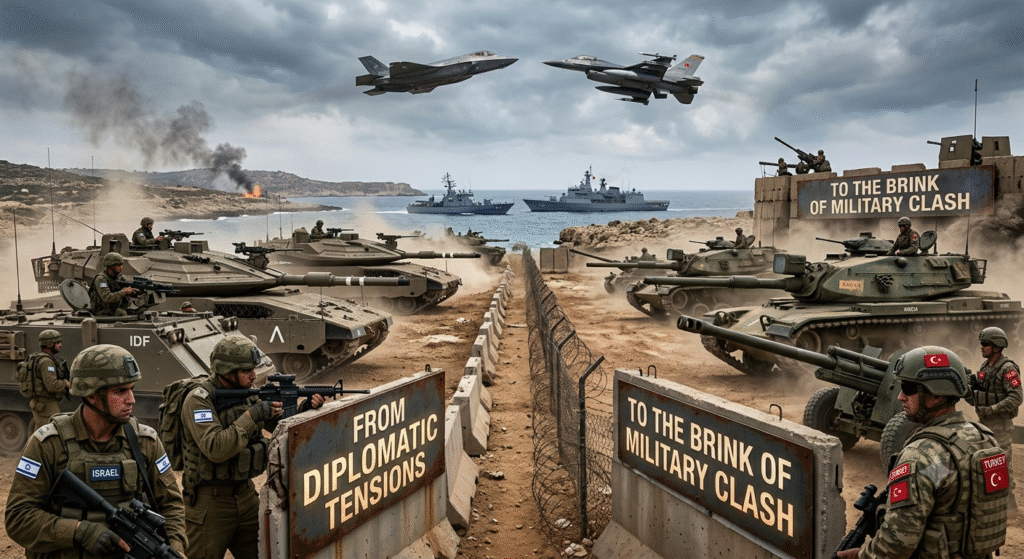
The past week has witnessed a dramatic escalation in the long-simmering rivalry between Israel and Turkey, pushing their relationship to a dangerous new low. A series of actions—including a controversial Israeli airstrike in Syria, Turkey’s request for an Interpol Red Notice against Prime Minister Benjamin Netanyahu, and a blistering exchange of rhetoric—has raised fears of a direct military confrontation between the two regional powers .
🛩️ The Flashpoint: A Strike in Syria
The immediate trigger for the crisis was an Israeli airstrike on August 18 targeting the Abu al-Duhur military airbase in northwestern Syria’s Idlib province, approximately 70 kilometers east of the Turkish border . The Israeli Prime Minister’s Office confirmed the strike, stating that Syria was on the “verge” of violating a security “status quo” by allowing Turkish troops to deploy at the base .
Israel claimed to have “repeatedly warned Syria” that such a deployment would pose a threat to its security, adding that “Syria chose to ignore these warnings” . The airbase is considered strategically vital, and reports indicate that a Turkish technical team may have been tasked with repairing the runway and control tower, though both Ankara and Damascus denied any permanent Turkish military presence at the base .
⚠️ A Narrow Escape from Conflict
The strike carried a significant risk of rapid escalation. Tom Barrack, the U.S. special envoy for Syria and Iraq and ambassador to Turkey, revealed that the attack “carried a real risk of rapid escalation into a direct military confrontation between Israel and Turkey, as well as Syria” . He explained that Turkish forces at the base were unaware of the Israeli aircraft’s intentions and “therefore could potentially have been inclined to scramble their own jets in the belief that they themselves were under attack” .
Barrack noted that “the lack of clear communication channels” between the states could have made the situation “much more serious” . He is now engaged in quiet talks to relaunch a deconfliction mechanism between Israel and Syria, with Turkey potentially invited as a direct or indirect participant .
⚖️ Turkey’s Legal Offensive: An Interpol Red Notice
In a move that escalated the confrontation from the battlefield to the legal arena, Turkey’s Ministry of Justice formally requested that Interpol issue a Red Notice for the international arrest of Prime Minister Benjamin Netanyahu and an Israeli soldier named Afek Moskovitch . The request stems from an arrest warrant issued on July 14 by an Istanbul court on charges of “genocide” and “crimes against humanity” .
The charges relate to the interception in international waters of the Global Sumud Flotilla, which set sail from Turkey in May in an attempt to break Israel’s blockade of Gaza and deliver humanitarian aid . Israel intercepted the flotilla and deported all those on board. Turkish Justice Minister Akin Gurlek stated, “We reject outright that Netanyahu’s government is immune from accountability. We will not allow the crimes committed in Gaza to go unpunished” .
🔥 A War of Words and Nationalist Posturing
The tit-for-tat actions have been accompanied by some of the harshest rhetoric between the two countries in years.
- Israeli Defense Minister Israel Katz directly attacked President Erdogan, accusing him of “dragging Turkey into dangerous adventures in Syria” and warned that Israel would not allow any entity to threaten its security .
- Netanyahu’s office dismissed Turkey’s legal move as a “pathetic attempt” to intimidate Israeli leaders and soldiers, calling Erdogan an “antisemitic dictator” who is trying to “extend his aggression against Israel into Syria” .
- An opinion piece in Israel Hayom described Erdogan’s policies as “madly ferocious” and warned that without drawing concrete red lines, Israel could find itself facing “Turkish tanks on the Golan Heights and Turkish frigates off the coast of Caesarea” .
🧩 The Broader Geopolitical Context
The current crisis is rooted in a fundamental shift in the Middle East’s security architecture. With Iran’s regional influence waning, Turkey is increasingly positioning itself as a dominant Sunni power, challenging Israel’s strategic depth. Ankara’s expanding military footprint in Syria, its deepening alliance with Qatar, and its hosting of Hamas leaders have all been sources of deep concern for Israel’s security establishment .
The Nagel Commission, an Israeli security body, recently warned that the “threat from Syria could evolve into something even more dangerous than the Iranian threat” . Israel views any Turkish military presence in Syria, particularly with advanced radar or air defense systems, as a direct challenge to its freedom of operation in the region.
📉 Conclusion: A Relationship at Its Lowest Ebb
The past week has exposed a dangerous truth: the once-strategic relationship between Israel and Turkey has devolved into a direct and bitter confrontation. With no functioning deconfliction channel and both sides engaging in provocative actions and rhetoric, the risk of miscalculation is high . The U.S. is scrambling to lower tensions, but as the crisis deepens, the region is left watching closely to see if the two powers can pull back from the brink or if this week’s actions are a prelude to a much wider and more destructive conflict.
