

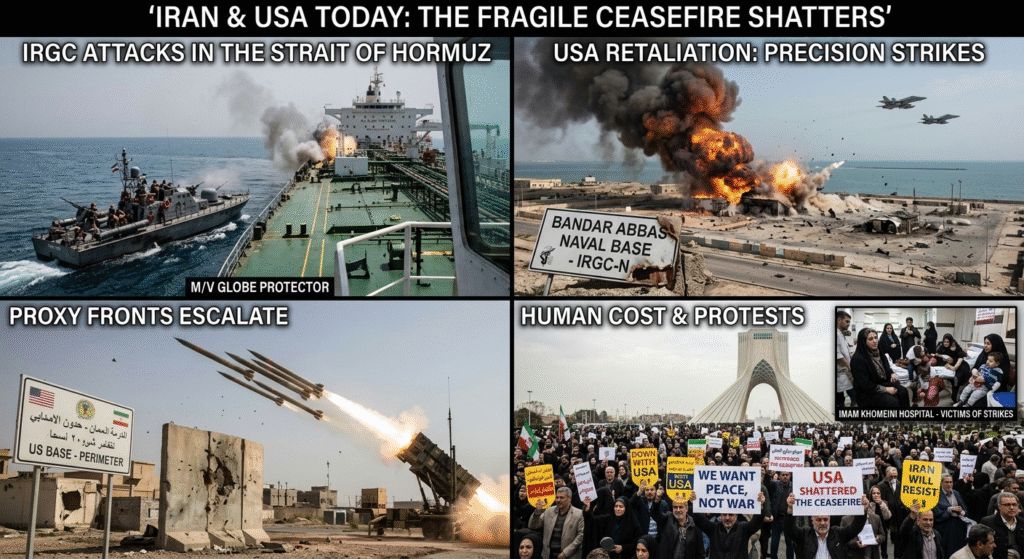
July 19, 2026
The ceasefire that was supposed to be the foundation for peace between Washington and Tehran has effectively collapsed. Just weeks after the signing of a historic Memorandum of Understanding, the United States and Iran are locked in a cycle of airstrikes, retaliation, and mutual recrimination. As the Strait of Hormuz is once again closed to much of the world’s shipping, the region stands on the precipice of a wider conflict.
The Deal Unravels: Suspension of Commitments
The most decisive blow to the agreement came on July 18, when Iran formally announced the suspension of its commitments under the Islamabad Memorandum of Understanding . Iranian Deputy Foreign Minister Kazem Gharibabadi stated that Tehran had “suspended the implementation of commitments” after accusing the United States of “violating its commitments” . “We are no longer fulfilling them and are now busy defending our country,” Gharibabadi declared .
Foreign Ministry Spokesman Esmaeil Baghaei echoed this, emphasizing that the agreement was based on the principle of “commitment for commitment” and that Iran could not be expected to uphold its side of the bargain while the U.S. failed to do the same . He specifically cited Washington’s launch of military operations before a 30-day period for restoring normal shipping could elapse as a key violation .
A Cycle of Military Escalation
The diplomatic collapse has been accompanied by a dramatic military escalation. According to the U.S. Central Command (CENTCOM), the U.S. has conducted airstrikes against Iran for seven consecutive nights, targeting “Iran’s monitoring sites, military logistics infrastructure, underground weapons depots, and naval combat capabilities” .
These strikes have focused heavily on Bandar Abbas, Iran’s largest port, and the strategically vital Qeshm Island inside the Strait of Hormuz . Reports indicate that attacks have damaged a power plant, a desalination facility, two tunnels, a bridge on the main highway leading to Bandar Abbas, and the train station in coastal Bandar Khamir . Iran has reported at least 50 people killed and more than 500 injured in U.S. airstrikes over the past three weeks .
Iran has responded by expanding its attacks beyond its borders. Tehran has targeted U.S. military facilities in Bahrain and Kuwait, including an air base in Jordan . Explosions were reported in Doha, Qatar, with a child injured by shrapnel . These attacks signal that Iran is prepared to escalate the confrontation across the region.
The Strategic Prize: Control of the Strait of Hormuz
At the heart of the current crisis is control over the Strait of Hormuz, the world’s most vital oil and gas shipping route. The renewed military escalation has once again largely halted traffic through the strait, pushing up global energy prices .
Iran has resumed its blockade, with the Islamic Revolutionary Guard Corps (IRGC) announcing the strait would remain closed “until further notice” . Tehran insists that it is only preventing ships from entering and leaving Iranian ports and not fully blockading the strait, but Washington has responded by blockading Iranian ports .
The U.S. has fired on and disabled an unladen tanker attempting to sail toward a blockaded Iranian port . President Donald Trump has warned of expanding airstrikes to hit Iranian bridges, power plants, and other critical infrastructure unless Tehran returns to the negotiating table .
Economic Warfare and New Sanctions
In tandem with the military campaign, the U.S. has reimposed severe economic pressure on Iran. The Treasury Department revoked a general license issued in June that had paused unilateral sanctions against Iran’s oil sector . The new license does not authorize any new transactions, including purchases or loading of Iranian oil, and mandates winding down all previously authorized activities until July 17 .
Washington has also imposed new sanctions on individuals and entities linked to Iran’s Supreme Leader and the Revolutionary Guard Corps . Iran has condemned these measures as a “clear violation” of the Memorandum of Understanding .
Diplomatic Channels Remain Open — Barely
Despite the escalation, both sides have left the door slightly ajar for diplomacy. Indirect talks between Iran and the U.S. through Qatari and Pakistani mediators recently concluded in Doha, focusing on the implementation of the MoU and the release of frozen Iranian assets .
However, the negotiations have been marred by controversy, with both sides offering starkly different accounts of who requested talks . While President Trump has stated he prefers a deal, he has warned that “we’re either going to make a deal or we’re going to finish the job” .
The current situation is deeply volatile. Experts warn both countries are engaging in a leverage contest, trying to improve their negotiating position through military pressure . Neither side seems to desire a full-scale war, but the continued cycle of attacks risks an uncontrolled escalation that could draw in the entire region.
