

TEHRAN — June 2, 2026
At 1:35 AM local time, air defense systems in northern Israel were scrambling to intercept projectiles fired from Lebanon—a stark reminder that the ceasefire President Donald Trump claimed to have brokered with Hezbollah is, at best, fragile. And at the heart of this volatility sits Iran, watching, waiting, and holding the region’s breath.
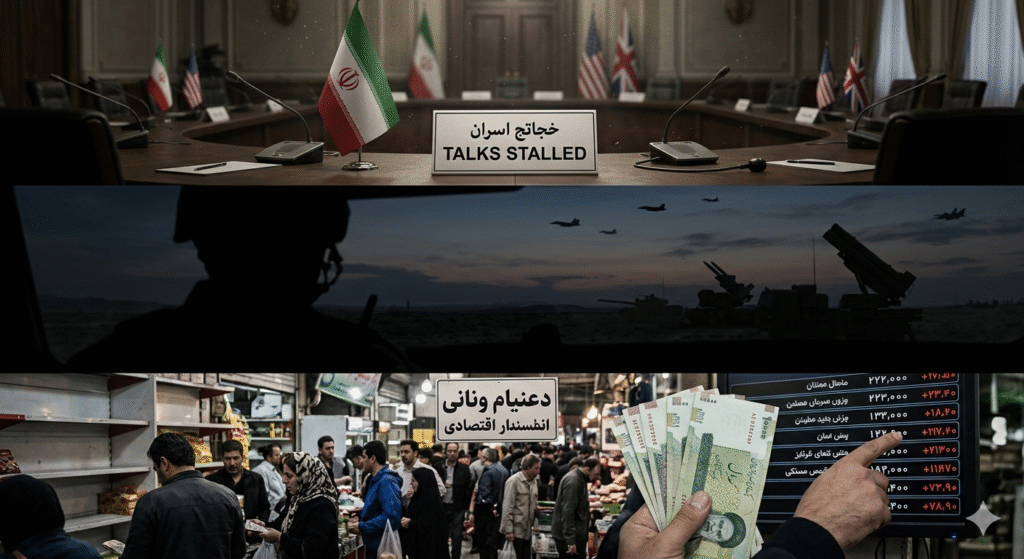
Today, the Islamic Republic finds itself at a crossroads of unprecedented pressure. On one front, negotiations with the United States over a preliminary memorandum of understanding have ground to a halt. On another, the Iranian rial continues its freefall, inflation has topped 60 percent, and protests that began in December have spread to all 31 provinces. And looming over everything is the threat of a renewed military confrontation with Israel and the United States.
This is Iran today—a nation caught between diplomatic necessity and ideological defiance, between economic collapse and military brinkmanship, between a population demanding change and a leadership determined to survive.
Part 1: Talks Suspended as Iran Protests Israeli Attacks
The most significant development in the past 48 hours has been Iran’s decision to suspend message exchanges with the United States. According to a source close to the Iranian negotiating team speaking to the semi-official Fars News Agency, communications between Tehran and Washington regarding a preliminary memorandum of understanding have been halted for “at least several days now”.
The reason? Israeli military operations in Lebanon.
Iran’s Parliament Speaker Mohammad Bagher Qalibaf made Tehran’s position explicit during a phone call with Lebanese Parliament Speaker Nabih Berri on Monday. According to Fars, Qalibaf warned that if Israeli “crimes” against Lebanon continue, Tehran would not only suspend the negotiation process but also “stand against” Israel.
The IRGC-linked Tasnim news agency went further, reporting that Iran and what it calls its “resistance front” will look to completely block the Strait of Hormuz—a chokepoint through which approximately 20 percent of the world’s oil passes. It also threatened to “activate” other fronts, including the Bab el-Mandeb Strait off the coast of Yemen, where Iran’s Houthi allies have previously targeted shipping.
The suspension of talks comes despite President Trump’s public optimism. On Monday, Trump wrote on Truth Social that negotiations were “continuing, at a rapid pace, with the Islamic Republic of Iran”. Hours later, Iranian sources were making clear that no meaningful discussions were taking place.
Part 2: The Final Text Remains Unanswered
Behind the public posturing, the diplomatic reality is one of cautious review. According to a source close to the Iranian negotiating team speaking to Mehr News, Iran has not yet responded to a proposed final agreement with the United States aimed at ending the conflict between the two countries.
Discussions on the final text are continuing in Tehran, the source said, adding that Iran was reviewing the proposal “cautiously” because of what it sees as a history of U.S. non-compliance and longstanding mistrust.
The proposed agreement—details of which remain murky—would reportedly extend the ceasefire that took effect on April 8 and reopen the Strait of Hormuz. President Trump has stated that negotiations would conclude within the next week.
But Iranian officials have repeatedly emphasized that any agreement must be linked to a cessation of Israeli operations in Lebanon and Gaza. As Parliament Speaker Qalibaf put it, any deal reached between Tehran and Washington would require an end to attacks “across all fronts”.
Part 3: The Nuclear Question—Who Is Telling the Truth?
One of the most contentious issues in the negotiations is Iran’s nuclear program—and the dueling narratives emanating from Washington and Tehran could not be more different.
On Sunday, President Trump told his daughter-in-law Lara Trump in an interview on her Fox News show that Iran had agreed to forgo nuclear weapons. “The one guarantee that I have to have is that there will be no nuclear weapons. They’ve agreed to that, and it was very interesting,” he said.
Trump also took aim at media reports suggesting otherwise. “Fake News CNN said today, routinely, that my Iran Nuclear Deal doesn’t talk about Nuclear, when actually it states, very clearly, that Iran will not have a nuclear weapon,” he wrote on Truth Social. “In fact, that’s what most of the agreement is about”.
But Iranian officials have cast doubt on these assertions. Parliament Speaker Qalibaf, who also serves as Iran’s chief negotiator, struck a far more cautious tone on Sunday. “We will not approve any agreement until we are certain that the rights of the Iranian people have been upheld,” he said in a video broadcast on state television.
Foreign Minister Abbas Araghchi added that “until a clear conclusion is reached… everything that is being said now is speculation,” according to state TV.
The gap between the two sides remains wide. Iranian officials have repeatedly stated that during the current negotiations, the Iranian delegation is not even discussing Tehran’s nuclear program.
Part 4: ‘Free Fall’—The Economic Collapse
While diplomats haggle over texts and threats, ordinary Iranians are living through an economic catastrophe. U.S. Treasury Secretary Scott Bessent delivered a stark assessment on Thursday: “The Iranian economy and currency are in free fall”.
The numbers bear out this grim diagnosis. The Iranian rial halved in value between July 2024 and March 2025 and reached a record low in December 2025. Annual inflation has been above 30 percent for five consecutive years, and in 2025, food price inflation exceeded 70 percent.
The World Bank projects that Iran’s economy will shrink in both 2025 and 2026, with annual inflation rising toward 60 percent.
Bessent painted a picture of a state struggling to function. Iranian troops, he claimed, are not being paid. Police personnel are failing to report for duty. Operations at Kharg Island—Iran’s key oil export hub—have been disrupted.
The U.S. naval blockade, Bessent said, has reduced Iranian crude shipments to “record lows.” Washington is also moving to restrict Iranian airlines’ access to landing rights, refueling services, and ticket sales.
“Only a satisfactory outcome in negotiations will end the downward spiral,” Bessent warned.
Part 5: Protests Spread Across All 31 Provinces
The economic collapse has sparked the most extensive protests in Iran since the “Women, Life, Freedom” movement of 2022. Beginning on December 28, 2025, demonstrations spurred by Iran’s deteriorating economy and rising inflation have been held in all 31 of Iran’s provinces—including areas considered typically loyal to the state.
Human rights monitors report that between 36 and 45 people have been killed in the crackdown, with over 2,000 arrested. An internet blackout has also been reported.
Supreme Leader Ali Khamenei, now 86 years old, has adopted a dual approach: engagement for protesters, iron fist for “rioters.” He said the government would speak with protesters but that “rioters should be put in their place”.
In response to the protests, Iran’s central bank governor has been replaced, and a new system of subsidies to support households purchasing essential goods has been announced. Political groups previously allied to President Masoud Pezeshkian during his 2024 election campaign have called for “institutional and sustainable reforms” and the protection of the right to protest.
The protests represent a direct challenge to a regime that has long prided itself on its stability. As the UK Parliament’s House of Commons Library noted in a recent briefing, “despite recurrent protests, unified opposition to the Iranian regime has been largely absent and security forces have remained loyal to the state”—but the 2025-26 protests are widely regarded as the most extensive since 2022.
Part 6: The Revolutionary Guards Threaten ‘New Fronts’
As economic pressures mount at home, Iran’s military leadership is looking outward. The Islamic Revolutionary Guard Corps (IRGC) threatened on Monday to open “new fronts” in the conflict with Israel and keep the Strait of Hormuz closed.
“Iran considers crossing the red lines in Lebanon and Gaza to mean direct war,” state TV quoted the Guards’ intelligence organization as saying. The statement added that Iran is “determined to carry out defensive operations by taking meaningful actions and opening new fronts”.
The IRGC’s intelligence arm also announced that the probability of the ceasefire between Iran and the United States ending is “high” if Israeli attacks on Lebanon do not stop.
These threats are not merely rhetorical. In January 2026, U.S. forces intercepted the Bella 1 ship (renamed ‘Marinera’), which was accused of being part of a “shadow fleet” carrying sanctioned oil for Venezuela, Russia, and Iran—with UK support. The capture of Venezuelan President Nicolás Maduro by the United States in January also poses a challenge to Iran’s economy, as the two nations have long-established economic ties to offset sanctions.
Part 7: U.S. Sanctions Intensify
The United States is not relying solely on naval power to pressure Iran. On Friday, the U.S. Treasury announced new sanctions targeting Iran’s Persian Gulf Strait Authority (PGSA), with Secretary Bessent warning companies and governments against paying tolls or disguising such payments as aid transfers.
The State Department is simultaneously sanctioning “numerous entities, individuals, and vessels that form the backbone of Iran’s illicit oil economy, directly targeting the financial lifelines of the Islamic Revolutionary Guard Corps (IRGC) and Iran’s military apparatus”.
Eight entities have been designated, and eight vessels identified as blocked property for their transportation of Iranian petroleum or petrochemical products. Three additional entities and an individual have been sanctioned in connection with trade in Iranian-origin petrochemical products.
The Treasury Department is also sanctioning “key players in an oil sales network that has moved tens of millions of barrels of Iranian oil worth billions of dollars,” according to the official announcement. These Hong Kong-based entities have “facilitated the storage, transport, and sale of this oil, directly funding the IRGC, Iran’s Armed Forces General Staff, and its military apparatus”.
Additionally, the Rewards for Justice (RFJ) program is offering a reward of up to $15 million for information leading to the disruption of the financial mechanisms of Iran’s IRGC and its various branches.
Part 8: The Regional Landscape—A Weakened ‘Axis of Resistance’
Iran’s position in the region has deteriorated significantly over the past two years. Between 2023 and 2025, Iran’s regional military position has weakened, with the loss of a significant ally in Syria’s Bashar al-Assad and extensive damage to Iran’s nuclear program and defenses from US and Israeli strikes.
Iran-backed groups across the Middle East are under unprecedented pressure:
Hamas in Gaza: Under the October 2025 agreement, Hamas is to disarm and not wield power in Gaza. However, Hamas has not committed to disarm, citing Israel’s continuing presence and lack of progress on Palestinian statehood.
Hezbollah in Lebanon: Under the 1989 Taif Accords and subsequent UN Security Council resolutions, Hezbollah is to disarm. The Lebanese Armed Forces have been extending their control over Hezbollah-controlled parts of south Lebanon, but the process is not complete. Israel has continued to conduct strikes against Hezbollah in 2026.
Popular Mobilisation Forces in Iraq: In 2025, the US said there was an “urgency” in disarming the Iran-backed PMF. Iraqi politicians have suggested any disarmament can only occur after US troop withdrawal in September 2026.
Houthis in Yemen: The Houthis remain the exception, having retained power and influence over the majority of Yemen despite US, UK, and Israeli strikes between 2023 and 2025.
Part 9: The Leadership Question
Adding to Iran’s instability is the question of succession. Supreme Leader Ali Khamenei is 86 years old, and debate continues on candidates who could succeed him.
The regime’s stability depends heavily on Khamenei’s continued leadership. His death or incapacitation would trigger a succession crisis that could plunge Iran into internal turmoil at precisely the moment it faces maximum external pressure.
Analysts note that even if the regime were to fall, there exists a range of possible outcomes “including further clerical or military rule, as well as democracy”. The path forward is anything but certain.
Part 10: Oil Prices and Global Markets
The uncertainty surrounding Iran has real-world consequences for the global economy. Oil prices jumped more than five percent on Monday as the Middle East peace talks stumbled and tensions mounted between Iran and the United States.
An Iranian news agency announcement that Tehran had suspended negotiations with the United States via mediators sent crude futures shooting higher. The Strait of Hormuz, which Iran has blockaded since the war began, remains largely shut—a situation that has kept global energy markets on edge.
President Trump has said that reopening the Hormuz shipping lane is one of his top priorities in the negotiations. But as long as Israeli operations in Lebanon continue, Iran shows no sign of relenting.
Looking Ahead: What the Rest of 2026 Holds
As June 2026 begins, Iran stands at a precipice. The coming days and weeks will determine whether the nation moves toward de-escalation or deeper conflict.
If negotiations resume and a memorandum of understanding is reached, the Strait of Hormuz could reopen, sanctions could ease, and Iran’s economy could begin a painful but necessary recovery. But the political cost to Iran’s leadership would be high—requiring concessions on the nuclear program and, potentially, a reduced role for Iran-backed groups across the region.
If negotiations remain stalled and Israeli operations in Lebanon continue, the IRGC has made clear it will escalate. “New fronts” could open. The Strait of Hormuz could remain blocked indefinitely. And the United States has warned that if Iran begins to re-establish its nuclear programs, “we’re going to have to knock them down”.
For ordinary Iranians, the calculus is different. They are living through an economic collapse that shows no signs of abating. Their currency is worthless. Their food prices are skyrocketing. Their children are protesting in the streets—and being arrested or killed for doing so.
As one analyst put it, “Only a satisfactory outcome in negotiations will end the downward spiral”. But for a regime that has built its legitimacy on resistance to the West, “satisfactory” is a word that carries heavy weight.
The world watches. Iran waits. And the region holds its breath.
