

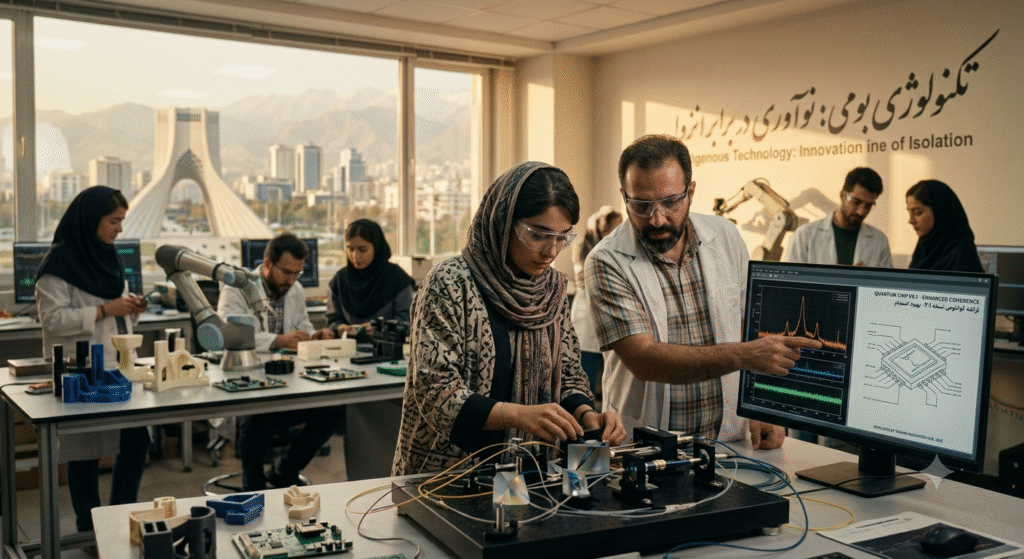
Iran’s technology sector presents a study in stark contrasts. On one side lies a story of remarkable resilience—a startup ecosystem that has flourished despite crippling sanctions, a space program launching satellites into orbit, and a nation ranking among the world’s top nations in artificial intelligence knowledge creation. On the other lies a story of state control, pervasive censorship, and a digital isolation strategy that has cut off millions from the global internet .
As of June 2026, Iran is a nation simultaneously building a “National Information Network” to shield its citizens from the outside world while aggressively developing AI, space technology, and domestic manufacturing capabilities to ensure survival in a hostile geopolitical environment.
Part 1: The Startup Paradox — Growth Amid Sanctions
Despite unilateral sanctions and economic headwinds, Iran’s startup ecosystem has grown into one of West Asia’s most structured innovation networks. The country is home to more than 6,000 startups across diverse sectors, with over 4,500 officially registered knowledge-based companies . Iran hosts more than 45 Science and Technology Parks, 600 Innovation and Growth Centers, and numerous innovation factories .
Tehran’s position in the Global Startup Ecosystem Index advanced by 20 spots in 2026, ranking 348 among the world’s most innovative cities. The city has approximately one startup per 100,000 people, with an annual growth rate of over 36 percent in 2025 . Fintech leads Iran’s startup industry, ranking 72nd globally and 5th in the Middle East, with 23 startups representing 19 percent of all startups in Iran .
Flagship companies serve as evidence of the sector’s potential:
- Digikala, Iran’s answer to Amazon, serves more than 30 million users
- Snapp!, the Iranian ride-hailing platform, also serves over 30 million users
- MCI Ventures, Iran’s first mobile operator, has become a key driver of the innovation ecosystem
The ecosystem has demonstrated exceptional growth, recording a +54.4 percent growth rate over the past year . At the heart of this ecosystem is the Pardis Technology Park, east of Tehran, which bills itself as the “Silicon Valley of the Islamic World,” offering infrastructure, legal support, and preferential taxation for high-tech firms .
Part 2: Artificial Intelligence — A Scientific Powerhouse
Iran’s artificial intelligence sector is a story of both scientific achievement and infrastructure vulnerability. The country ranks among the world’s top 12 to 14 nations in AI knowledge creation, according to the Vice President for Science, Technology, and Knowledge-Based Economy . According to Nature Index, Iran’s ranking in scientific production in AI has improved from 33 to 30, placing the country among the top 50 leaders globally .
Iran’s participation in open-source AI projects has surged from almost zero in 2010 to 2,728 projects in 2023, representing 1.1 percent of global open-source AI projects and placing Iran second in the region . In high-impact open-source AI projects, Iran accounts for six percent of the total projects, also ranking second behind Turkey .
However, the AI infrastructure has proven vulnerable. The national AI platform was damaged during US-Israeli attacks against the country . The government is now rebuilding it with “a more resilient approach,” preserving the platform’s core while developing a strategy that “benefits from the capabilities of private sectors” . A major investment has been made to expand the country’s processing capacity, creating the foundation for stronger AI infrastructure .
The Ministry of Science, Research, and Technology plans to launch 15 artificial intelligence laboratories at universities across the country to develop and test fundamental AI models, with reference labs to be set up at top universities . An AI action plan has been finalized, focusing on transformation in education, empowering research and innovation, promoting and commercializing AI, expanding international cooperation, and improving Iran’s scientific standing .
Part 3: Space Technology — Pars 2 and the Radar Satellite
Iran’s space program continues to advance despite international skepticism. Minister of Communications and Information Technology Sattar Hashemi announced that preparations for the launch of the Pars 2 satellite have reached an advanced stage, with work underway to complete the technical requirements for the launch .
The head of the Iranian Space Agency, Hassan Salarieh, confirmed that Iran is preparing to unveil its first domestically produced radar satellite, in addition to continuing development of the Pars 3 imaging satellite and the Rad 2 radar satellite . Improved versions of the Nahid 2 and Nahid 3 satellites are also in development .
Part 4: Internet Control — The “Stealth Blackout” and Economic Cost
The most significant technological development in Iran over the past six months has been the nation’s aggressive move toward digital isolation. Starting January 8, 2026, Iran imposed a near-total internet blackout that largely cut the country off from the outside world during a violent crackdown on anti-government protests .
Unlike traditional shutdowns where international links are severed, this blackout preserved Iran’s global routing presence while isolating domestic users through deep packet inspection, aggressive throttling, and selective protocol blocking. This represents what experts call a “censorship-in-depth” model: multiple orthogonal filters working simultaneously on the same traffic .
The economic toll has been staggering. Each day of the January shutdown cost the Iranian economy an estimated $36 million — an extraordinary price for a system that fails to deliver complete digital control . Online sales dropped approximately 80 percent, and the Tehran Stock Exchange shed about 450,000 points over four days . Iranian small businesses reported being unable to operate, with one Tehran travel agency “losing most of its income” and laying off staff as bookings and payments failed under prolonged restrictions .
The blackout was followed by a second shutdown on February 28 when hostilities with Israel and the United States escalated. Cloudflare Radar confirmed traffic in Iran dropped to nearly zero, indicating a fresh, state-enforced blackout . Even during partial restoration, connectivity recovered only to 50-60 percent of normal levels, with VPNs working unpredictably and inconsistently across cities .
A “two-tier internet” has emerged: connectivity for the state, darkness for the people. Authorities have issued so-called “White SIM cards” providing uncensored access to the global internet for individuals close to the government, while the broader population remains disconnected .
Part 5: The National Information Network — An Incomplete Digital Cage
The centerpiece of Iran’s digital strategy, the National Information Network (NIN), has been in development for two decades but remains only 60 percent operational . First conceptualized in 2005, the NIN was positioned as a way to protect Iranian digital sovereignty. In practice, it has been weaponized to restrict access to information and curb dissent .
Its limitations were starkly exposed during the July 2025 “twelve day war” with Israel, when Iran was hit with over 20,000 cyberattacks, including against applications housed on the domestic network. Even state-controlled banks operating on domestic platforms were breached, resulting in service outages and massive data leaks .
Minister Hashemi acknowledged that domestic platforms can only function in the short term without a stable connection to the global internet . The regime has therefore resorted to aggressive countermeasures against circumvention tools, deploying military-grade jammers to disrupt Starlink and dispatching security forces to locate and confiscate satellite dishes .
Despite the blackout, information about the demonstrations reached international audiences, proving that the NIN neither insulated Tehran from international attention nor extinguished calls for change .
Part 6: Oil and Manufacturing — Technology for Self-Sufficiency
One sector where the state’s “resistance economy” has achieved genuine success is domestic manufacturing, particularly in the oil and gas industry. Iran has effectively localized over 7,200 unique parts through collaboration with domestic manufacturers in its drilling industry alone .
More than 1,700 new technology-based firms are now working with Iran’s petrochemical industry, with more than 120 trillion rials allocated last year to expand these capabilities . The CEO of the National Iranian Drilling Company confirmed that the construction of the third domestically built drilling rig resulted in savings of $7 million .
Iran is also pursuing energy cooperation internationally, with officials noting that Iranian specialists possess expertise in many fields that can be shared with Russian counterparts, while Iranian firms stand to benefit from Russian technologies in key areas . The knowledge-based economy has grown from a tiny fraction of GDP to approximately three percent, reflecting the sector’s increasing importance .
Part 7: International Cooperation — Vietnam and the Gulf Digital Ecosystem
Despite sanctions, Iran is finding partners for technology cooperation. Vietnam is stepping up cooperation with Iran in ICT, artificial intelligence, and nanotechnology, with Iranian Minister Hashemi highlighting “Iran’s significant role in the Gulf region’s digital ecosystem” . Hashemi noted that major telecommunications operators and digital service platforms such as Snapp! and Digikala generate rich data resources that are crucial for the development of AI applications .
The Iranian ICT Research Institute has discussed potential cooperation with Vietnam in AI, cybersecurity, quantum technology, and telecommunications .
Conclusion: Iran’s Technological Paradox
Iran’s technology sector today is a battlefield between innovation and control. The Islamic Republic has built one of West Asia’s most sophisticated innovation ecosystems, trained thousands of engineers and scientists, and ranked among the world’s top nations in AI knowledge creation. Yet it has also built a digital cage designed to isolate its citizens from the world—a cage that cannot be completed, cannot be afforded, and may ultimately be unsustainable.
The National Information Network remains incomplete. The economic cost of each shutdown is staggering. The regime’s escalating campaign against Starlink and VPNs reflects underlying insecurity rather than strength. And as the January 2026 protests demonstrated, even a total blackout cannot extinguish dissent.
For the Iranian people, technology offers both a path to the future and a reminder of their isolation. The startups continue to grow, the AI labs are being established, and the satellites are being launched—but for millions of ordinary Iranians, the daily reality is one of throttled connectivity, inaccessible platforms, and the constant fear that the next blackout will cut them off entirely.
As one analyst put it, “the Islamic Republic is racing to build a digital cage that it can barely afford and may never fully complete” . Whether that cage becomes Iran’s future or its undoing will be determined not by technology, but by the choices of those who wield it.
