

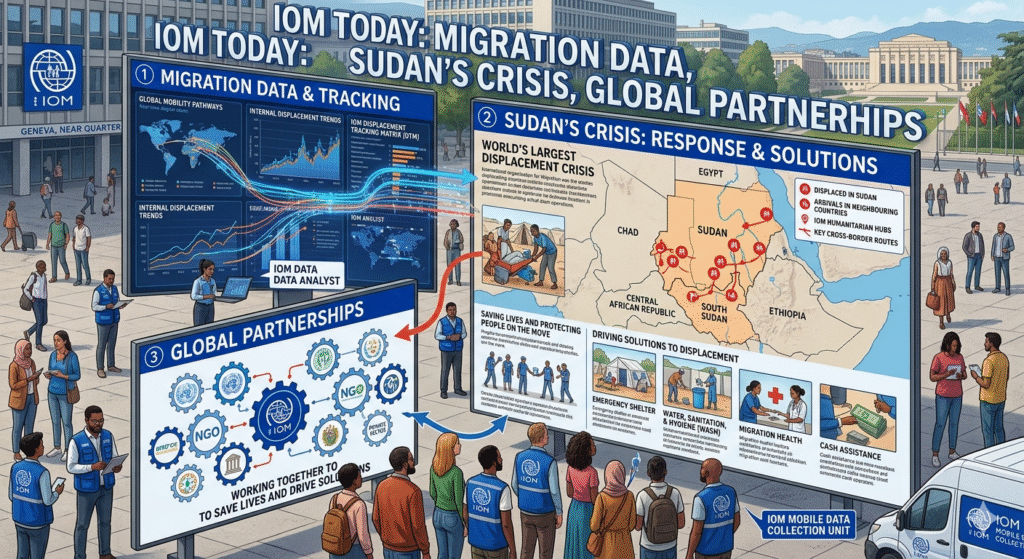
April 2026 has emerged as a pivotal month for the International Organization for Migration (IOM). From the release of harrowing global migration data to urgent warnings about Sudan’s fragile returnee crisis and new strategic partnerships, the UN migration agency is operating at full throttle across multiple continents. This article examines the state of IOM today across six key dimensions of its work.
Part 1: The Missing Migrants Report – 8,000 Dead or Disappeared in 2025
On April 21, 2026, IOM released data showing that nearly 8,000 migrants were reported dead or missing worldwide during migration attempts in 2025 . This brings the total number of recorded migrant deaths and disappearances since 2014 to more than 82,000 .
Behind each statistic is a human story. IOM noted that at least 340,000 family members have been directly affected by these tragedies . The Mediterranean route remains particularly deadly, with IOM warning that 2026 is already shaping up to be among the deadliest years on that route since records began .
Speaking at the UN press briefing in Geneva, Maria Moita, IOM Director of the Department of Humanitarian Response and Recovery, presented alongside the families report, emphasizing that despite declines in arrivals in some regions, risks remain extremely high along increasingly dangerous migration routes .
UN Spokesperson Stéphane Dujarric underscored the urgency: “The International Organization for Migration today released new data showing that nearly 8,000 migrants, 8,000 human beings, were reported dead or missing worldwide in 2025” . He noted that migration routes are shifting due to conflict, climate pressures, and political changes, rather than becoming safer .
Ahead of the International Migration Review Forum scheduled for May 2026, IOM is calling for renewed commitments to protect migrants, prevent deaths and disappearances, and better support families affected by migration tragedies .
Part 2: Sudan – 4 Million Returnees at Risk Amid Fragile Conditions
Perhaps the most immediate humanitarian crisis IOM is addressing today is in Sudan. Three years since the civil war erupted in April 2023, the agency has warned that nearly 4 million people have voluntarily returned to their places of origin, particularly to Al Jazirah and Khartoum states .
However, these returns are unfolding amid catastrophic conditions. Damaged water systems, electricity networks, health facilities, and housing continue to complicate recovery efforts . Speaking from Khartoum during a hybrid press briefing on April 21, IOM Deputy Director General for Management and Reform, SungAh Lee, described the stark reality returnees face .
“For many people, returning home should mark the beginning of recovery. Instead, too often it means confronting destroyed services, damaged homes and new uncertainty,” Lee said . “People need access to basic services, safe housing and ways to restore their livelihoods. Without that support, safe and dignified returns become much harder to sustain” .
Lee explained the multiple drivers pushing Sudanese to return: “Many were returning because they believed security had improved. Others returned because life in displacement had become unbearable, because of economic pressures, to reunite with families, or because conditions in neighbouring countries were increasingly hard” .
At the height of the conflict, nearly 12 million people fled heavily affected areas, while more than 4 million crossed into neighboring countries . Today, nearly 9 million people remain internally displaced .
IOM has reached over 4 million people in Sudan with lifesaving humanitarian aid since 2023 . But the 2026 Sudan Crisis Response Plan, which seeks $170 million, remains underfunded by $97.2 million . More than 2 million additional people are expected to voluntarily return to Khartoum alone this year .
Lee’s message was clear: “This was a pivotal moment for Sudan… With sustained partnership, coordinated action, and adequate resources, return movements could become a pathway toward recovery and stability, not the beginning of another crisis” .
Part 3: Displacement Tracking Matrix – Data Driving Response
IOM’s Displacement Tracking Matrix (DTM), operational in over 100 countries since 2004, continues to provide critical data on human mobility worldwide . The February 2026 edition of the DTM Insight report highlighted key trends across multiple regions.
In Ukraine and Haiti, DTM data is examining progress towards stability under IOM’s “Delivering Solutions” priority . In Asia and the Pacific, and Europe, data is tracking evolving migration patterns under “Regular Pathways” .
On the ground, DTM flow monitoring continues to capture real-time movements. In Niger, IOM observed 330,414 individuals at nine flow monitoring points in January 2026, representing a 26 percent decrease compared to December 2025 . Of those movements, 34 percent entered the country, 20 percent moved internally, and 46 percent left .
In Lebanon, between February 3 and February 11, 2026, IOM recorded 228,742 movements across official border crossing points and unofficial crossing areas . Air travel accounted for over 57 percent of movements, land travel for 42 percent, and sea travel for one percent .
This data is not merely academic—it informs humanitarian response, guides resource allocation, and helps identify vulnerable populations before crises escalate.
Part 4: Ghana – Strengthening Emergency Response Capacity
On April 23, 2026, IOM Ghana, with funding from the European Union, handed over critical emergency response equipment to Ghana’s National Disaster Management Organization (NADMO) . The equipment included surveillance drones, tablets, laptops, routers, printers, and a 20-kilowatt backup power system .
The technology will support Emergency Operations Centres in three regions: Upper East, Upper West, and Greater Accra . The handover followed an intensive training programme that equipped NADMO personnel with skills in emergency preparedness, data management, contingency planning, and psychosocial support for disaster victims .
“The combination of targeted training and the provision of this equipment marks a significant step forward in strengthening our operational readiness,” said Major (Rtd) Dr. Joseph Bikanyi Kuyon, Director-General of NADMO .
Ghana faces multiple climate-related risks: erratic rainfall, coastal and riverine flooding, land degradation in the north, and rising internal displacement driven by both conflict and environmental stress . The drones will provide real-time aerial reconnaissance during active disasters, while the backup power system ensures operations continue when the grid fails .
Fatou Diallo Ndiaye, IOM Ghana Chief of Mission, emphasized the broader commitment: “This handover will help save lives when disaster strikes, but our commitment doesn’t end there. Alongside Ghana’s government, we are working to address the deeper drivers of displacement: climate pressure, degraded livelihoods, and communities running out of options” .
The initiative is part of the “A Ghanaian-European Safe and Prosperous People’s Mobility Project on Migration Governance” (ATUU), funded by the European Union .
Part 5: Australia – A Strategic Partnership Renewed
On March 18, 2026, IOM and the Government of Australia signed a Strategic Partnership Framework for 2026–2030, renewing their long-standing collaboration . Australia has been a trusted IOM partner since its role as a founding Member State of the organization .
“Australia has long been a trusted partner to IOM and to migrants and communities across the region,” said IOM Director General Amy Pope . “As displacement rises and migration grows more complex, partnerships like this matter more than ever. Together, we are advancing practical solutions that protect people, strengthen resilience and ensure migration works for everyone” .
The agreement focuses on six shared priorities: supporting effective responses to humanitarian crises; driving solutions to displacement and increasing resilience; facilitating safe, orderly and regular migration; delivering efficient, evidence-based and needs-based programmes; advancing gender equality, disability and social inclusion for all migrants; and strengthening the UN system and advancing multilateral cooperation .
The ceremony was attended by Australian Ambassador and Permanent Representative to the United Nations, H.E. Clare Walsh, and IOM Director General Amy Pope in Geneva .
Part 6: The Strategic Framework – IOM’s Three Priorities
All of IOM’s current work is structured around the IOM Strategic Plan (2024-2028), which organizes activities under three key priorities: saving lives, delivering solutions, and facilitating regular migration pathways .
Under “Saving Lives,” IOM tracks cross-border mobility trends and migrant deaths, as highlighted in the Missing Migrants report. Under “Delivering Solutions,” the agency examines progress towards stability for displaced populations, as seen in the Sudan and Ukraine responses. Under “Regular Pathways,” IOM tracks evolving migration patterns and works to create safe, legal routes for human mobility .
The DTM Insight report, published monthly, aligns data collection with this strategic framework, ensuring that evidence directly informs policy and programming .
Part 7: Looking Ahead – The International Migration Review Forum
With the International Migration Review Forum scheduled for May 2026, IOM is using the current moment to build momentum for renewed commitments from member states . The forum will provide a platform to assess progress on the Global Compact for Safe, Orderly and Regular Migration and to identify gaps requiring urgent attention.
IOM’s message is consistent: migration is not a problem to be solved but a reality to be managed. The agency’s work in Sudan, Ghana, Australia, and across global data systems demonstrates that effective migration governance requires a combination of humanitarian response, development programming, and strategic partnerships.
Conclusion: IOM at a Crossroads
IOM today is larger and more operationally diverse than at any point in its 75-year history. The agency is simultaneously tracking migrant deaths on the Mediterranean, supporting returnees in Sudanese villages that lack electricity, equipping Ghanaian disaster responders with drones, and negotiating strategic frameworks with founding member states.
The thread connecting these activities is the recognition that human mobility—whether forced by war, driven by climate, or chosen for opportunity—requires coordinated, evidence-based, and humane responses. As SungAh Lee said from Khartoum: “Displacement and return are not separate dynamics, but deeply interconnected realities that require coordinated responses across regions” .
The challenges are immense. An $97.2 million funding gap threatens IOM’s Sudan response. Migrant deaths continue to rise. Climate pressures intensify. But IOM’s April 2026 activities demonstrate an organization that is adapting, innovating, and refusing to look away from the human realities behind the statistics.