

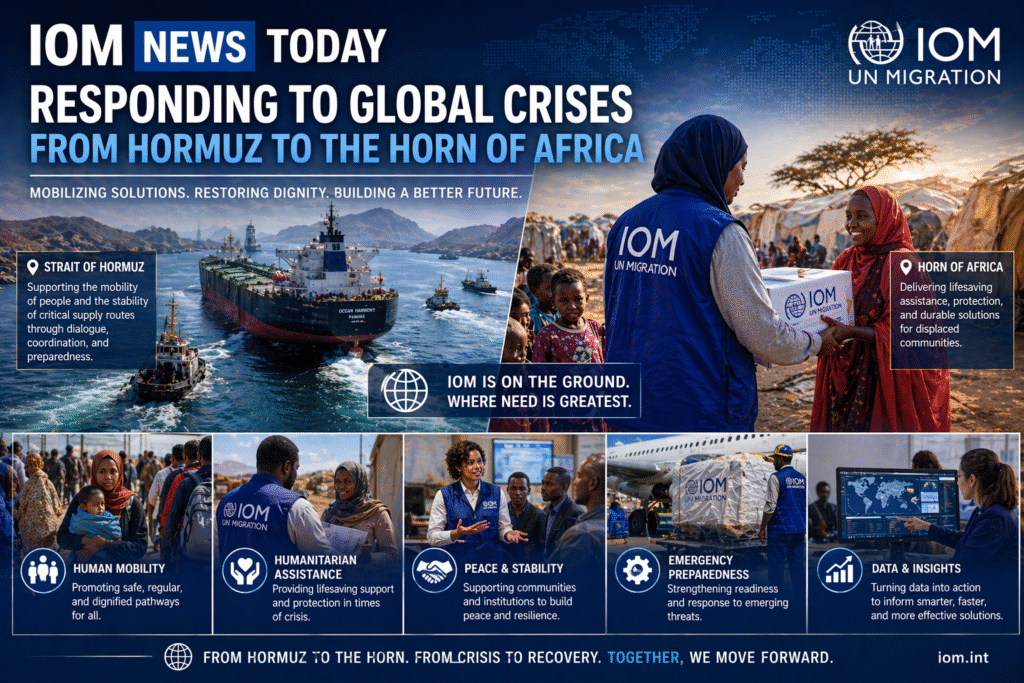
April 23, 2026 – The International Organization for Migration (IOM) finds itself at the epicenter of multiple, simultaneous global emergencies as spring 2026 unfolds. From the war-torn waters of the Persian Gulf to the drought-stricken plains of Somalia and the conflict zones of Ukraine, the UN migration agency is issuing urgent appeals, tracking record displacement, and calling for the protection of vulnerable populations. This article covers the major IOM news headlines today.
Part 1: IMO Chief Joins IOM’s Call for Seafarer Protection in the Gulf
In a significant show of inter-agency solidarity, the head of the International Maritime Organization (IMO) on Wednesday echoed long-standing IOM concerns about the safety of civilians caught in the escalating Middle East conflict. IMO Secretary-General Arsenio Dominguez called for an immediate halt to attacks on commercial vessels and warned of escalating risks to seafarers amid growing tensions in the region .
“The attacks on and seizures of commercial ships are unacceptable,” Dominguez said in a statement, urging that “these reckless actions” cease and that “any ships and innocent seafarers be released immediately” . The IMO chief’s comments come as IOM data continues to show the human toll of restricted maritime movement, particularly for migrant workers and seafarers stranded in conflict zones.
Describing the situation as “extremely volatile,” Dominguez questioned why companies continue to operate in high-risk waters. “I cannot understand why companies would take risks and endanger seafarers’ lives,” he said . According to the IMO, at least 26 incidents involving attacks on ships have been confirmed in the region as of April 22, resulting in 10 seafarer fatalities .
Most alarmingly for IOM, nearly 20,000 seafarers remain stranded after seven weeks, still uncertain when they will be able to return home . IOM has long advocated for the rights and safe return of all mobile populations, including maritime workers.
Tensions in the Strait of Hormuz have been rising since the United States on April 13 announced a blockade on vessels entering and leaving Iranian ports . The U.S. military said on Sunday it fired on an Iranian-flagged cargo ship, before boarding and taking control of the ship, while Iranian media reported that the Islamic Revolution Guard Corps had seized two vessels attempting to pass through the Strait without authorization . “De-escalation, meaningful actions and restoring the freedom of navigation are the only way forward,” Dominguez stated .
Part 2: Nearly 8,000 Migrants Died or Went Missing in 2025
In a sobering announcement that sets the stage for IOM’s 2026 operations, the organization revealed that nearly 8,000 migrants worldwide died or went missing during 2025. This brings the total number of deaths and missing cases documented by IOM’s Missing Migrants Project since 2014 to more than 82,000 .
The organization noted that at least 340,000 family members were directly affected by these losses, based on findings from its Displacement Tracking Matrix (DTM), its latest migration routes report, and analysis from the Missing Migrants Project . The data indicates that despite a decline in arrivals in some regions, migration routes have not become safer, but have instead shifted while risks remain high along journeys that have become increasingly dangerous .
IOM’s new migration routes report for 2025 explained that the decline in arrivals in certain areas does not reflect reduced migration pressure, but rather a shift in routes due to enforcement measures, conflict dynamics, and environmental pressures affecting existing pathways . This finding is critical for IOM’s humanitarian planning, as it requires the agency to constantly adapt its response to changing migration flows across Africa, Asia, and the Americas.
Part 3: $91 Million Appeal for the “Eastern Route” to Yemen
Responding directly to the deadly trends documented in its 2025 report, IOM has launched a massive $91 million funding campaign to address the escalating humanitarian crisis along migration routes in the Horn of Africa, focusing specifically on those traveling to and through Yemen . The 2026 Migrant Response Plan (MRP) seeks to provide life-saving assistance and protection to approximately 1.2 million migrants and members of host communities .
This appeal comes at a critical time as the “Eastern Route”—connecting Ethiopia and Somalia to the Gulf states via Yemen—remains one of the most dangerous and congested migration corridors in the world . Despite the ongoing conflict and deteriorating security conditions within Yemen, the influx of migrants has continued to surge. Recent IOM data indicates that in January 2026 alone, over 21,000 migrants were tracked entering Yemen, primarily through the coastal areas of Lahj and Shabwah .
Furthermore, 2025 was recorded as the deadliest year on the Eastern Route, with more than 900 migrants reported dead or missing due to shipwrecks and harsh desert conditions . While the flow remains predominantly male, there has been a significant increase in unaccompanied children and women who face heightened risks of human trafficking, abduction, and physical abuse .
The IOM, alongside 48 humanitarian partners, intends to use the $91 million to stabilize a region under immense pressure. The campaign’s priorities include providing food, clean water, and emergency medical care at Migration Response Centers in Yemen, Djibouti, and Somalia . Funds will also be allocated for psychological first aid, legal referrals, and specialized support for survivors of gender-based violence. Additionally, the initiative will facilitate the safe and dignified voluntary return of stranded migrants to their home countries and support host community infrastructure projects to reduce local tensions .
IOM Director General Amy Pope emphasized during the launch that the migration crisis in the region is fueled by a combination of climate change, instability, and extreme poverty. She stated that migration along these routes is a shared responsibility and that with sustained commitment, the international community can reduce suffering and strengthen resilience .
The organization warned that current funding levels fall far short of the actual needs, noting that without immediate support, critical shelters and medical clinics in transit countries risk closure, potentially leaving thousands of people stranded in active conflict zones without a safety net .
Part 4: Somalia – Drought and Displacement Projections
In the Horn of Africa, IOM Somalia’s Displacement Tracking Matrix (DTM), in collaboration with the Danish Refugee Council (DRC), has released movement projections for the second quarter of 2026 (April to June) . Although the Gu 2026 (April to June) seasonal outlook indicates normal to above normal rainfall, conditions across Somalia are expected to remain highly variable, with an elevated risk of dry spells and uneven rainfall distribution. These conditions are unlikely to offset cumulative drought impacts from previous seasons, prompting increased displacement .
As such, the Gu 2026 season should be viewed as a period of stabilization rather than recovery, underscoring the need for sustained drought response and close monitoring of mobility trends . The projections come on the heels of a devastating drought emergency that has significantly deepened. According to earlier IOM assessments, an estimated 4.61 million people have been affected by prolonged dry conditions across the country .
Between December 2025 and March 2026, over 211,000 individuals were projected to be displaced, with most (64%) displaced due to drought . The crisis is unfolding amid critical funding shortages. By the end of December 2025, the Humanitarian Needs and Response Plan had only been 26% funded, forcing agencies to scale back assistance despite rapidly rising needs .
Part 5: Asia-Pacific Pledges on Climate Mobility and Return
In a significant development for regional migration governance, the Asia-Pacific GCM Champion Countries agreed on two joint regional pledges ahead of the 2026 International Migration Review Forum (IMRF), to be held in New York from May 4-8, 2026 . The virtual session was chaired by Fiji’s Minister for Immigration, with coordination support provided by IOM, ESCAP, and the Asia Pacific UN Network on Migration .
All ten GCM Champion Countries from Asia and the Pacific participated: Azerbaijan, Bangladesh, Cambodia, Fiji, Indonesia, Nepal, the Philippines, Sri Lanka, Thailand, and Türkiye . The Champion Countries reaffirmed shared priorities from the Second Asia Pacific Regional Review of the GCM, including climate-responsive mobility; fair and ethical labor migration; protection of migrants in vulnerable situations; expanded regular pathways; stronger migration data and governance; and maximizing the benefits of migration for development .
A key outcome was agreement to advance two joint regional pledges for presentation at IMRF 2026: (1) the Asia Pacific Regional Pledge on Climate Mobility and (2) the Asia Pacific Regional Pledge on Safe, Dignified and Sustainable Return and Reintegration. Both pledges promote rights-based, gender-responsive and child-sensitive approaches .
Part 6: Ukraine Response – $200 Million Plan Amid Ongoing War
In Eastern Europe, IOM continues to address one of the world’s largest displacement crises. The Ukraine Crisis Response Plan 2026 requires $200 million to support 700,000 people targeted across the country . The response is structured around three key operating modalities: saving lives and protecting people on the move ($50 million), driving solutions to displacement ($133 million), and facilitating pathways for regular migration ($17 million) .
IOM’s blended model to support the response in Ukraine combines direct assistance with a strong network of trusted partners, ensuring agile, transparent, and compliant delivery. Bridging humanitarian relief, development, and peace efforts, IOM works closely with government and communities to provide sustainable, accountable support that strengthens resilience and recovery nationwide .
Across Ukraine and neighboring countries, IOM is providing essential household items, emergency shelter repair, heating supports, emergency health services, mental health and psychosocial support (MHPSS), and specialized protection services .
Part 7: Climate Mobility – Nature-based Solutions in the Pacific
Demonstrating IOM’s expanding focus on climate-induced migration, the organization’s Climate Mobility Innovation Lab, in partnership with the Pacific Community (SPC), launched a new framework exploring the role of Nature-based Solutions (NbS) in addressing climate mobility . A webinar held on March 31, 2026, brought together technical experts to share emerging evidence and practical approaches on how ecosystem-based solutions such as mangrove restoration and ecosystem protection can help reduce climate risks, strengthen resilience, and support communities facing climate-related mobility in the Pacific .
Part 8: The Funding Gap – A Persistent Challenge
A recurring theme across all IOM operations today is the funding shortfall. Whether in Somalia, where the 2025 Humanitarian Needs and Response Plan was only 26% funded, or along the Eastern Route, where the $91 million appeal faces an uncertain donor response, IOM is consistently forced to triage its assistance . The organization warns that without immediate support, critical shelters, medical clinics, and protection services risk closure, leaving millions of vulnerable people without a safety net .
Conclusion: IOM at the Crossroads
Today, IOM stands at the crossroads of multiple humanitarian emergencies. From the seafarers stranded in the Persian Gulf to the drought-displaced families in Somalia, from the migrants risking the Eastern Route to Yemen to the war-affected populations in Ukraine, the organization’s mandate has never been more urgent or more complex. As Director General Amy Pope has emphasized, migration is a shared responsibility. With sustained commitment from the international community, IOM can continue to reduce suffering, protect the vulnerable, and strengthen resilience across the world’s most dangerous migration corridors . But without adequate funding and political will, the human cost will continue to rise.
