

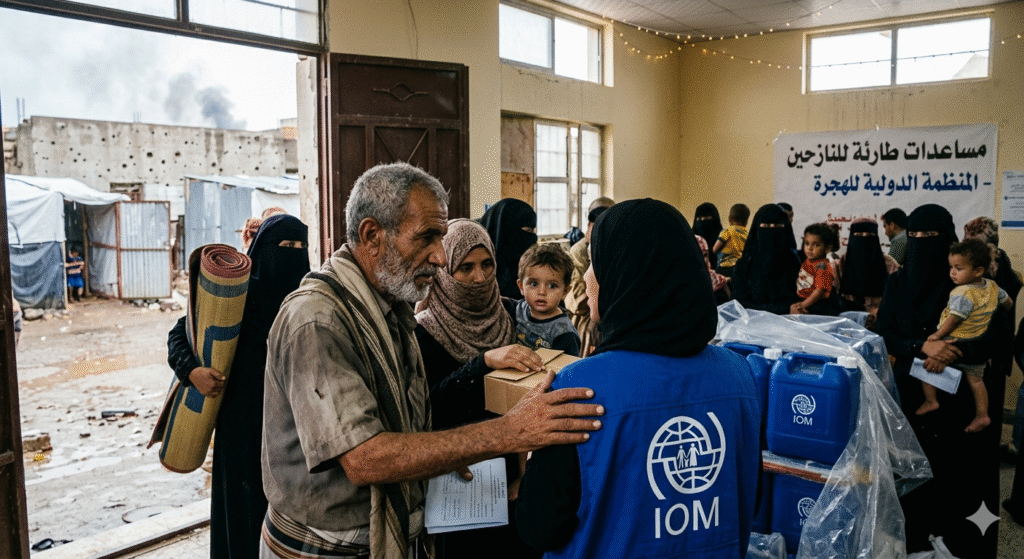
April 16, 2026 – In a country where over 22 million people require humanitarian assistance, the International Organization for Migration (IOM) has become an indispensable lifeline . Operating across one of the world’s most complex humanitarian emergencies, IOM Yemen is simultaneously responding to waves of internal displacement, supporting vulnerable migrants stranded along the perilous Eastern Route, rehabilitating critical water infrastructure, and laying the groundwork for long-term recovery. As Othman Belbeisi, IOM Regional Director for the Middle East and North Africa, concluded a field visit to Yemen in early April, his message was urgent: “Communities are resilient, but needs are immense” .
Part 1: The Scale of the Crisis – 22 Million in Need
Yemen’s humanitarian crisis, now in its second decade, shows no signs of abating. In 2026, over 22 million people require humanitarian assistance and protection services . This population includes:
- 5.2 million internally displaced persons (IDPs)
- 329,000 migrants, primarily from Ethiopia and Somalia
- 63,000 refugees and asylum seekers
- 10.95 million women and girls with specific protection needs
The drivers of this crisis are multiple and compounding: a decade of conflict has shattered the economy and public services; climate shocks, including devastating floods, have destroyed homes and infrastructure; and displacement continues to surge, with families fleeing renewed insecurity in eastern Yemen . As IOM Director General Amy Pope warned in January: “This surge in displacement is pushing already desperate communities to the brink. Without immediate and sustained aid, countless lives are at risk” .
Part 2: Internal Displacement – Tracking a Moving Crisis
IOM’s Displacement Tracking Matrix (DTM) is the backbone of Yemen’s humanitarian response. Through its Rapid Displacement Tracking tool, IOM collects daily data on households forced to flee, allowing for real-time reporting on displacement patterns, causes, and needs . Between January 18 and 24, 2026 alone, IOM tracked 58 households (348 individuals) displaced at least once. Since January 1, 402 households (2,412 individuals) have experienced displacement .
The causes of displacement reveal the complex nature of Yemen’s crisis. Safety and security concerns related to economic pressures accounted for 67 percent of displacements, while active conflict accounted for the remaining 33 percent . This economic dimension—collapsing livelihoods, hyperinflation, and inability to pay rent—is increasingly driving families from their homes, even in areas where active fighting has subsided.
In Ma’rib Governorate, which hosts some of Yemen’s largest displacement sites including Al Jufainah Camp (home to approximately 16,000 families), the situation is particularly acute . IOM has provided emergency assistance to more than 1,600 newly displaced families arriving in Ma’rib, many after days of movement under unsafe and exhausting conditions. Assistance includes shelter support, water and sanitation services, health care, and protection services . However, shortages of shelter materials, non-food items, and rapid response stocks continue to limit the scale-up of assistance .
Part 3: The Migrant Crisis – 329,000 Stranded on the Eastern Route
Yemen is not only a country of displacement but also a primary transit point for migrants from the Horn of Africa seeking to reach Gulf countries. In 2026, an estimated 329,000 migrants are present in Yemen, many stranded, vulnerable, and facing extreme risks .
The Eastern Route—connecting Ethiopia and Somalia to the Gulf states via Yemen—remains one of the most dangerous migration corridors in the world . In January 2026 alone, over 21,000 migrants were tracked entering Yemen, primarily through coastal areas of Lahj and Shabwah . The journey is brutal: migrants face violence, exploitation, hunger, dehydration, arbitrary detention, and abuse. In 2025, more than 900 migrants died or went missing on the Eastern Route—the deadliest year on record .
IOM operates Migrant Response Points (MRPs) and roving mobile teams across key locations in Yemen, providing essential information, direct assistance, accommodation, case management, and referrals to vulnerable and stranded migrants . Through its Voluntary Humanitarian Return (VHR) program, IOM enables stranded migrants to return home with safety and dignity . In Aden, IOM continues to provide protection and assistance to vulnerable migrants through its Migrant Response Points, while along the West Coast, rapid response teams deliver lifesaving aid to newly affected households .
To address this crisis at its source, IOM and 48 partners launched a USD 91 million appeal in February 2026 to support migrants along key African migration corridors . The 2026 Migrant Response Plan aims to deliver life-saving aid and protection services to approximately 1.2 million migrants and host community members, expand access to voluntary return and reintegration, and support community stabilization . As IOM Director General Amy Pope stated: “Migration along these routes is a shared responsibility. With sustained commitment, we can reduce suffering, strengthen resilience, and respond to this crisis with the coordination and humanity it demands” .
Part 4: Water Infrastructure – Rebuilding a Lifeline
One of IOM’s most impactful interventions in Yemen is the rehabilitation of water infrastructure. With roughly 17.8 million people struggling daily for safe water as of early 2026, access to clean water is a matter of life and death . IOM is implementing Cash-for-Work activities that simultaneously restore water systems and provide immediate income to vulnerable participants.
In Ma’rib, years of conflict and repeated displacement have damaged irrigation canals and strained farmland. In early 2026, over 1,600 newly displaced families added further pressure on water, land, and local infrastructure . IOM engaged 170 Cash-for-Work participants, including 50 women, to clear canals clogged with soil and debris across Al-Jaber, Al-Gharib, and Al-Mubarak in Al-Wadi District. Water now flows to previously parched fields, enabling farmers to irrigate crops and easing competition over scarce resources .
In southern Ta’iz, districts such as Al-Turbah and Al-Ma’afer face water scarcity compounded by high population density, displacement, and disrupted supply networks. IOM engaged 441 Cash-for-Work participants (131 women and 310 men) to build diversion barriers, dig water channels, and rehabilitate valve chambers and pipelines to capture and store rainwater more effectively .
Beyond these local interventions, the Mokha City Water Project is restoring access to clean water for over 120,000 people . As Abdusattor Esoev, IOM Chief of Mission in Yemen, explained: “Restoring water systems goes beyond fixing infrastructure—it directly supports families’ livelihoods and access to essential water in communities facing conflict, displacement, and competition over scarce resources” .
Part 5: Emergency Response – Floods and Rapid Shocks
Yemen’s vulnerability to climate shocks was starkly demonstrated in early April 2026, when flooding across the country displaced thousands of families and damaged critical infrastructure . On the West Coast alone, more than 500 flood-affected households received emergency assistance from IOM . Across the country, rapid response teams are delivering lifesaving aid to newly affected households, providing emergency shelter, clean water, healthcare, and protection services .
IOM’s ability to respond rapidly is enabled by its operational presence across Yemen and its coordination through the Rapid Response Mechanism, working closely with the UN Country Team and humanitarian partners . This network ensures that when disasters strike—whether conflict, floods, or economic shocks—assistance can reach affected communities within days, not weeks.
Part 6: The Crisis Response Plan – A $94.6 Million Blueprint
For 2026, IOM has developed a comprehensive Crisis Response Plan (CRP) requiring $94,611,320 to reach 904,648 targeted individuals . The plan is organized around three strategic objectives, each with specific funding allocations and target populations.
Objective 1: Saving lives and protecting people on the move ($51.4 million, 762,826 people targeted) focuses on delivering emergency services and protection assistance to migrants, IDPs, and crisis-affected persons . This includes multi-sectoral services through IOM’s Migrant Response Points and roving mobile teams, as well as capacity strengthening for local authorities and first responders, including the Yemeni Coast Guard, on first aid, search and rescue, and trauma life support .
Objective 2: Driving solutions to displacement ($41.2 million, 280,844 people targeted) focuses on restoring livelihoods, rehabilitating public infrastructure, and building community resilience . Activities include agriculture training with start-up kits (tools, seeds, fertilizers, irrigation equipment), support for issuing civil documentation for marginalized groups including the Muhamasheen, and disaster risk reduction and climate adaptation planning with strong emphasis on women’s participation in community management structures .
Objective 3: Facilitating pathways for regular migration ($2.0 million, 1,400 people targeted) supports enhanced migration governance in line with the Global Compact for Migration, including capacity strengthening for local actors and efforts to ensure migrants’ access to basic services .
Part 7: Education and Community Recovery – Beyond Emergency Aid
IOM’s commitment to Yemen extends beyond immediate lifesaving assistance. The organization is actively investing in longer-term solutions alongside emergency response, working to reduce dependency on aid and support communities to rebuild their lives in a more sustainable way .
In Aden, the Basuhaib School, rehabilitated by IOM, supports more than 1,000 children and host community members . This intervention represents a dual investment: restoring educational infrastructure for a generation of Yemeni children whose schooling has been disrupted by conflict, while also providing jobs and community stability.
These efforts are part of IOM’s broader approach to early recovery, which includes rehabilitating water, sanitation, and education infrastructure; supporting livelihoods through cash-for-work and agricultural training; and strengthening community capacities to manage their own recovery . As the IOM Chief of Mission noted, these interventions “strengthen resilience and stability for both displaced and host populations” .
Part 8: Funding Challenges – A Crisis Within a Crisis
Despite the scale of need and the effectiveness of IOM’s programs, funding remains critically insufficient. Only around 25 percent of needs are currently covered, leaving millions without access to lifesaving assistance, including health care, shelter, water, sanitation, cash assistance, and protection services .
The consequences of underfunding are not abstract. Without increased resources, shelters in Ethiopia, Kenya, Somalia, and Djibouti could close, cutting off critical medical care, protection, and safe accommodation—particularly for trafficking survivors, unaccompanied children, and others facing violence . In Yemen, shortages of shelter materials, non-food items, and rapid response stocks continue to limit the scale-up of assistance to newly displaced families .
Sustained international support is essential. As the Regional Director emphasized during his April 2026 visit: “Thousands of families have lost homes and access to basic services. Sustained international support is critical to ensure assistance continues and to help communities recover” .
Conclusion: A Commitment to Stay and Deliver
In April 2026, IOM Yemen stands as a testament to what humanitarian action can achieve even in the most challenging environments. The organization has maintained operational presence across Yemen throughout a decade of conflict, adapting its programs to evolving needs, tracking displacement in real-time, and delivering assistance to some of the hardest-to-reach communities in the world.
From the Cash-for-Work participants clearing irrigation canals in Ma’rib to the Migrant Response Points in Aden providing protection to stranded Ethiopians, from the Mokha City Water Project serving 120,000 people to the emergency flood response on the West Coast, IOM’s footprint across Yemen is both broad and deep. But as IOM Director General Amy Pope warned: “Without immediate and sustained aid, countless lives are at risk” .
The gap between needs and resources remains vast. Yet IOM’s commitment is unwavering: to save lives, to protect the vulnerable, and to help Yemen’s communities build a path toward recovery—one rehabilitated school, one cleared canal, one safely returned migrant at a time.