

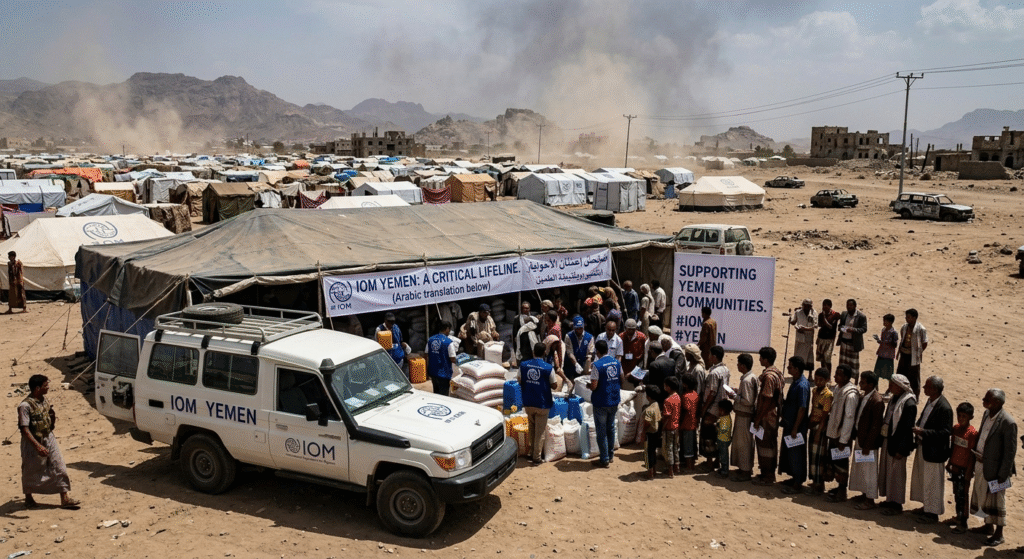
As of August 2026, the International Organization for Migration (IOM) is operating at the epicentre of one of the world’s most complex and underfunded humanitarian crises. Yemen, a country shattered by over a decade of conflict, is now facing the compounded shocks of mass displacement, extreme weather, economic collapse, and the relentless flow of migrants along one of the world’s deadliest routes . The IOM is on the frontlines, delivering life-saving aid while desperately calling for sustained international support .
🆘 The Scope of the Crisis: A Nation on the Brink
The scale of human suffering in Yemen is staggering. The IOM and its partners estimate that over 22 million people – more than two-thirds of the population – require humanitarian assistance and protection services in 2026 . This vulnerable population includes 5.2 million internally displaced persons (IDPs), a figure that is growing due to ongoing conflict, and over 329,000 migrants who have crossed the Gulf of Aden from the Horn of Africa, hoping to reach the Gulf States for work .
The situation is further exacerbated by climate shocks. Between August and October 2025, devastating floods wreaked havoc across the country, damaging homes, infrastructure, and critical health facilities . A single IOM visit to the West Coast in April 2026 revealed that more than 500 flood-affected families had already received emergency assistance, but the need is immense and widespread . This is compounded by a collapsing health system where only 59% of health facilities are fully functional, leaving millions without access to even basic medical care .
⚕️ IOM on the Frontlines: Health, Shelter, and Livelihoods
Despite these overwhelming challenges, the IOM is maintaining a massive and multi-faceted humanitarian operation.
Healthcare: A Lifeline for the Sick
Yemen’s health system is near collapse, but the IOM is sustaining critical health services across the country. In 2025 alone, they supported over 350,000 primary health-care consultations, including 73,000 for migrants . Their work extends to specialized care: they renovated the Ta’iz Mental Hospital, the region’s only referral centre, installing solar power and providing medical equipment to improve care for patients . Crucially, the IOM is fighting preventable diseases by supporting Cholera Treatment Centres, vaccinating over 53,000 children in 2025, and providing treatment for HIV, TB, and malaria through a Global Fund-supported programme .
Shelter and Livelihoods: Immediate and Long-Term Solutions
Displacement is a defining feature of the crisis. IOM’s Displacement Tracking Matrix (DTM) is constantly monitoring the situation, reporting that from 9 to 15 August 2026 alone, 176 households (1,056 individuals) were newly displaced, largely in Ta’iz and Ma’rib governorates . In response, the IOM provides emergency shelter and non-food items to displaced families.
To move beyond immediate relief, the IOM is investing in longer-term solutions. A recent Cash-for-Work programme, supported by the German government, is a powerful example. The programme is employing over 600 vulnerable people in Ma’rib and Ta’iz to rehabilitate critical water infrastructure . By providing an income and restoring access to water, the initiative is strengthening resilience and easing tensions between displaced and host communities over scarce resources. The Mokha City Water Project, for instance, is restoring clean water access for over 120,000 people .
🏃♂️ A Dangerous Crossroads: The Migrant Crisis
The migration flow from the Horn of Africa to Yemen continues unabated, even as the country remains a dangerous conflict zone . In May 2026 alone, the IOM tracked 11,587 migrants entering Yemen . While this was a 22% decrease from April, the numbers are still staggering: 83,835 migrants have been recorded arriving in Yemen since the start of 2026 . The vast majority (96%) are Ethiopians, and the journey remains one of the world’s deadliest; 2025 was the deadliest year on record for the “Eastern Route,” with over 900 reported deaths .
The IOM provides a critical safety net for these migrants through its Migrant Response Points, offering protection, healthcare, and a place to rest . They also facilitate the safe and dignified voluntary return of stranded migrants to their home countries. However, the IOM’s ability to operate is severely constrained by a lack of funding.
💰 The Funding Gap and the Path Forward
The IOM’s Yemen operation is dangerously underfunded. In January 2026, the IOM Director General, Amy Pope, sounded the alarm as a surge in displacement pushed families to the brink, stating that “millions remain without access to lifesaving assistance” . The situation has only grown more precarious since. To support migrants along the Eastern Route through Yemen and elsewhere, the IOM and 48 partners launched a $91 million appeal for the 2026 Migrant Response Plan . Without this funding, critical shelters and medical clinics risk closure, potentially leaving thousands stranded in a warzone. The IOM continues to stress that “sustained international support is critical to ensure assistance continues and to help communities recover” .
