

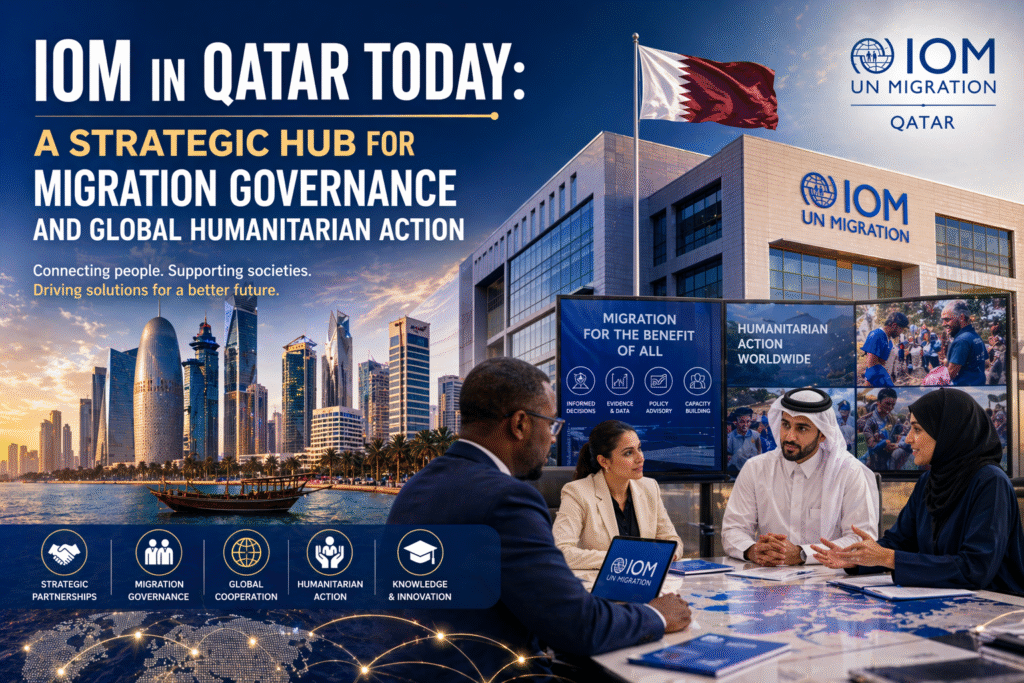
In the heart of the Gulf, Qatar has emerged as more than just an energy-rich nation or the host of the 2022 FIFA World Cup. It has become a critical partner for the International Organization for Migration (IOM), the leading UN agency dedicated to promoting safe, orderly, and regular migration. As of April 2026, the IOM’s presence in Qatar is multifaceted: it serves as a policy advisor, a humanitarian financier, a logistics operator, and a key player in addressing some of the world’s most pressing displacement crises. This article explores the dimensions of IOM’s work in and with Qatar today.
Part 1: A Strategic Government Partnership
At the core of IOM’s presence in Qatar is a close and strengthening relationship with the Qatari government. In January 2026, a high-level meeting took place in Doha between the Undersecretary of the Ministry of Labour, H.E. Sheikha Najwa bint Abdulrahman Al-Thani, and the IOM’s Head of Mission in Qatar, Firas Adel Al-Budairi .
The meeting was not ceremonial. It focused on concrete areas of cooperation and ways to “strengthen and further develop” collaboration in the coming period . This reflects a broader reality: Qatar views the IOM not merely as an observer but as a technical partner capable of providing data-driven insights and policy frameworks to manage its unique demographic situation.
Given that migrants comprise a staggering 76.7% of Qatar’s total population, with 77% of that migrant population being male, the need for sophisticated migration management is acute . The IOM’s expertise in labor mobility, data collection, and rights-based governance provides Qatar with the tools to balance its economic appetite for foreign labor with international standards.
Part 2: The Labour Reform Backing
Qatar has undergone a dramatic transformation in its labor laws over the past half-decade. The abolition of the exit permit system, the introduction of a non-discriminatory minimum wage, and the dismantling of parts of the “kafala” (sponsorship) system have been widely documented . Behind many of these reforms, the IOM has played a quiet but essential advisory role.
The UN’s human rights apparatus has backed Qatar’s “real and authentic will” to tackle labor abuse, noting that while violations still exist, the structural changes—such as the Wage Protection System and the construction of massive labor cities—represent genuine progress . The IOM continues to support these efforts by providing technical assistance on contract compliance, grievance mechanisms, and ethical recruitment. For the millions of workers arriving from South Asia and beyond, the IOM’s presence helps ensure that the legal reforms on paper translate into fair treatment on the ground.
Part 3: The Global Partnership with Qatar Charity
Beyond its work inside Qatar’s borders, the IOM is leveraging Qatari financial power to fuel global humanitarian operations. In November 2025, IOM and Qatar Charity signed a landmark Memorandum of Understanding (MoU) in Doha .
The agreement, signed by IOM Chief of Staff Mohammed Abdiker and Qatar Charity CEO Yousef bin Ahmed Al-Kuwari, is a three-year framework designed to combine IOM’s operational reach with Qatar Charity’s funding and local networks. The partnership focuses on health, nutrition, water, sanitation, and protection mechanisms for conflict-affected communities. It also emphasizes “bridging humanitarian responses with long-term solutions” in livelihoods and education .
This is not a symbolic agreement. With a joint working group established to oversee implementation, the IOM-Qatar Charity axis represents a significant non-Western funding stream for global migration programs, diversifying the IOM’s donor base.
Part 4: The $20 Million Syrian Return Initiative
Perhaps the most concrete example of IOM’s operational work with Qatar is the $20 million initiative to support the voluntary and safe return of displaced Syrians. Announced in late January 2026 by Qatar’s Minister of State at the Foreign Ministry, the project targets nearly 100,000 people .
The mechanics of the program are comprehensive. It is not simply about transportation; it is a “humanitarian approach” that includes securing suitable housing, providing food assistance, and delivering medical aid for three months after the returnees arrive in Syria . Qatar expressed gratitude to the Syrian government for cooperation in facilitating the returns, and the IOM serves as the implementing partner on the ground.
This initiative highlights a critical function of the IOM: enabling governments to turn political will (in this case, Qatar’s desire to facilitate returns from Lebanon) into a safe, dignified, and sustainable process.
Part 5: Logistical Footprint and Infrastructure
To execute these programs, the IOM requires a robust logistical presence in Qatar. Public procurement notices from early 2026 reveal that the IOM is actively seeking accommodation and catering services in the country .
These tenders, issued under reference QA10-2025-071, cover “hotels and lodging and meeting facilities” . This indicates that Qatar serves as a regional staging post or transit hub for IOM staff and beneficiaries. Whether it is housing experts flying in for policy workshops or providing temporary accommodation for migrants in transit, the IOM maintains a physical and operational footprint that requires substantial local contracting.
Part 6: The Regional Security Role (IMO vs. IOM – A Crucial Distinction)
In a complex twist, Qatar has recently been active in international maritime diplomacy, but it is crucial to distinguish between two different “IOMs.” In March 2026, Qatar strongly condemned Iranian attacks on commercial vessels at an emergency meeting of the International Maritime Organization (IMO) in London .
While this is a different organization—the IMO deals with shipping safety, while the IOM deals with migration—the confusion highlights Qatar’s broader geopolitical role. Qatar called for the protection of sailors and the safeguarding of navigation in the Strait of Hormuz, which has been effectively closed due to the US-Israeli war with Iran .
Why does this matter for the IOM? Regional instability directly impacts migration flows. The closure of the Strait of Hormuz and the spike in oil prices to over $105 per barrel makes humanitarian logistics more expensive. Furthermore, if the conflict expands, Qatar may see new displacement flows, requiring the IOM’s emergency response mechanisms.
Part 7: Data and Demographics
The IOM’s most enduring contribution to Qatar is often invisible: data. According to IOM reports cited by mobility experts, the demographic reality of Qatar is extreme. The reliance on single, male labor from specific Asian countries dictates everything from visa policy to housing design .
The IOM assists the Qatari government in tracking these flows. This data allows Qatar to forecast labor needs, manage visa quotas, and ensure that the health and infrastructure systems are not overwhelmed. For a country where foreigners outnumber nationals by a ratio of nearly 3:1, the IOM’s role as a neutral data aggregator is indispensable for long-term national planning.
Part 8: The Challenge of “Kafala” Legacy
Despite the reforms, the shadow of the old “kafala” system lingers. Rights groups have historically accused Qatar of doing “almost nothing” on labor abuse, and the International Trade Union Confederation once estimated that thousands of workers could die . While the IOM and UN officials now see “real progress,” the perception gap remains.
The IOM’s challenge today is to bridge the gap between Qatar’s stated legal reforms and the lived reality of workers in sectors like construction and domestic service. The IOM focuses on empowering workers with knowledge of their new rights and establishing feedback loops so that abuses can be reported without fear of deportation.
Part 9: Future Outlook
Looking ahead, the IOM’s role in Qatar is set to expand. The MoU with Qatar Charity has provisions for renewal, suggesting a long-term financial commitment . Furthermore, as Qatar continues to position itself as a global mediator (evidenced by its role in hostage negotiations and regional diplomacy), the IOM provides the technical skeleton for humanitarian components of those deals.
The IOM Mission in Doha is likely to grow from a liaison office into a regional logistical hub, particularly for operations in the Middle East and South Asia. With continued government backing and substantial funding from Qatari charities, the IOM in Qatar today is a model of how a resource-rich state and a UN agency can collaborate to manage one of the defining issues of the 21st century: human mobility.
