

NAIROBI — July 13, 2026
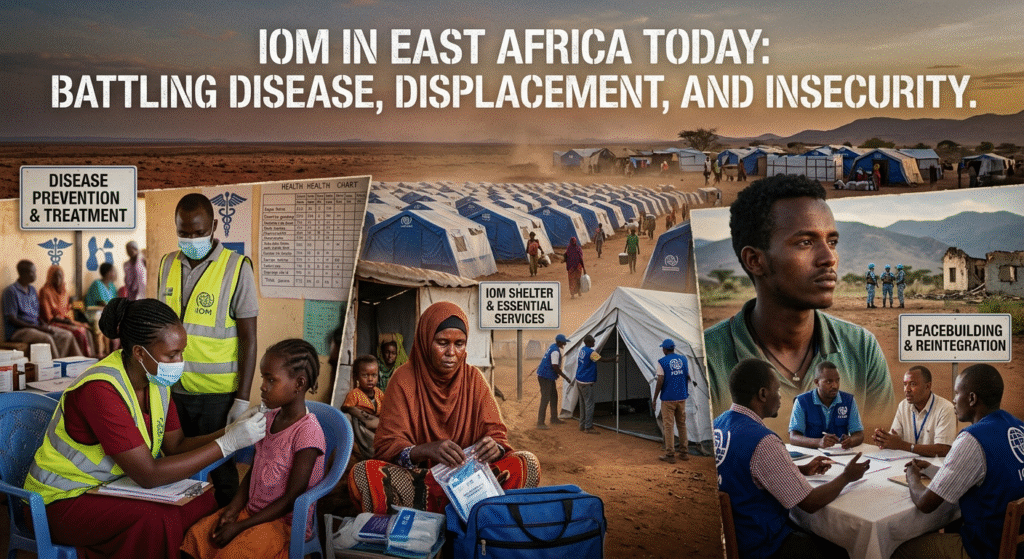
Across the East, Horn, and Southern Africa region, the International Organization for Migration (IOM) is operating on multiple fronts, responding to simultaneous crises ranging from a deadly Ebola outbreak to climate-induced displacement and conflict-driven migration. From the border posts of the Democratic Republic of Congo to the drought-stricken districts of Somalia, the agency is working to protect millions of vulnerable people on the move—while navigating complex security environments and chronic funding shortages.
Part 1: The Ebola Emergency — One Million Screenings
The most urgent operation is the response to the Ebola outbreak that has spread across eastern Democratic Republic of the Congo and into Uganda. Since mid-April 2026, IOM has conducted more than one million health screenings at borders and along key cross-border routes and travel corridors . The outbreak has now resulted in 198 deaths and over 856 infections as of June 18, according to the World Health Organization .
The scale of the challenge is immense. In Ituri Province alone, more than 16,000 people cross porous borders every day for trade, work, family reunification, and access to essential services . IOM Regional Director Frantz Celestin emphasized: “Human mobility is central to both the spread and containment of infectious diseases” .
Part 2: Border Health Infrastructure
IOM is boosting health surveillance across 110 Points of Entry and 43 additional health screening points along major routes, with surge personnel deployed to high-risk border areas . Population mobility mapping has been expanded to inform national and regional containment strategies .
The Organization is also strengthening preparedness in at-risk countries including Burundi, Ethiopia, Kenya, Rwanda, South Sudan, Tanzania, and Zambia by enhancing surveillance systems at Points of Entry and mapping high-risk travel routes . In Burundi, IOM supports the government’s work of preventing disease spread at key migration points—including airports and border crossings—with emergency public health officers ensuring isolation rooms have power, water, and disinfectants .
Part 3: The Displacement Crisis — 25 Million Affected
Beyond health emergencies, IOM is addressing one of the world’s largest displacement crises. According to the PROGRESS 2025 report released in December, there are more than 25 million internally displaced persons (IDPs) in the East, Horn, and Southern Africa region, including 14.8 million currently in displacement locations and 10.7 million returnees who continue to face displacement-related vulnerabilities .
The report, based on data from 92,549 households surveyed between 2022 and 2024, found that 42% of IDP households intend to stay in their current location, with preferences varying widely by country . Local integration is more common in Burundi and Somalia, while in South Sudan, return has remained the preferred solution for three consecutive years .
Part 4: Vulnerabilities of Displaced Populations
Conditions for IDPs differ sharply within countries. In South Sudan, IDPs living in states where they make up one-third or more of the population report higher access to healthcare (71%) than those in states with proportionally fewer IDPs (62%). In Somalia, neighborhood-level data show large variations in progress toward solutions—81% of IDPs in Kismayo report positive feelings of integration versus just 39% in Baardheere .
Female-headed households face distinct and often heightened vulnerabilities. In Somalia, only 38% of female-headed IDP households have overcome most displacement-related vulnerabilities, compared with 45% of male-headed households . In South Sudan, female-headed households are more likely to depend on precarious livelihoods and less likely to afford healthcare .
Part 5: Somalia’s Durable Solutions Leadership
Somalia, which hosts 3.86 million IDPs, has advanced policies and data systems to support displaced populations . The Federal Government’s Ministry of Planning, Investment and Economic Development is leading the implementation of the Durable Solutions Progress Survey, coordinated with Federal Member States, local authorities, and IOM to support the National Durable Solutions Strategy .
IOM’s approach in Somalia leverages a Co-Funding System to build a platform for district-level Public Financial Management, strengthening country systems to enable on-budget intergovernmental fiscal transfers from the federal government . This aims to bridge the gap between short-term stabilization and long-term resilience .
Part 6: Tigray — A Mother’s Story of Recovery
Individual stories illustrate the impact of IOM’s work. In Tigray, Ethiopia, Embetu Alem, a 35-year-old mother of three, lost her husband in the 2020 conflict and fled her home in Korem with her children. After years of displacement, she returned following the Pretoria Agreement, only to find her home destroyed .
Through IOM support, she received access to a communal kitchen where she could bake injera, basic household items, and connections to local markets. Today, she earns approximately 300 Ethiopian Birr (about $2 USD) per day from selling her injera—bringing stability, food security, and dignity back to her family . Her story highlights the importance of dignity-centered interventions for vulnerable returnees, particularly women-headed households .
Part 7: Security Challenges for IOM Personnel
IOM operates in increasingly complex environments across the region. In June 2026, the IOM Office of Staff Security convened a Security Focal Points Workshop in Mombasa, bringing together participants from across the region to strengthen their ability to assess risks, respond to incidents, and support staff in dynamic and unpredictable environments .
For many missions, limited resources mean that a small number of colleagues take on multiple responsibilities, often beyond their primary roles . As participants noted: “We have learned a great deal not only from the facilitators but also from our colleagues through shared mistakes, best practices, and by exploring how we can work together as one UN” .
Part 8: The Regional Migrant Response Plan
The 2025–2028 Regional Migrant Response Plan addresses urgent needs of migrants along the Eastern Route from the Horn of Africa to Yemen and Southern Africa, focusing on life-saving aid, protection, reintegration, and resilience . In 2025, IOM and partners appealed for USD 81 million, but funding remains critically low .
The funding gap has real consequences. Nearly 500 nutrition clinics have closed across Somalia due to lack of funding . The situation is compounded by the reduction of aid to Somalia, which has had “significant social consequences, with food insecurity increasing and poverty reduction stalling” .
Part 9: Labour Mobility and Regional Integration
IOM is also working to advance safe, orderly, and humane labour migration governance. There are 13.7 million migrant workers in Africa and 3.6 million in the East and Horn of Africa region . The majority of labour movements are intra-regional, and IOM works with governments to protect the fundamental human, labour, economic, and social rights of migrant workers .
IOM supports regional forums where Labour Ministers from 11 countries meet to discuss harmonizing labour migration policies, mapping skills gaps, bilateral labour agreements, diaspora engagement, and remittances policies .
Part 10: Reintegration in Eastern Ethiopia
In April 2025, IOM and the Government of Japan launched a project to enhance response and recovery assistance for IDPs and returnees in Dire Dawa City Administration, Eastern Ethiopia, with a budget of $500,000 . The project aims to improve access to essential services including water, sanitation, and hygiene for 15,040 individuals, and healthcare support for 21,400 individuals. Protection and psychosocial support is being strengthened, with 500 individuals receiving gender-based violence protection services .
Part 11: Regional Strategy 2025-2029
IOM’s Regional Strategy for East, Horn and Southern Africa 2025-2029 builds on the IOM Strategic Plan 2024-2028 and highlights how IOM will work with partners to deliver on the promise of migration, enabling it to serve as a force for development and prosperity . The strategy focuses on operations and emergencies, migrant protection and assistance, labour migration, immigration and border management, migration health, and migration, environment and climate change .
Part 12: The Path Forward
As the Ebola outbreak continues to spread and climate-induced displacement deepens, IOM faces an urgent challenge: scaling up life-saving assistance while addressing the root causes of displacement and migration. The Organization is appealing for additional support to sustain life-saving interventions, protect vulnerable communities, and strengthen cross-border health systems .
The message from IOM’s Regional Director is clear: “Our goal is finding a future beyond humanitarian aid—where internally displaced people chart their own path with the right support, the right policies, and the right evidence” . The question is whether international funding will match the growing humanitarian need. For the millions of displaced people, migrants, and vulnerable communities across East Africa, the answer cannot come soon enough.