

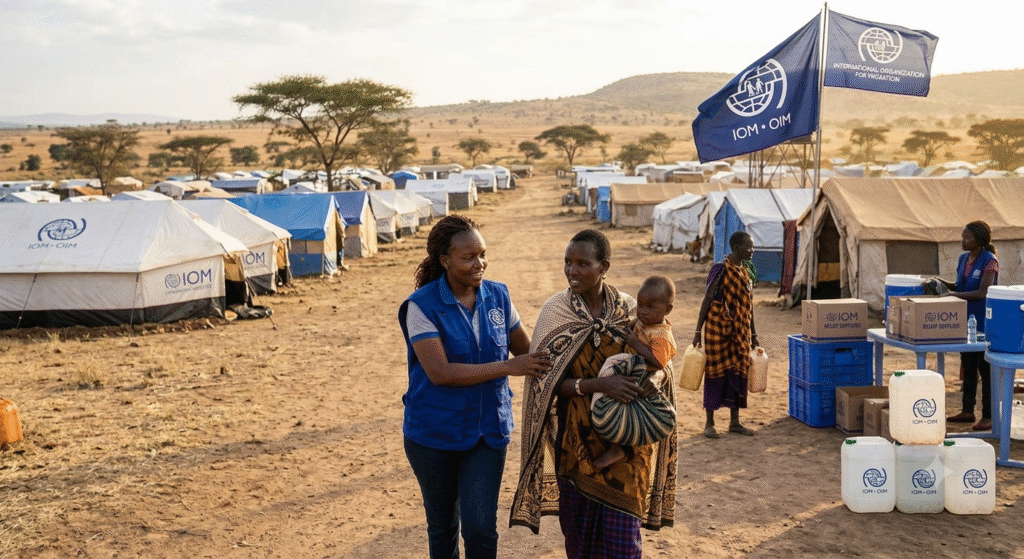
As of August 2026, the International Organization for Migration (IOM) stands at the forefront of East Africa’s most pressing humanitarian and security challenges. Operating across the region, IOM is actively responding to the devastating effects of the Sudan conflict, strengthening border security to combat smuggling, and launching multi-million-dollar initiatives to protect vulnerable migrants along some of the world’s most dangerous migration routes. Yet, as the organization scales up its efforts, chronic underfunding threatens to unravel these critical operations.
A Region in Crisis: The Scale of Migration and Displacement
East Africa is a region defined by movement, but in 2026, much of that movement is driven by crisis. The war in Sudan continues to drive massive displacement. Cross-border movements have increased by 3% in Libya, 2% in South Sudan, 2% in Chad, and 1% in Uganda compared to the previous quarter . However, there has been a decrease in cross-border movements by 14% in Ethiopia and 11% in the Central African Republic .
At the same time, increasing return movements to Sudan have been recorded. In March 2026, a total of 3,682,861 returnees were recorded by IOM since monitoring began, representing a 22% increase from October 2025 . The vast majority of these returnees (83%) are people returning from internal displacement, while 17% returned from abroad, primarily from Egypt, South Sudan, and Libya .
The region also faces a severe drought crisis. An estimated 15 million people face a humanitarian crisis due to drought in Kenya, Somalia, and Ethiopia . Pastureland and waterpoints are drying up, displacing pastoral and agricultural communities dependent upon livestock for survival . IOM’s flow monitoring is recording increased drought-induced movements from Somalia into Ethiopia, as migrants seek access to water and pasture .
Combatting Migrant Smuggling and Strengthening Borders
A significant pillar of IOM’s work in the region is enhancing border security to disrupt criminal networks that exploit migrants. In July 2026, IOM launched a new regional program in Somalia to combat migrant smuggling, document fraud, and transnational organized crime . The three-year Regional Counter-Smuggling Program spans Ethiopia, Kenya, and Somalia and targets criminal networks that exploit weak border management, limited institutional capacity, and poor information-sharing to facilitate irregular migration .
The program, launched in Mogadishu by Somalia’s Minister of Internal Security Abdullahi Sheikh Ismail, focuses on modernizing border management, upgrading airport security systems, and expanding international cooperation to support Somalia’s stabilization efforts . “Protecting our borders is fundamental to safeguarding Somalia’s security, facilitating legitimate travel and trade, and preventing transnational crime,” the minister said .
A complementary initiative, the Regional Counter-Smuggling Programme (RCSP), was launched in Kenya in partnership with the UK Home Office Border Security Command . This three-year programme, running from June 2026 to March 2029, will strengthen airport border management capacities across 13 airports in Kenya, Ethiopia, and Somalia . The programme focuses on enhancing enforcement efforts, strengthening border control and immigration systems, and adopting a protection-sensitive approach that safeguards victims of trafficking .
The Kampala Forum: Advancing Safe Labour Migration
In March 2026, IOM convened ministers from 11 countries in Kampala for the seventh Regional Ministerial Forum on Migration (RMFM), where governments reaffirmed their commitment to expanding safe and regular labour migration pathways and reducing irregular migration across the East and Horn of Africa . “Labour migration is one of the region’s most transformative development tools,” said Frantz Celestin, IOM Regional Director for East, Horn and Southern Africa .
The forum focused on expanding access to regular employment opportunities for migrants, strengthening safeguards to protect their rights throughout the migration cycle, and promoting sustainable development outcomes for both origin and destination countries, including through ethical recruitment practices and improved labour agreements . There are an estimated 3.6 million migrant workers across the East and Horn of Africa, with hundreds of thousands travelling abroad, including to the Gulf, in search of employment .
For the first time, the forum convened representatives from key countries of destination, including the Kingdom of Saudi Arabia, the Sultanate of Oman, and the Hashemite Kingdom of Jordan, to deepen dialogue and cooperation .
The Migrant Response Plan: A $91 Million Lifeline
In February 2026, IOM, together with 48 partners, launched a USD 91 million appeal to support migrants along key migration routes in Africa . The 2026 Migrant Response Plan seeks to deliver life-saving assistance to migrants from the Horn of Africa travelling along the Eastern Route to Yemen and the Gulf, and the Southern Route towards Southern Africa, as well as to support host communities .
Thousands of migrants – including children – primarily from Ethiopia and Somalia, undertake perilous journeys through Djibouti to Yemen in hopes of reaching Gulf countries, driven by the search for safety, security, and jobs . Others travel south from the Horn of Africa through Kenya, Tanzania, Mozambique, Zambia, and Malawi, aiming to reach South Africa . They face violence, exploitation, hunger, dehydration, arbitrary detention, and other abuse . In 2025, more than 900 migrants died or went missing on the Eastern Route – the deadliest year on record .
The plan will deliver life-saving aid and protection services, expand access to voluntary return and reintegration, and support community stabilization . Without increased funding, shelters in Ethiopia, Kenya, Somalia, and Djibouti could close, cutting off critical medical care, protection, and safe accommodation – particularly for trafficking survivors, unaccompanied children, and others facing violence .
Reintegration and Sustainable Returns
In Ethiopia, IOM is working to ensure that returnees can rebuild their lives. In February 2026, the Government of Ethiopia, IOM, the European Union, and Sweden launched a new Team Europe Initiative to support the dignified return and sustainable reintegration of Ethiopian returnees . The initiative comprises two complementary programmes totaling EUR 9.8 million .
IOM currently operates five migration response and one transit centre in Ethiopia, offering age- and gender-sensitive protection services . In 2025, these centres and related reintegration programmes supported tens of thousands of migrants and returnees through shelter, health care, mental health and psychosocial support, onward transportation to communities of origin, and individual and community-based reintegration assistance .
Responding to Climate-Induced Displacement
Beyond conflict and economic migration, climate change is a growing driver of displacement. IOM is working closely with governments, UN agencies, and partners in each country to address the acute water needs of internally displaced persons (IDPs), migrants, and vulnerable groups . However, needs are outpacing capacities due to limited resources, and additional funding is urgently required to save lives and livelihoods, mitigate further displacement, and avoid greater needs in the future .
Conclusion
IOM’s work across East Africa today is a testament to the scale and complexity of the region’s migration and displacement challenges. From responding to the Sudan conflict and drought crisis to launching multi-million-dollar border security programmes and supporting the reintegration of returnees, IOM is a critical lifeline for millions. However, as the organization’s leadership has repeatedly warned, current funding falls far short of growing needs . Without sustained international commitment, life-saving assistance will be disrupted, exposing some of the world’s most vulnerable people to even greater risks.