

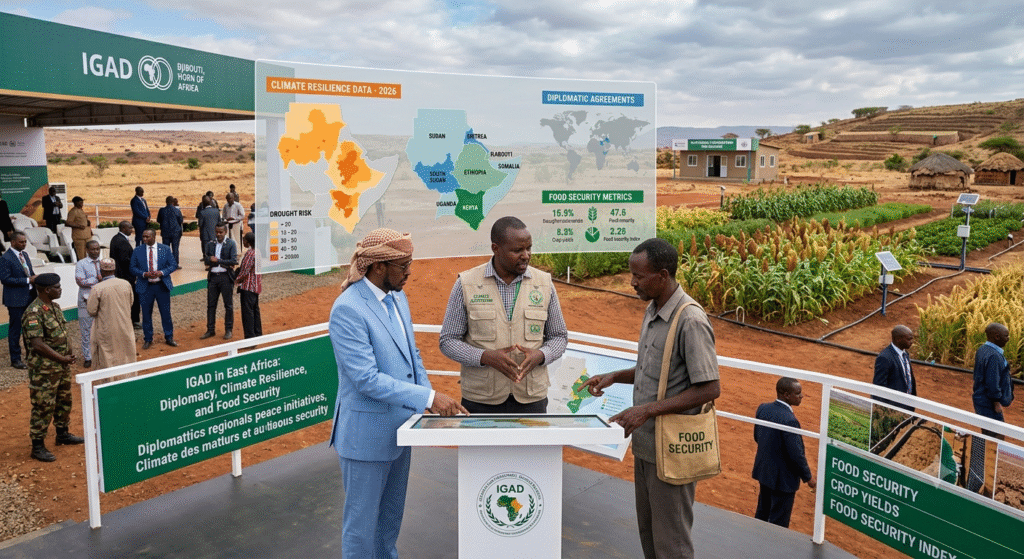
The Intergovernmental Authority on Development (IGAD), the eight-member regional bloc spanning the Horn of Africa, is navigating a turbulent landscape in mid-2026 . The past month has seen the organization actively engaged on multiple fronts: confronting geopolitical tensions over the recognition of Somaliland, spearheading a new regional initiative to combat soil degradation and food insecurity, and continuing its fraught efforts to mediate an end to Sudan’s civil war. These actions underscore IGAD’s central, yet increasingly challenging, role in fostering stability and cooperation across one of the world’s most volatile regions.
A Stance on Sovereignty: IGAD and the Somaliland Question
A central flashpoint for IGAD in recent weeks has been the escalating diplomatic situation involving Israel and the breakaway region of Somaliland. In December 2025, Israel became the first country to formally recognize Somaliland as an independent state, a move that prompted Somaliland to open an embassy in Jerusalem .
This development drew a firm response from the IGAD secretariat. On June 18, 2026, the bloc issued a statement reaffirming its commitment to the sovereignty, unity, and territorial integrity of the Federal Republic of Somalia, a founding member state . The statement, referencing its own treaty, the African Union’s Constitutive Act, and the UN Charter, cautioned that actions undermining Somalia’s sovereignty risk “raising tensions and damaging regional peace and cooperation” . This position aligns with that of the African Union and the Arab League, and underscores IGAD’s foundational principle of respecting the territorial integrity of its member states . The bloc’s stance has been a direct counter to Somaliland’s diplomatic overtures, which have included discussions with the U.S., Ethiopia, Kenya, and the UAE .
The Soil Health Hub: A Cornerstone of Food Security
While navigating these geopolitical undercurrents, IGAD has also been advancing practical, long-term development strategies. On June 21-23, 2026, Nairobi hosted the inaugural Steering and Technical Committees meeting of the IGAD Soil Health and Fertilizer Hub . This event marked the official operationalization of a key commitment from the 2024 Africa Fertilizer and Soil Health Summit .
The hub is a direct response to a critical threat: an estimated 62.3 million people in the region are currently food insecure, and soil degradation is a primary driver . Dr. Sylvia Henga, an IGAD policy and food security expert, emphasized the core logic of the initiative: “Without soil there is no agriculture; soil is where food begins” . The hub will focus on six priority areas: policy harmonization, capacity building, soil information systems, research and innovation, market development, and resource mobilization . It aims to shift the regional focus from solely increasing fertilizer use towards a comprehensive approach to “soil health,” reflecting evidence that simply applying more inputs hasn’t translated into food security . Dr. Senait Regassa, a Project Coordinator for the IGAD Food Systems Resilience Program, reinforced the Hub’s critical role, calling it “an essential investment not just for the present but for generations to come” . This initiative builds on IGAD’s broader climate resilience efforts, including partnerships with organizations like AICCRA to advance data-driven climate-smart agriculture .
A Unified Climate Strategy: Recovering from Crisis
The Soil Health Hub is part of a larger IGAD strategy to address interconnected climate shocks. The region is one of the most climate-vulnerable in the world, having endured the worst drought in 40 years between 2021 and 2023, which led to the displacement of over a million people in Somalia alone . In April 2026, IGAD’s Agriculture and Environment Division convened a regional consultation to refine the RECOVER-HORN program, a “bankable regional programme” designed to build climate resilience . This initiative focuses on pillars such as climate-resilient agriculture, early warning systems, and integrated natural resource management . Daher Elmi Houssein, IGAD’s Director of Agriculture and Environment, stated that the Horn of Africa is “facing increasingly complex and interconnected climate challenges that no single country can address alone,” making RECOVER-HORN a timely regional response .
Sudan’s Return: Renewed Hope for Peace
On the peace and security front, IGAD is grappling with the ongoing civil war in Sudan. A significant development came in February 2026 when Sudan rejoined the authority after a nearly two-year suspension . Khartoum had frozen its participation in early 2024, accusing the bloc of interfering in its internal affairs by inviting representatives of the paramilitary Rapid Support Forces (RSF) . The IGAD Executive Secretary, Workneh Gebeyehu, welcomed the return, stating it “strengthens IGAD’s unity and enhances its ability to address shared regional priorities” . The move is seen as a vital step for Sudan to “regain regional legitimacy and re-engage with collective diplomatic frameworks” .
IGAD’s Special Envoy for Sudan, Lawrence Korbandi, has emphasized that the organization is doing its “utmost to bridge differences among Sudan’s military and political actors” and is working with regional and international partners to end the war . This includes participation in the multilateral “Quad” mechanism involving the AU, Arab League, EU, and UN . However, the path to peace remains fraught. Executive Secretary Workneh, reflecting on the fall of al-Fasher, has acknowledged the limits of the collective response, stating plainly that “there is still no credible peace effort underway” and that coordination among international actors “has not kept pace with the enormity of this war” .
As a regional bloc, IGAD is working to hold a fragmented region together, deploying a strategy that intertwines strict adherence to international law on sovereignty, practical cooperation on climate and agriculture, and persistent, if difficult, peacemaking. Its success in these interconnected arenas will shape the future of the Horn of Africa.