

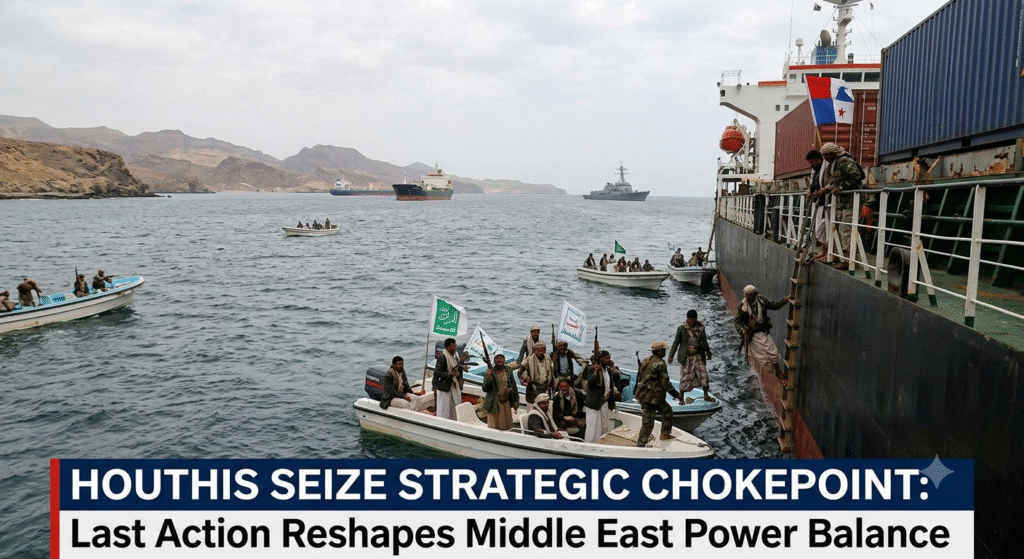
Yemen’s Iran-backed rebels complete lightning offensive, tightening grip on Bab al-Mandab Strait and escalating attacks on Saudi Arabia and Israel
In a dramatic escalation that has reshaped the strategic landscape of the Middle East, Yemen’s Houthi movement has completed a sweeping military offensive along Yemen’s Red Sea coast, seizing control of the Bab al-Mandab Strait and capturing strategic islands that give the Iran-backed group unprecedented leverage over one of the world’s most critical maritime chokepoints. The offensive, which unfolded over the past week, represents the Houthis’ most significant territorial gain since they seized Yemen’s capital Sanaa in 2014, and has sent shockwaves through global energy markets and regional capitals alike.
The Lightning Offensive
The Houthi advance culminated on Friday, September 11, 2026, when government officials confirmed that the rebels had “completed their takeover of the Bab al-Mandab area and Mayyun Island”. A government military official later reported that the group had also seized Greater and Lesser Hanish islands—the last two in the narrow waterway not under their control—as well as the entire neighboring Red Sea coastline.
“Everything that was under our control on the western coast has fallen,” the military official stated, speaking on condition of anonymity. Witnesses in the area reported seeing gunmen “deploying along the Bab al-Mandab shore and driving around in military vehicles”.
The offensive began earlier in the week with the capture of the port city of Mocha on Thursday, followed by Zuqar Island and Perim Island, which sits directly inside the Bab al-Mandab Strait. By Friday, the Houthis had established control over approximately 2,000 square miles of territory along Yemen’s western coast.
The human cost has been staggering. The offensive has left more than 500 people dead and displaced approximately 46,000 people, according to the UN migration agency. Mohamed, a 46-year-old resident who fled Mocha in the middle of the night, described the atmosphere in the historic city as “apocalyptic”.
A Strategic Chokepoint Under Houthi Control
The Bab al-Mandab Strait, which connects the Red Sea to the Gulf of Aden and serves as the southern gateway to the Suez Canal, is one of the world’s most vital maritime corridors. Approximately 10 percent of global shipping passes through this narrow waterway, making it indispensable for trade between Europe and Asia.
The capture of Mayyun Island, situated in the middle of the strait, and the Hanish islands further north, significantly enhances the Houthis’ ability to threaten maritime traffic. The group has already demonstrated its willingness to attack shipping, having launched more than 50 attacks on vessels since November 2024, seizing one ship and sinking another.
For Saudi Arabia, the timing could hardly be worse. The kingdom has increasingly relied on the Red Sea route to export its crude oil after Iran’s blockade of the Strait of Hormuz choked off its traditional shipping lanes through the Gulf. The Houthis’ military spokesman, Yahya Saree, stated that maritime navigation through Bab al-Mandab was “safe” for all companies except Saudi ships, which he said had “already been banned”.
The Iranian Hand
The Houthi offensive did not emerge in a vacuum. According to Reuters, the dramatic advance came with direct guidance from Iran’s Revolutionary Guards, which told the Houthis last week to escalate attacks on Saudi Arabia and promised more funding, weapons, and senior officers to help them do so.
Iran publicly describes the Houthis as an ally but denies giving them military direction, insisting they are “not a proxy”. However, Mohammad Mokhber, an adviser to Iranian supreme leader Mojtaba Khamenei, congratulated the Houthis on their “resounding victory” on Friday, underscoring the strategic alignment between Tehran and the Yemeni rebels.
The implications for Iran’s regional strategy are profound. Farea Al-Muslimi, a research fellow at the Chatham House think tank, told AFP: “Now the Iranians don’t only control… the Strait of Hormuz, but they control the other most strategic chokepoint in the Middle East”.
This dual pressure on the region’s two most important maritime arteries—Hormuz in the north and Bab al-Mandab in the south—has created what Brett Erickson, a risk advisory consultant tracking energy markets, described as an “increasing constriction of the energy flows that keep the global economy alive”.
Saudi Arabia Under Siege
The Houthi offensive has been accompanied by a massive escalation in cross-border attacks on Saudi Arabia. On Sunday, the Houthis claimed to have launched a large-scale ballistic missile and drone attack on King Khalid Air Base in the southern Saudi city of Khamis Mushait. Houthi military spokesman Yahya Saree claimed the attack targeted aircraft hangars, radars, runways, and ammunition depots, causing “significant losses”.
Saudi Arabia’s Civil Defense issued alerts for potential danger in the southern cities of Najran, Khamis Mushait, Jazan, and Abha, later declaring that “the danger has passed”. The previous week, Saudi authorities reported that 73 civilians were injured in Houthi attacks targeting these southern cities, while attacks also caused fires and temporary disruptions at energy facilities.
Most critically, Saudi Arabia was forced to shut down its East-West pipeline after it came under aerial attack on Thursday. The pipeline, which carries Saudi oil from the eastern fields to the Red Sea coast, had become increasingly vital as a bypass to the blocked Strait of Hormuz. Satellite images taken on Thursday showed black smoke billowing near Medina, along the general route of the pipeline.
The Saudi energy ministry confirmed that “the East-West pipeline in the Riyadh and Medina regions was subjected to several attacks on Thursday morning,” adding that “the pipeline was stopped as a precaution, and the attacks resulted in some injuries”.
The combined impact of the Hormuz blockade and the Houthi threat to the Red Sea has sent global oil prices soaring past $100 per barrel, with Brent crude briefly exceeding $107. Average US diesel prices topped $6 for the first time, creating a potential political headache for President Donald Trump ahead of November’s midterm elections.
Saudi Arabia Seeks American Help
Facing an escalating crisis, Saudi Crown Prince Mohammed bin Salman called President Trump at least twice on Thursday to request US military assistance in fighting the Houthis, according to sources familiar with the matter. Washington reportedly told Riyadh it was not willing to take direct military action for now but would help with intelligence sharing and targeting.
The reluctance reflects a broader American caution about being drawn into another Middle Eastern conflict. Trump has previously expressed skepticism about prolonged military engagements in the region, and with midterm elections approaching, the political calculus favors restraint.
Meanwhile, Saudi Arabia has continued its own airstrikes against Houthi positions. Houthi media reported that Saudi strikes hit Mocha’s airport and seaport, while Yemeni government forces claimed to have destroyed Houthi vehicles and weapons near Mokha’s port. The Houthis said Saudi aircraft had carried out 129 airstrikes across several Yemeni provinces over 48 hours.
However, these countermeasures have failed to halt the Houthi advance. Chatham House’s Al-Muslimi observed: “I think the Saudis have tried everything they can to avoid this war, but I don’t think they have any more choice”.
A Region on the Brink
The UN Security Council met Thursday to discuss the escalating crisis, with Yemen envoy Hans Grundberg calling for “the active investment of every member of this body to contain” what could become a more dangerous conflict. The ongoing exchanges risk reviving a war that killed hundreds of thousands of Yemenis and sparked one of the world’s worst humanitarian crises.
For the Houthis, the offensive represents the culmination of years of preparation. “They have been preparing for this front for four years,” said Abdulhamid Dhaifallah, a Sanaa resident who lauded the group’s “great victories”.
The strategic implications extend far beyond Yemen’s borders. With the Houthis now positioned just 32 kilometers from the US military base in Djibouti—the largest American installation in Africa—the group’s newfound territorial control creates direct security concerns for US interests in the region. Ahmed Nagi, a senior Yemen analyst for the International Crisis Group, told the Washington Post that for Iran, the gains provided “leverage over key US interests in Bab-Al Mandab and beyond”.
The world now faces a stark reality: two of the Middle East’s most critical maritime chokepoints—the Strait of Hormuz and the Bab al-Mandab—are simultaneously under threat from Iran and its allies. As Ami Daniel, CEO of the shipping platform Windward, noted: “This is layering on a new disruption. That strait is needed a lot. Assuming the war with Iran gets solved, now you also have to solve this situation with the Houthis. You need two solutions, not one”.
