

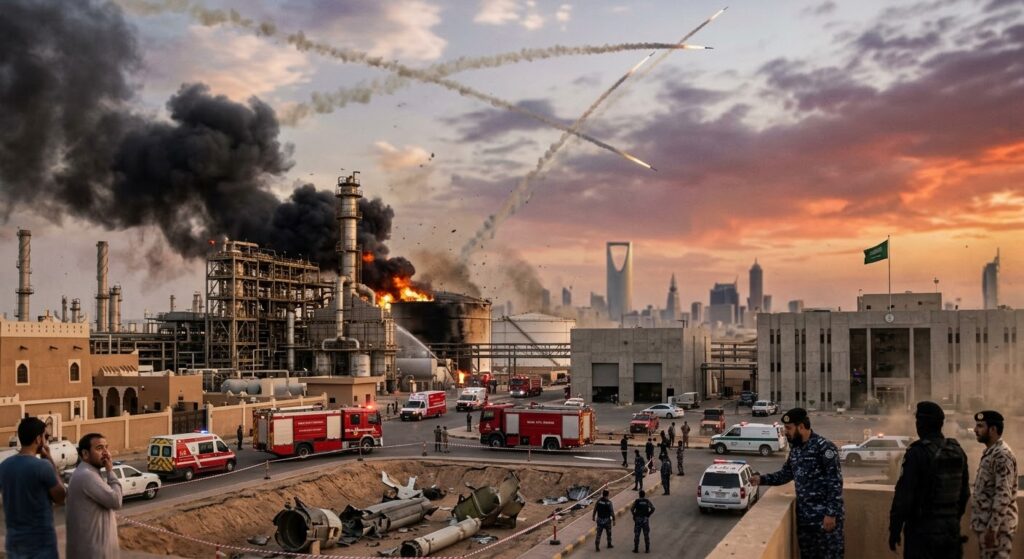
SANAA/RIYADH — Yemen’s Houthi movement has carried out its most audacious and deadly military operation in years, launching a coordinated wave of ballistic missiles, cruise missiles, and drones against airports and energy facilities deep inside Saudi Arabia. The attacks, which struck the heart of Riyadh and killed at least 13 people across multiple nationalities, have triggered emergency sessions at the United Nations, drawn condemnation from Israel and four Arab states, and prompted US President Donald Trump to publicly consider joining Saudi Arabia’s military campaign against the group.
Four Operations in 24 Hours
Houthi military spokesman Yahya Sarea, in a televised statement broadcast on the group’s al-Masirah TV, announced that the movement had conducted four separate operations over a 24-hour period targeting Saudi infrastructure.
The first operation, launched on Saturday evening and continuing into Sunday, targeted King Khalid International Airport in Riyadh in three waves. Sarea claimed the strikes disrupted air traffic and forced the airport’s closure. The second operation struck Aramco’s Shedgum gas facility in the Eastern Province, with Sarea claiming a “direct hit” that ignited a large fire. The third targeted Aramco’s Tanajib facility, also in the Eastern Province. The fourth operation hit King Fahd International Airport near Dammam.
The casualty toll from the attacks on King Khalid International Airport alone was devastating. Saudi Arabia’s General Authority of Civil Aviation confirmed that Saturday’s strike killed 12 people and wounded 309 others. On Sunday, a second strike on the same airport killed a Pakistani national and wounded 11 more. The dead included citizens of Saudi Arabia, Bangladesh, the United States, Egypt, Jordan, Syria, Palestine, Sudan, and Pakistan.
A Warning to Global Aviation
Sarea issued an extraordinary warning to international airlines, aviation workers, and travelers, declaring that all Saudi airports and airspace—with the sole exception of those in the holy cities of Mecca and Medina—were “unsafe” and constituted legitimate targets for Houthi forces.
The operational claims extended beyond Saudi territory. Sarea stated that Houthi forces had launched six ballistic missiles and two drones at what he described as Saudi military gatherings in Lahj province in southern Yemen, claiming dozens of casualties. He also claimed that Houthi air defenses had fired locally manufactured surface-to-air missiles at Saudi warplanes, forcing them to retreat.
The Houthis framed the attacks as retaliation for intensified Saudi airstrikes across Yemen. Sarea claimed that Saudi warplanes had conducted 124 airstrikes in the preceding 24 hours targeting Sanaa and the provinces of Taiz, Marib, Al-Jawf, Hajjah, Hodeidah, and Saada, and accused the coalition of causing civilian casualties, including women and children.
International Condemnation and the UN Security Council
The attacks drew swift and widespread condemnation. On October 15, the UN Security Council issued a presidential statement condemning “in the strongest terms” the Houthis’ continued attacks against Saudi Arabia, including those targeting civilian aviation and energy infrastructure. The Council expressed its deepest condolences to the families of the victims and to the Saudi government and people. It also condemned Houthi attacks and threats against commercial shipping in the Red Sea and Bab el-Mandeb Strait, emphasizing the importance of freedom of navigation under international law. The statement affirmed Saudi Arabia’s right to self-defense under international law and stressed that lasting peace in Yemen could not be achieved through violence, coercion, or the use of force.
Saudi Arabia, Egypt, Pakistan, and Turkey issued a joint statement on October 11 strongly condemning the Houthi attacks, demanding that the group “immediately and unconditionally cease such attacks.” The four countries described the strikes as a violation of Saudi sovereignty and territorial integrity and a direct threat to regional and international peace and security, holding the Houthis fully responsible for the consequences.
Netanyahu Condemns “Horrible Terror,” Convenes Security Meeting
Israeli Prime Minister Benjamin Netanyahu condemned the attack on King Khalid International Airport as “horrible terror” and expressed Israel’s deep condolences to the families of the victims. “I condemn in the strongest terms the horrible terror attack at King Khalid International Airport in Riyadh,” Netanyahu wrote on X.
Netanyahu convened an emergency security meeting at the Kirya military headquarters in Tel Aviv on October 11, attended by Defense Minister Israel Katz and senior security officials. The meeting focused on Iran, Gaza, and Lebanon, but was convened in the immediate aftermath of the Houthi attacks on Saudi Arabia and amid escalating concerns about a wider US-Iran confrontation. Israeli officials described the meeting as reflecting Israel’s vigilance against the possibility that the conflict could spill over into Israeli territory.
Trump Signals Possible US Military Involvement
US President Donald Trump told reporters at the White House on Saturday that Washington might join Saudi Arabia’s military operations against the Houthis. “We may. We’re going to look at it. We just found out about the recent attack. We will make a decision. We move very quickly,” Trump said.
The remarks marked a potential shift in Washington’s posture. According to reports, Saudi Crown Prince Mohammed bin Salman had repeatedly requested US military assistance against the Houthis in September, but Trump had ultimately declined to authorize strikes despite operational preparations having been made. An AP-NORC poll from October 1 found that 69 percent of Americans considered a war with Iran not worthwhile, suggesting domestic political constraints on any expanded US military role.
Iran Offers to Mediate
Iranian Foreign Minister Abbas Araghchi held a telephone call with Saudi Foreign Minister Prince Faisal bin Farhan on October 11, expressing concern over the escalation and emphasizing that “insisting on a military approach and ignoring a political solution would complicate the situation.” Araghchi stated that Iran was ready to provide all necessary assistance to facilitate dialogue between Saudi Arabia and the Houthis and to pave the way for a political resolution.
The offer came as the Houthis’ leader, Abdulmalik al-Houthi, delivered a defiant speech marking the anniversary of a 2016 Saudi airstrike on a funeral gathering in Sanaa. He accused Saudi Arabia of wielding its military power exclusively against Muslims and never against Israel or the United States, and claimed that Yemen’s extension of sovereignty over the Bab el-Mandeb Strait was the true source of Saudi “rage”.
A Dangerous New Threshold
The attacks represent a qualitative escalation in the Houthis’ long-range strike capabilities and a direct challenge to Saudi Arabia’s security architecture. The targeting of King Khalid International Airport—the kingdom’s busiest aviation hub—with precision missile strikes demonstrates a level of operational sophistication that Saudi air defenses have struggled to counter. The repeated strikes over consecutive days, despite Saudi claims of successful interceptions, have exposed vulnerabilities in the kingdom’s defensive umbrella.
For the Houthis, the operation serves multiple purposes: retaliation for Saudi airstrikes, a demonstration of military capability to regional and international audiences, and a signal that the group can impose costs on Saudi Arabia far beyond Yemen’s borders. The warning to international airlines has already disrupted global aviation networks and raised the prospect of sustained economic pressure on the kingdom.
With the UN Security Council united in condemnation, four Arab states demanding an end to the attacks, Israel watching warily, and the United States weighing direct military involvement, the Houthis’ latest operation has achieved its most provocative objective: placing Yemen’s war at the center of a volatile regional confrontation that shows no sign of de-escalation.