

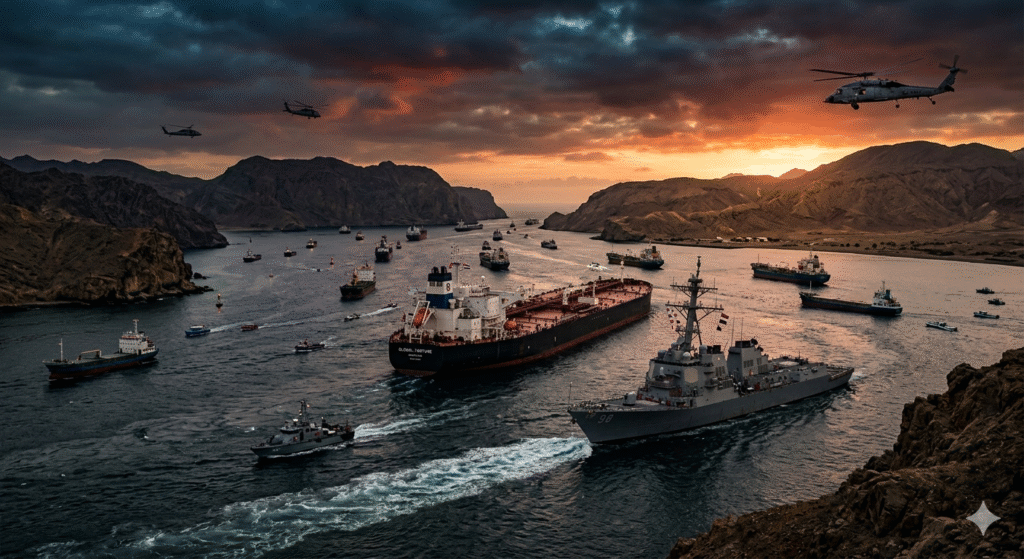
For decades, the Strait of Hormuz functioned as the silent workhorse of the global economy—a 21-mile-wide passage through which one-fifth of the world’s oil sailed with little fanfare. Today, that silence has been shattered. In the spring of 2026, this narrow waterway separating Iran from the Arabian Peninsula has transformed into the central front of a devastating war, a geopolitical lever of unprecedented power, and the site of an unfolding ecological catastrophe. What was once a conduit for energy is now a chokehold on the world, leaving global markets, regional powers, and fragile marine ecosystems gasping for air.
From the deck of oil tankers to the halls of Washington and Tehran, the message is the same: the old rules of the Strait are gone. In their place is a high-stakes contest of endurance, where mines, missiles, and maritime seizures have replaced the predictable rhythms of global shipping. The crisis gripping Hormuz is not merely a regional conflict—it is a structural rupture that will reshape energy security, international diplomacy, and environmental stability for years to come.
The Lever of Last Resort: Iran’s ‘Golden Asset’
The Islamic Republic had brandished the threat of closing the Strait for years, but it was always a hypothetical—a rhetorical warning designed to deter military action. That changed on February 28, 2026, when the United States and Israel launched a surprise war on Iran, killing Supreme Leader Ayatollah Ali Khamenei and plunging the region into open conflict. Facing an existential struggle, Tehran finally pulled the lever it had spent decades preparing.
Today, Iranian officials describe the Strait not as a contingency but as a “golden, invaluable asset rooted in Iran’s geography”. A senior Iranian security source told Reuters that the closure scenario had been planned for years, adding: “Today it is one of Iran’s most effective tools—a form of geographic leverage that serves as a powerful deterrent”. Former Russian president Dmitry Medvedev crystallized this reality in an April 8 social media post, bluntly stating that the Strait of Hormuz was Iran’s functional equivalent of a nuclear weapon—an asset with “inexhaustible potential”.
Iran’s strategy is ruthless but coherent. By bringing the Strait to a near-standstill, Tehran has demonstrated that it can inflict global economic pain without crossing the nuclear threshold. The choice, as Iran’s First Vice President Mohammad Reza Aref put it, is now stark: “either a free oil market for all, or the risk of significant costs for everyone”. In response, the United States has imposed its own maritime blockade on Iranian ports, creating a deadly stalemate in which neither side can fully control the waterway, but both can ensure no one else uses it freely.
Global Fallout: Shipping Scars and Economic Shock
The scale of disruption is historic. Normally, roughly 20 percent of global oil and liquefied natural gas shipments transit Hormuz. During peak disruption phases this year, maritime traffic through the corridor dropped by as much as 90 percent. Hundreds of vessels have been forced to wait outside the Gulf of Oman, while millions of barrels of oil have been diverted into floating storage as operators refuse to assume the risk of transit.
Even if the Strait were to fully reopen in the coming weeks, the global energy system will not return to business as usual. According to an April analysis by Northern Trust, tanker operators continue to reroute cargoes, insurers have not restored full cover, and charter rates still reflect elevated risk assumptions. War-risk premiums surged dramatically after major underwriters withdrew coverage, effectively halting commercial navigation even when the waterway was declared open. Analysts warn that this mirrors the pattern seen in the Red Sea following attacks near the Bab el-Mandeb strait: traffic never fully recovered because operators permanently redesigned routes around the Cape of Good Hope.
The consequences are already rippling through global energy markets. Benchmark Brent crude has hovered near $105 a barrel, with markets attaching a significant geopolitical premium despite intermittent signals of reopening. European nations are accelerating purchases from the Atlantic basin and West Africa, while Asian buyers—including China, India, and Japan—are expanding strategic reserves and diversifying sourcing to reduce future exposure to chokepoint disruptions. Fatih Birol of the International Energy Agency has warned that the crisis could have permanent implications for future oil demand growth, as supply insecurity drives policy shifts toward electrification and efficiency.
The Forgotten Front: An Ecosystem on the Brink
Amid the geopolitical maneuvering and market volatility, a quieter but equally devastating drama is unfolding beneath the surface. The waters of the Strait of Hormuz are not just a strategic corridor—they are an ecological crown jewel, home to the most diverse and resilient coral reefs in the Gulf, along with dolphins, sea turtles, and critically endangered Arabian humpback whales. Scientists now warn that the conflict could inflict catastrophic damage on this unique marine environment, with consequences that will long outlast the fighting.
Since the war began, there have been at least 16 attacks on ships in the Persian Gulf and near the Strait. Each attack carries the risk of oil spills, and the worst may already have occurred. The Shahid Bagheri, a modified Iranian drone carrier, was bombed by a US warplane on March 6 and has been leaking heavy fuel oil in Iranian territorial waters ever since. Satellite imagery shows the slick spreading slowly westward toward the Hara biosphere reserve—the largest mangrove forest on the Gulf shoreline and a vital habitat for migrating birds and endangered turtles.
Environmental analyst Wim Zwijnenburg, who has been tracking harmful incidents, told The Guardian that the Shahid Bagheri spill could be the most ecologically significant in the region since the First Gulf War. Compounding the problem, approximately 2,000 vessels remain trapped in the Gulf, carrying a total of around 21 billion liters of oil. Greenpeace researchers regularly detect oil slicks in the region, and as one expert told CNN, the chemicals in crude oil target the heart function, respiration, and nervous systems of marine animals—damage that cascades through entire ecosystems.
Sidelined Allies: Gulf States Caught in the Crossfire
Perhaps the most paradoxical dimension of the crisis is the position of the Gulf Arab states—the very nations that sit adjacent to the Strait and bear the most immediate consequences of its disruption. Officials and analysts report that as the United States and Iran move toward potential negotiations, the focus has shifted away from the concerns that matter most to Gulf capitals: Iran’s missile program and its network of armed proxies. Instead, diplomatic efforts are increasingly centered on “managing” Hormuz—tacitly accepting Tehran’s leverage over the waterway in exchange for global energy stability.
For Gulf leaders, this is a deeply unsettling shift. “What is taking shape today is not a historic settlement,” Ebtesam Al-Ketbi, president of the Emirates Policy Centre, told Reuters, “but a deliberate engineering of sustainable conflict”. The Gulf states, she noted, are the ones suffering from Iran’s missiles and proxies—yet the negotiations seem focused almost exclusively on the Strait, as if their security concerns are an afterthought.
The sense of being sidelined has bred frustration across the region. “The US is part and parcel of regional security,” said Abdulaziz Sager, chairman of the Gulf Research Center. “But that does not mean acting unilaterally—going full-fledged without involving the region”. Some Gulf officials have urged Washington to resist full sanctions relief and adopt a phased approach. But as one source close to government circles told Reuters, the goal posts have moved: “Hormuz will be the red line. It wasn’t an issue before. It is now”.
Conclusion: A New Era of Maritime Volatility
As a fragile ceasefire holds for now, the temptation is to view the Hormuz crisis as a temporary disruption that will eventually fade. That would be a mistake. The conflict has shattered long-standing taboos around the militarization of the Strait, normalized the use of energy chokepoints as primary instruments of statecraft, and inflicted lasting damage on the insurance and shipping architectures that underpin global trade.
Iranian Parliament Speaker Mohammad Bagher Ghalibaf has vowed that Iran is “not going to leave” the Strait. The United States has ordered its Navy to “shoot and kill” Iranian small boats laying mines. And in boardrooms from London to Singapore, shipping companies are rewriting their route plans around the assumption of persistent maritime volatility. The era of frictionless Gulf energy transit, analysts warn, is unlikely to return. The Strait of Hormuz may reopen—but the world that relied on its silent efficiency is already gone.
