

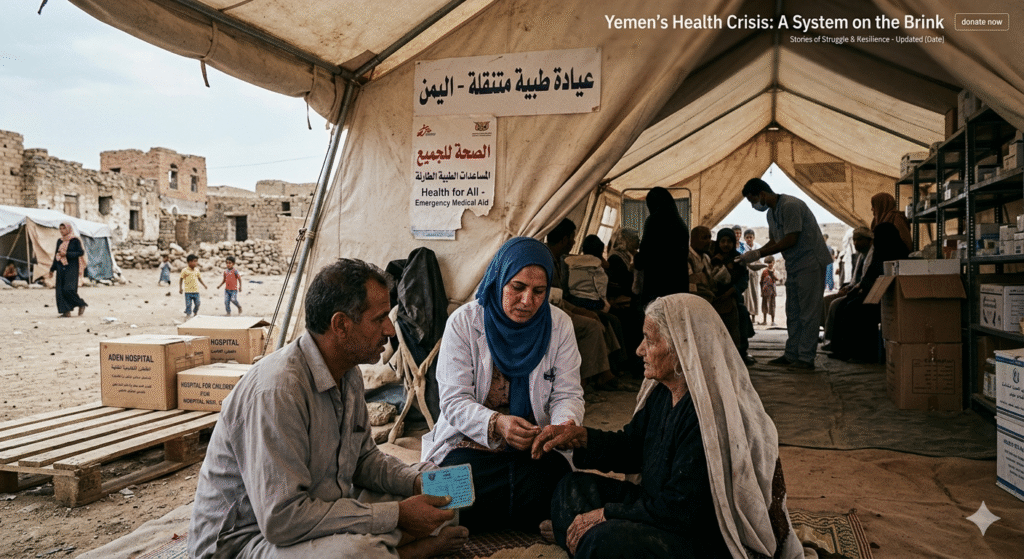
Introduction: The Unfolding Medical Catastrophe
As Yemen enters its second decade of civil war, the country’s health system is facing its most perilous moment yet. With over 22 million people — nearly two-thirds of the population — in urgent need of humanitarian assistance, Yemen has become one of the world’s most severe health emergencies . Today, the nation is simultaneously battling multiple disease outbreaks, a malnutrition crisis of staggering proportions, and the near-total collapse of its medical infrastructure. This article examines the state of health in Yemen today, drawing on the latest data from international health organizations and humanitarian agencies operating in the country.
Part 1: The Scale of the Crisis — 23 Million in Need
After more than a decade of conflict, economic collapse, and repeated climate shocks, Yemen’s humanitarian crisis has reached unprecedented levels. According to the United Nations, an estimated 23.1 million people require humanitarian assistance in 2026 — a number that represents the vast majority of the country’s population .
Of these, 10.5 million are specifically targeted for health assistance by the World Health Organization (WHO) . The United Nations Population Fund (UNFPA) adds that among those in need are 10.95 million women and girls, who face heightened risks of gender-based violence, early marriage, and limited access to essential reproductive health services .
The internally displaced population — those forced from their homes by fighting — now exceeds 5.2 million people, placing additional strain on already overwhelmed host communities and health facilities .
Part 2: Health Facilities — Only 60% Remain Functional
The physical destruction of Yemen’s health infrastructure has been catastrophic. According to WHO data, only around 60% of health facilities remain fully functional across the country . Other UN assessments place the figure even lower, with 40% of health facilities only partially or completely operational — leaving 19.3 million people without reliable access to essential medical care .
For the estimated 662,000 pregnant women requiring life-saving reproductive health services, this collapse has deadly consequences. Of these, 340,000 need emergency obstetric care — services that simply are not available in many parts of the country .
The shortages extend beyond infrastructure to medical supplies, electricity, clean water, and trained personnel. Salaries for health workers have gone unpaid for years in many areas, forcing doctors and nurses to abandon their posts or work without compensation.
Part 3: The Cholera Emergency — A Preventable Epidemic
Perhaps the most immediate and visible health crisis unfolding in Yemen today is the resurgence of cholera. Just last month, the International Committee of the Red Cross (ICRC) reported a devastating outbreak: 115 deaths and 8,500 suspected cases across 14 governorates between April 27 and early May 2026 .
The situation has overwhelmed hospitals beyond capacity. According to ICRC Director of Operations Dominik Stillhart, “There are up to four cholera patients in one single bed. There are people in the garden, and some even in their cars with the IV drip hanging from the window” .
WHO data from the first quarter of 2026 confirms the severity of the outbreak, recording 3,177 suspected cases of cholera and acute watery diarrhea between January 1 and March 29, including three confirmed deaths. Yemen now ranks as the fifth most affected country globally for cholera outbreaks, following the Democratic Republic of Congo, Afghanistan, Mozambique, and South Sudan .
Cholera — a bacterial infection spread through contaminated food or water — causes severe diarrhea and dehydration that can be fatal within hours if untreated. Its resurgence is driven by the collapse of water and sanitation infrastructure, population displacement, and the onset of rainy seasons that contaminate water sources.
Part 4: Multiple Disease Outbreaks — A Perfect Storm
Cholera is far from the only infectious disease threatening Yemen today. The country continues to experience concurrent outbreaks of measles, dengue fever, and polio . These outbreaks are fueled by the same underlying factors: low immunization coverage, unsafe water and sanitation, widespread displacement, and limited access to care.
Complete vaccination coverage in Yemen now stands at only 63% — far below the levels needed to prevent outbreaks of vaccine-preventable diseases . Climate-related shocks, including floods and extreme weather, are intensifying transmission risks and further damaging already fragile health infrastructure.
The combination of multiple disease outbreaks occurring simultaneously creates what health officials describe as a “perfect storm.” Health facilities that might have managed one outbreak are completely overwhelmed by four or five, forcing impossible triage decisions and leaving many patients untreated.
Part 5: Malnutrition — 2.2 Million Children at Risk
Beyond infectious diseases, Yemen faces one of the world’s most severe malnutrition crises. According to the latest Integrated Phase Classification (IPC) analysis, 18.3 million people are acutely food insecure — a number that has continued to deteriorate, with districts shifting from crisis to emergency levels and pockets of catastrophic conditions affecting some of the most fragile communities .
The impact on children is staggering. Over 2.2 million children under five years of age are acutely malnourished, including 516,157 suffering from severe acute malnutrition (SAM) — the most dangerous form of hunger that requires urgent medical treatment . Without access to timely nutrition services, these children remain highly vulnerable to preventable and life-threatening infections.
An additional 1.3 million pregnant and breastfeeding women are also expected to be malnourished in 2026 . Malnutrition in pregnant women increases the risk of pregnancy-related complications, poor birth outcomes, and infant health issues — perpetuating a cycle of poor health across generations.
Part 6: The Funding Gap — Lives Hanging on Donor Pledges
The humanitarian response to Yemen’s health crisis is severely underfunded. In 2026, WHO is appealing for US$38.8 million to deliver life-saving emergency health assistance to 10.5 million people across the country . This funding would support disease surveillance and rapid response, ensure access to essential medicines and supplies, deploy mobile and surgical teams, support immunization campaigns, and build national capacity to sustain essential health services.
UNFPA requires US$71.9 million to deliver critical reproductive health services and gender-based violence prevention programs. As of March 2026, only US$9 million had been received — leaving an 87% funding gap .
The consequences of this funding shortfall are already visible. Challenging operating conditions and funding cuts since 2025 have forced UNFPA to scale back critical programs across the country . As Dr. Syed Jaffar Hussain, WHO Representative in Yemen, warned: “Without sustained and timely funding, preventable diseases will spread unchecked, health facilities will be forced to scale down services, and the most vulnerable communities will pay the highest price” .
A UN report titled “The Price of Inaction,” published in April 2026, starkly warned that continued funding shortages have left 22.3 million people at risk, describing Yemen as having entered “a critical turning point in 2026” .
Part 7: Maternal Health — Silent Deaths in a Broken System
Amid the focus on infectious diseases and malnutrition, maternal mortality remains a silent crisis. UNFPA reports that approximately 662,000 pregnant women require life-saving reproductive health services, including 340,000 needing emergency obstetric care .
Yet with 40% of health facilities non-functional and skilled birth attendants in short supply, countless women are giving birth without access to emergency care. When complications arise — hemorrhage, obstructed labor, infection — there is often nowhere to turn.
The malnutrition crisis compounds these risks. Malnourished pregnant women are more likely to experience complications, and malnourished infants are more vulnerable to disease. The cycle of poor health perpetuates itself, with one crisis feeding another.
Part 8: WASH Crisis — The Foundation of Disease Prevention
The prevention of most infectious diseases begins with something simple: clean water and sanitation. Yet in Yemen today, 14.4 million people require WASH (water, sanitation, and hygiene) assistance . Water scarcity, damaged infrastructure, and population displacement have left millions without reliable access to safe drinking water.
Without clean water, cholera and other waterborne diseases cannot be stopped. Without sanitation facilities, contamination spreads unchecked. Without hygiene supplies, even basic preventive measures become impossible. The WASH crisis is both a cause and a consequence of the broader health emergency — and until it is addressed, disease outbreaks will continue to recur.
Part 9: WHO’s Response Plan — What Is Being Done
Despite the overwhelming challenges, international health organizations continue to operate on the ground. In 2026, under the “Humanitarian Reset,” WHO’s response in Yemen prioritizes life-saving and time-critical interventions in areas with the highest needs .
Through its leadership of the Health Cluster, WHO is strengthening disease surveillance and rapid response, ensuring access to essential medicines and supplies, deploying mobile and surgical teams, supporting immunization campaigns, and building national capacity to sustain essential health services.
UNFPA continues to deliver emergency relief and reproductive health services through support to 26 health facilities, 14 safe spaces, 8 shelters, 7 youth spaces, and 5 specialized mental health centers — reaching over 165,000 people between January and March 2026 .
Yet these efforts are dwarfed by the scale of need. And without sustained funding, even these reduced operations may be forced to scale back further.
Part 10: The Road Ahead — What Yemen Needs Now
As the international community looks toward the remainder of 2026, the question is not whether Yemen’s health crisis can be solved quickly — it cannot — but whether the slide toward complete collapse can be arrested.
The immediate priorities are clear. First, funding must be delivered now. Every delay, as Dr. Hussain warned, “translates into lost opportunities to save lives” . Second, access must be improved to allow humanitarian organizations to reach all communities in need, regardless of which party controls the territory. Third, the WASH crisis must be addressed as a foundation for disease prevention. Fourth, vaccination campaigns must be supported to prevent outbreaks of measles, polio, and other vaccine-preventable diseases. And fifth, the health workforce must be supported — through salary payments, training, and protection — to sustain what remains of Yemen’s medical infrastructure.
Conclusion: A Preventable Tragedy
The health crisis in Yemen today is not inevitable. Cholera is preventable with clean water and sanitation. Malnutrition is treatable with adequate nutrition support. Maternal deaths are preventable with skilled birth attendance and emergency obstetric care. Vaccine-preventable diseases are, by definition, preventable with immunization.
Yet prevention requires resources — resources that are not arriving in sufficient quantity or speed. As Yemen enters another year of crisis, the world faces a choice: fund the response and save lives, or watch as one of the worst humanitarian emergencies of our time grows even worse. For the 2.2 million malnourished children, the 23 million people in need, and the 115 cholera victims already lost this year, the time for action was yesterday.
“Yemen’s health system is stretched to its limits,” Dr. Hussain said. “Without sustained and timely funding, preventable diseases will spread unchecked, health facilities will be forced to scale down services, and the most vulnerable communities will pay the highest price” . The question now is whether the world is listening.