

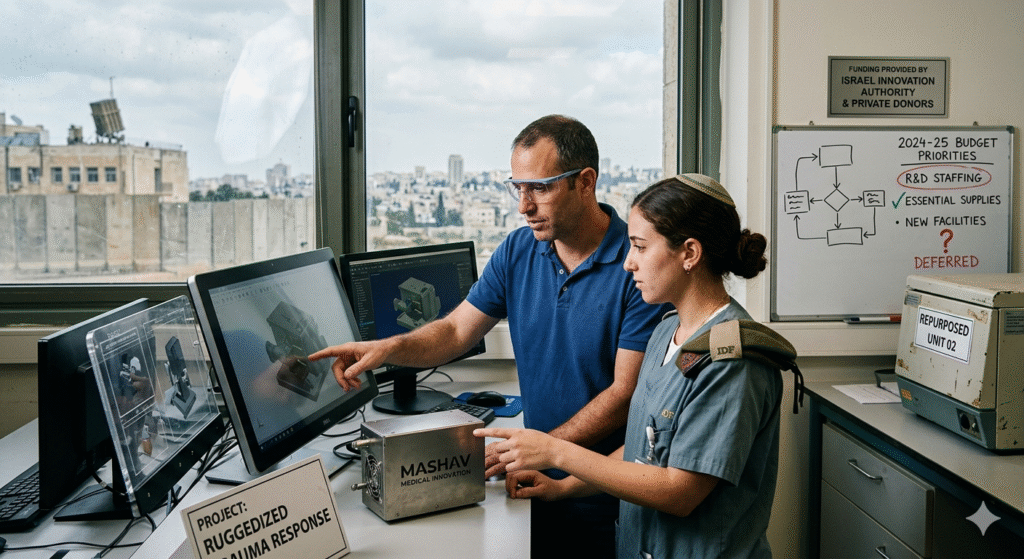
As March 2026 draws to a close, Israel’s healthcare system finds itself at a critical juncture, balancing world-class medical innovation with the harsh realities of an ongoing war against Iran, budgetary constraints, and the lingering challenges of pandemic recovery. The country that has long prided itself on being a “startup nation” in healthcare is now being tested on multiple fronts—from its ability to absorb groundbreaking technologies to its resilience in the face of prolonged conflict and fiscal pressure.
The Innovation Engine: Israeli Health Tech Roars Ahead
Despite the geopolitical turmoil, Israel’s digital health sector has never been more vibrant. According to the Startup Nation Central Finder Annual Report for 2024, the country’s health tech and life sciences sector accounts for approximately 27 percent of the entire ecosystem, with close to 1,600 companies—making it the largest sector in the Israeli economy by company count .
The funding landscape in 2025 demonstrated remarkable resilience. In January, Eleos raised $60 million to transform behavioral healthcare through AI tools, followed by Navina’s $55 million round in March to redefine clinical workflows. Healthsee secured $50 million in April to automate U.S. health benefits, while Hyro raised $45 million in October to deploy AI agents across hospitals nationwide. These investments underscore the global appetite for Israeli innovation even as regional tensions escalate .
The regulatory environment is evolving to keep pace. The Ministry of Health has published guiding principles for AI-based technologies and is actively aligning its framework with international standards such as those from the European Union. The Privacy Protection Authority issued guidance in 2025 clarifying how Israel’s Privacy Protection Law applies to AI systems throughout their entire lifecycle—from model training to deployment—emphasizing lawful processing, informed consent, and transparency .
Breakthrough Treatments: From CAR-T to Home-Based Brain Recovery
Perhaps the most dramatic medical breakthrough this year came from the Ichilov Medical Center in Tel Aviv. In late January, the hospital announced the successful development and administration of a first-of-its-kind Dual CAR-T therapy for patients with multiple myeloma—an aggressive blood cancer. What makes this treatment revolutionary is its dual-activation mechanism: engineered T cells simultaneously recognize two tumor markers (CD38 and CD138) overexpressed on cancer cells, allowing them to destroy malignant cells while largely sparing healthy tissue .
The journey from laboratory concept to human patient took less than one year—an exceptionally short timeframe for such complex cellular technology. The therapy was developed at the Institute for Advanced Cell Therapy using an automated Cocoon platform, a closed-system bioreactor that minimizes contamination risk and ensures reproducibility. This represents a major breakthrough for both Israeli and global oncohematology .
Meanwhile, Israeli health-tech company BRAIN.Q launched the country’s first home-based AI brain recovery service for stroke survivors—a population that includes over 100,000 people in Israel, with approximately 18,400 new stroke cases recorded annually. The system combines a wearable helmet delivering low-intensity, frequency-tuned electromagnetic stimulation with a personalized rehabilitation program managed through a cloud-based AI platform .
The clinical results are striking. According to a meta-analysis presented at the American Heart Association’s International Stroke Congress, 34 percent of patients who began treatment with moderate-to-severe disability achieved full functional independence within months—compared to just 12 percent in the control group. Approximately 85 percent of treated patients showed measurable improvement, with more than 8,000 sessions conducted to date and no serious adverse events reported .
The 2026 Health Basket: Expanding Access Amidst Delays
Israel’s universal healthcare system received its annual update in February, with the Public Committee for the Expansion of the Health Care Services Basket approving 650 million shekels (approximately $208 million) in new drugs and technologies. However, the recommendations were submitted nearly three months late due to a coalition crisis that left the Health Ministry without a permanent minister for an extended period .
Oncology received the largest allocation—337 million shekels ($107 million)—representing 52 percent of the total increase. The basket now includes early-detection tests for breast and lung cancer, expanded genomic profiling for gastrointestinal malignancies, and for the first time, acupuncture treatments for chemotherapy patients suffering from pain. The eligibility age for CT screening for early lung cancer detection was lowered from 65 to 55 .
Diabetes and obesity treatments saw significant expansion. Wegovy will be added for adolescents ages 12 to 18 with severe obesity, while Ozempic, Trulicity, and Rybelsus coverage was extended beyond Type 2 diabetes to include patients with cardiovascular and kidney disease. Flash continuous glucose monitoring systems will now be funded for pregnant women with Type 2 diabetes .
Mental health received notable additions, including Reagila as a first-line treatment for major depressive disorder and Guanfacine—a non-stimulant medication—for children and adolescents with ADHD who have not responded to standard treatments. Approximately 1,450 patients are expected to benefit from this addition .
However, the committee also made controversial exclusions. Leqembi, a drug designed to slow the progression of early-stage Alzheimer’s disease, was left out despite adding an estimated 58 million shekels ($19 million) to the basket. The committee cited both high cost and the need to establish a preliminary mechanism for identifying appropriate patients. Similarly, Kalsody for ALS patients with a specific genetic mutation—costing 700,000 shekels ($220,000) per patient—was excluded due to gaps in evidence regarding its clinical effectiveness .
War and Preparedness: Hospitals Brace for Prolonged Conflict
The most pressing challenge facing Israeli healthcare today is the ongoing war with Iran. Following the state of emergency declared in June 2025, the Ministry of Health has transformed many temporary measures into permanent operational continuity plans. Hospitals across the country are now operating under protocols designed to withstand weeks or even months of sustained missile fire .
Soroka Medical Center in the south, which has faced high-pressure situations due to its geographical proximity to risk zones, has adjusted its internal evacuation plans, strengthened protected areas, and expanded capacity to operate underground or in reinforced zones. The focus is no longer solely on mass casualty care after a direct impact but on ensuring the continuity of critical services—intensive care, emergency surgery, neonatology—even under sustained fire .
Coordination mechanisms between the Ministry of Health, the Home Front Command, and emergency services have been consolidated, with periodic drills that contemplate scenarios of multiple simultaneous points of impact. Hospitals have revised their rapid triage systems to prioritize resources for critical cases while referring minor injuries to peripheral centers. Public-private cooperation has become a key element, with agreements in place for private clinics to absorb non-urgent procedures, freeing hospital capacity for wartime needs .
In late February, the Ministry of Health instructed all medical institutions to prepare for possible hostilities lasting two to four weeks, with major hospitals preparing to move their operations entirely to protected underground facilities if necessary . Health authorities acknowledge that the strategic risk in 2026 is greater than the previous year, with working hypotheses considering impacts on critical infrastructure, partial power outages, and prolonged precision missile campaigns .
Budget Cuts: A System Under Fiscal Strain
Compounding the wartime pressure is a contentious budget decision. In March, the government approved across-the-board 3 percent cuts to all ministries, including NIS 66.6 million ($21.4 million) from the Health Ministry budget—this despite the simultaneous approval of over NIS 5 billion ($1.6 billion) in discretionary coalition funds for ultra-Orthodox institutions, West Bank settlements, and other party priorities .
Public health experts have reacted with alarm. Prof. Hagai Levine, head of the Israeli Association of Public Health Physicians, warned that “the war is severely harming public health, causing serious disruptions in the supply of medical services, and will require a health rehabilitation plan. Therefore, a budget increase is required, not a horizontal cut.” He noted that the current conflict follows “two years of difficult war with severe burnout of staff, physical damage to institutions like Soroka, a chronic shortage of professional manpower, and low public spending” .
Prof. Nadav Davidovitch, chairman of the Taub Center’s Health Policy Program, agreed that the cuts could lead to “significant damage” to health promotion programs and to the implementation of the Tama 49 plan for updating and expanding Israel’s public health system by 2048. Both experts noted that the Health Ministry has been without a full-time minister for months, with Tourism Minister Haim Katz holding the portfolio as an additional responsibility .
Scientific Resilience: Research Amidst Conflict
Perhaps nothing symbolizes Israel’s healthcare resilience more than the story of a recent HIV study conducted jointly by the Weizmann Institute of Science and Hadassah Medical Center. The research, published in February in Nature Microbiology, revealed that gut microbes help bolster immunity in people living with HIV—and that, one day, these microbes might be harnessed to protect this population from infections driven by immune deficiency .
What makes the study remarkable is the context in which it was completed. One of its first authors, Dr. Jemal Ali Mahdi, was forced to flee his native Ethiopia when civil war flared up. Meanwhile, Prof. Eran Elinav’s laboratory at Weizmann was among those wrecked by an Iranian missile in June 2025. Despite these setbacks, after nearly a decade of work, the team brought its findings to publication—a testament to the determination of Israeli medical researchers .
The study’s conclusions are significant: it provides strong evidence in humans that the microbiome and the immune system causally affect one another, with the microbiome acting as a kind of immune organ. For people living with HIV, this opens the possibility of modifying the microbiome through diet, tailored probiotics, or other interventions to support immunity—particularly critical in places where advanced antiviral therapies are still out of reach .
Looking Ahead: Innovation, Resilience, and Uncertainty
As Israel navigates the remainder of 2026, its healthcare system faces a paradoxical reality. On one hand, the country continues to produce world-leading medical innovations—from Dual CAR-T therapies to AI-powered stroke recovery systems—attracting billions in investment and setting global standards. The digital health sector alone comprises over 1,600 companies, making it the largest pillar of Israel’s vaunted startup economy .
On the other hand, the system is under unprecedented strain. The war with Iran has forced hospitals to prepare for prolonged conflict, diverting resources and attention from routine care. Budget cuts of NIS 66.6 million threaten prevention programs and health promotion initiatives just when they are most needed. The absence of a dedicated health minister for much of the past year has slowed decision-making and delayed critical updates to the health basket .
The central question for Israeli healthcare in 2026 is whether the system’s remarkable capacity for innovation can be matched by the political will to fund and protect it. As Prof. Dan Ben-David of Tel Aviv University observed regarding broader budget priorities, “When these children become half of the adults, and eventually, the majority, they will not be able to maintain a first-world economy—which means that they will not be able to support the first-world army needed to defend Israel” .
For now, Israel’s doctors, nurses, and researchers continue to do what they have always done: push boundaries, save lives, and prepare for the worst. Whether the political system will rise to meet their efforts remains to be seen.