

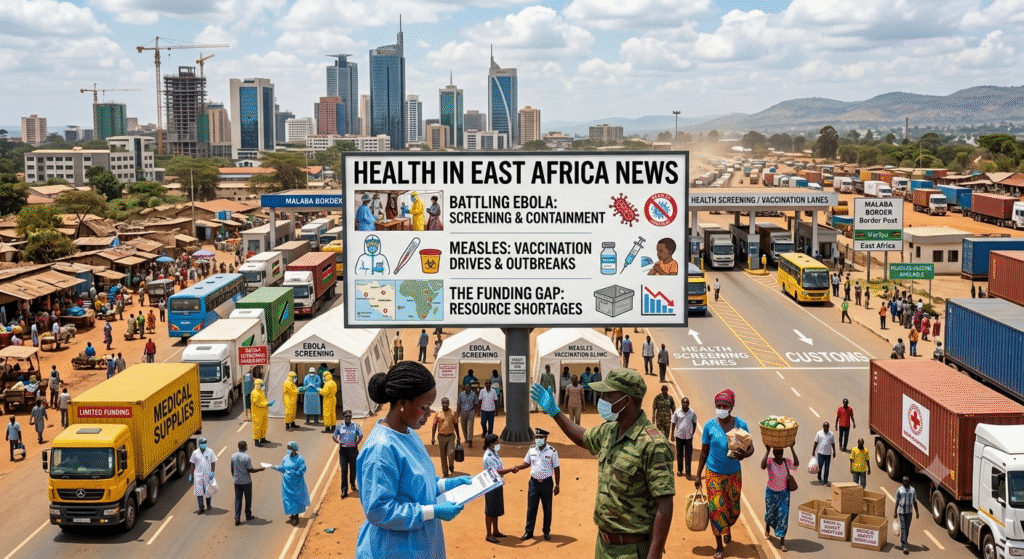
East Africa’s health sector is facing a defining moment as of August 2026. The region is simultaneously battling multiple viral hemorrhagic fever outbreaks, a devastating measles resurgence, and a critical funding shortfall that threatens to undermine years of progress. From the Ebola epicenters of eastern Democratic Republic of Congo to the measles wards of Somaliland’s Burao hospital, health systems are stretched to their breaking point.
The Ebola Emergency: A Regional Threat
The most pressing health crisis is the Ebola outbreak caused by the Bundibugyo strain, for which there is no approved vaccine or targeted treatment . Since mid-May, the Democratic Republic of Congo has recorded 3,973 confirmed cases and 1,801 deaths across Ituri, North Kivu, South Kivu, Haut-Uele, and Tshopo provinces, registering a fatality rate of more than 45 percent . Uganda has confirmed 19 cases, including two deaths .
The World Health Organization has warned that insecurity, population displacement, and cross-border movement continue to hamper response efforts and increase the risk of further spread . The outbreak has spread into densely populated urban areas, including Goma in eastern Congo and Kampala in Uganda, heightening concern over containment. Cases among healthcare workers indicate the virus is spreading inside medical settings, a sign that infection control measures may be insufficient in some hospitals and clinics .
The EAC has unveiled a coordinated regional strategy, including harmonized border screening measures and a new technical taskforce . The ministers agreed to establish an EAC Regional Technical Taskforce on Ebola Response, comprising experts nominated by partner states, responsible for monitoring the outbreak, coordinating technical interventions, reviewing epidemiological trends, and providing regular updates to policymakers .
The WHO has described the situation as one where response teams are “still working to catch up.” Contact tracing remains a major challenge, with only about 45 percent of identified contacts being effectively followed up . The WHO and Africa CDC have launched a $518-million plan to battle the outbreak over the next six months .
Kenya’s Vigilance: Ebola Preparedness on the Border
Kenya remains on high alert, implementing rigorous screening at its border crossings to prevent Ebola from entering the country. At the Malaba border post, health workers screen approximately 1,500 travelers each day, using overhead thermal scanners and handheld thermal guns to check temperatures .
“We’ve been screening every person coming in. We have officers at the point of entry and at the gates. Anyone whose temperature is above the normal range is isolated immediately as we continue monitoring them,” said Evelyn Walela, public health officer in charge of Malaba Port .
The operation runs around the clock. During the day, six health workers are deployed at screening points, while three officers take over the night shift. Since enhanced Ebola surveillance began about two months ago, more than 50,000 travelers have been screened at Malaba alone . The response team includes public health officers, nurses, and health workers specially trained to identify Ebola symptoms.
Health workers also use the All-Disease Outbreak Module (ADaM), a digital surveillance system to register travelers and capture their travel histories, allowing authorities to quickly trace contacts and monitor movements should a suspected Ebola case emerge . So far, Busia County has recorded three suspected cases—one in Malaba and two in Busia town—but all tested negative.
Despite these efforts, challenges persist. Some travelers attempt to bypass official crossing points through informal routes to avoid screening, while misinformation continues to fuel skepticism. “There are people who say Ebola does not exist. That’s why we continue working with community leaders, the media and organizations like the Kenya Red Cross to provide the correct information,” Walela said .
The Marburg Complication: A Dual Outbreak in Uganda
Uganda faces a particularly complex situation, with the emergence of Marburg virus disease complicating an already challenging public health landscape . On June 30, WHO confirmed Uganda’s first Marburg case—an 18-month-old girl from Kyegegwa district in western Uganda who initially presented as a suspected Ebola case but tested positive for Marburg .
The case was detected through Uganda’s rigorous testing protocol for viral hemorrhagic fever suspects, demonstrating the importance of differential diagnosis in outbreak response . Both Marburg and Ebola cause viral hemorrhagic fever with similar clinical features, but require distinct case management protocols and contact tracing strategies.
This dual outbreak challenge demands robust laboratory capacity, clear case definitions, and real-time data sharing between disease control programs. The WHO is supporting Uganda’s containment efforts across multiple sites to manage both the Marburg case and the concurrent Ebola outbreak .
Measles: A Preventable Crisis in Somaliland
Beyond the hemorrhagic fever outbreaks, East Africa is grappling with a severe measles resurgence. In Somaliland’s Togdheer region, cases have spread sharply since the start of 2026. By mid-June, Ministry of Health surveillance had recorded more than 1,600 cases and eight deaths across Somaliland, with Togdheer alone accounting for over 1,400 cases and six deaths . The real figure is almost certainly higher, as only 150 of Somaliland’s 325 public health facilities report centrally.
Médecins Sans Frontières (MSF) returned to Somaliland for the first time since June 2023 to respond to the crisis. Since May 15, MSF has treated more than 350 patients at Burao Regional Hospital .
The reasons measles took hold are structural. Routine vaccination coverage across Togdheer region is estimated at best 40 percent . The outbreak is also revealing a significant vaccination gap beyond early childhood: 65 percent of cases treated by MSF are in patients aged five and above, a sign that vaccination coverage has been insufficient across age groups for years .
Many nomadic and rural communities are rarely reached by immunization. Some families carry misconceptions about the vaccine or turn to traditional remedies. Surveillance is weak, distances to care are long, and cost keeps families home .
Before MSF’s response, families were routinely charged around $30 for medicines and admission. A fee waiver was meant to protect those who could not pay, but many families still feared the cost and delayed coming. “Families bring children earlier when the care is free. In measles, time matters,” said Dr Issa Jama, MSF Medical Activity Manager at Burao Regional Hospital .
The Funding Crisis: A System at Risk
The deteriorating funding picture is perhaps the most alarming development. According to UN financial tracking, the Humanitarian Response Plan for Somalia, which includes Somaliland, was 57 percent funded in 2024. It fell to 29 percent in 2025, and by late May 2026 stood at just 18 percent overall, with the health sector at 11 percent .
This funding gap has severe consequences. Health systems are stretched thin, vaccination campaigns are under-resourced, and outbreak response capacities are compromised. As MSF’s project coordinator Dr Fuad Dahir emphasized: “The better the coverage reaches the cities, the nomadic families, and the rural areas, the less often outbreaks like this return” .
Conclusion
East Africa’s health sector in August 2026 is defined by the convergence of multiple crises: the relentless Ebola outbreak, the Marburg complication, the preventable measles resurgence, and a funding gap that threatens to undo years of progress. The EAC’s coordinated regional strategy, Kenya’s rigorous border screening, and the work of humanitarian organizations like MSF are critical lifelines. Yet the warning from an NIH analysis is clear: actionable priorities include protected domestic budget lines for surveillance, a funded cross-border preparedness mechanism, and ongoing funding for community health workers . Without sustained international commitment, the region’s health systems will continue to be overwhelmed, leaving millions exposed to preventable diseases.