

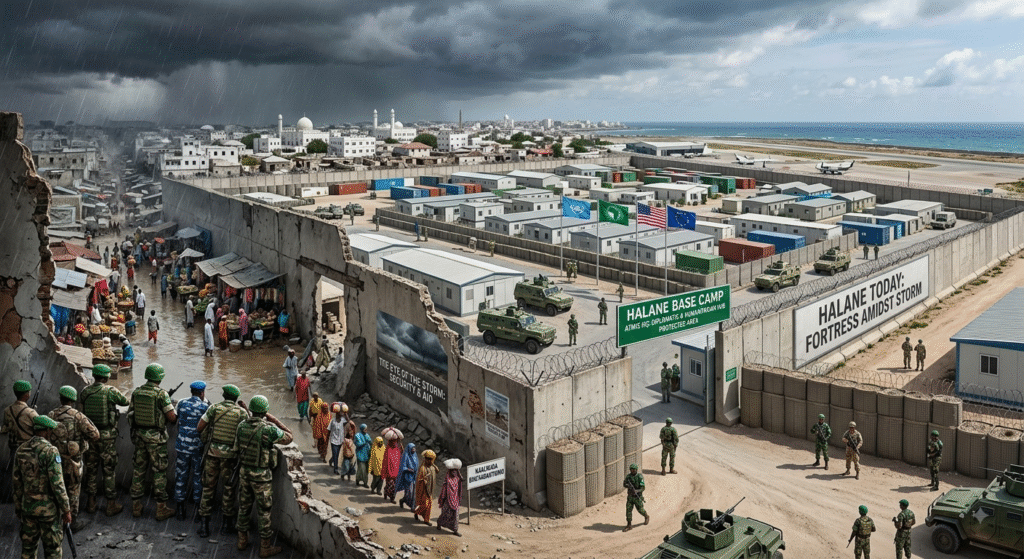
Halane, the heavily fortified compound in Mogadishu, remains the epicentre of Somalia’s security and political crises in August 2026. This walled enclave, adjacent to Aden Adde International Airport, houses the United Nations, foreign diplomatic missions, aid agencies, and the headquarters of the African Union peacekeeping mission . Its symbolic and strategic importance makes it a prime target for Al-Shabaab militants and the stage for the nation’s most consequential political negotiations.
🔴 A Persistent Security Threat
The compound’s security has been tested repeatedly. On August 7, Al-Shabaab launched mortar attacks targeting both the airport perimeter and the Halane camp . Projectiles landed in open areas, though no casualties were initially reported . This attack followed a pattern of harassment aimed at destabilising the international presence in Mogadishu, with previous incidents in 2024 and 2025 also striking the compound, sometimes resulting in casualties among peacekeepers .
🏛️ The Political Arena: Talks and Tensions
Beyond the security threat, Halane has become the primary venue for resolving Somalia’s deep political divisions. The compound has hosted numerous internationally-facilitated dialogue sessions between the federal government and opposition leaders .
In May 2026, the collapse of talks inside Halane over the president’s expired mandate and the controversial electoral model triggered a new political crisis . The international community, which uses Halane as its base for mediation, has since warned that it is entering the final phase of its efforts . A recent meeting inside the compound saw diplomats from the UN, US, EU, and AU deliver a stark warning to opposition leaders: if a political breakthrough is not achieved, the international community may take unspecified unilateral measures .
🤝 A Hub for Strategic Diplomacy
The compound’s role extends to high-level strategic coordination. On July 31, 2026, President Hassan Sheikh Mohamud met with the commander of U.S. Africa Command (AFRICOM), General Dagvin Anderson, inside Halane . The closed-door discussions focused on accelerating counter-terrorism operations and strengthening the Somali National Army, highlighting the compound’s role as the nerve centre for international security cooperation .
The Symbolism of Halane
Halane is more than a physical location; it is a symbol of the international community’s engagement in Somalia. Its continued functioning, despite persistent attacks, represents a commitment to stabilisation. However, its role as a venue for political talks also underscores the international community’s leverage and frustration. As one analyst noted, when the government signalled an end to domestic dialogue at Halane, it began seeking external alliances to cement its legitimacy . For now, Halane remains the fortress where Somalia’s future—both its security and its political stability—is being decided.
