

SANAA/ADEN — June 14, 2026
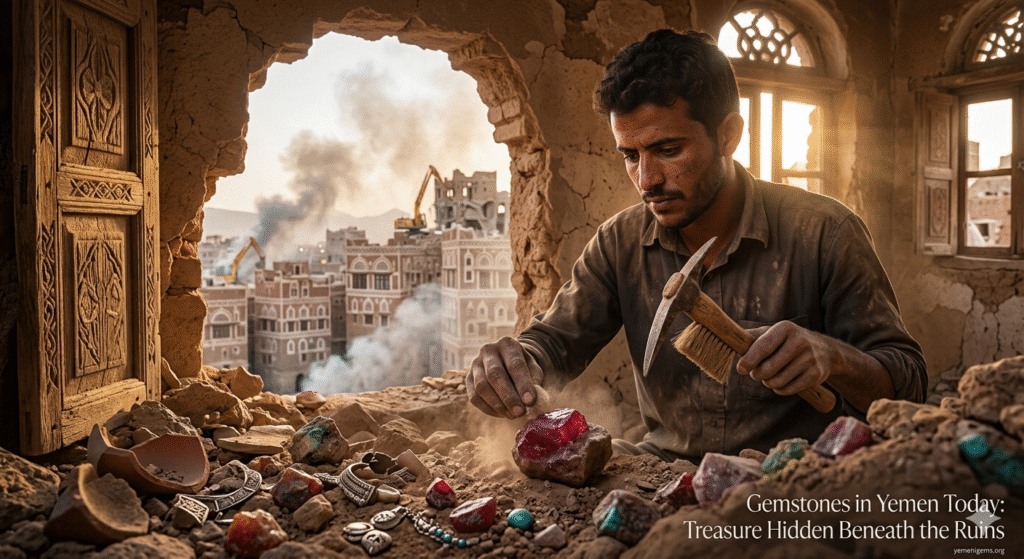
In the rugged mountains of Shabwah province, hundreds of men dig by hand into the earth with primitive tools—compressed air drills, pickaxes, and their bare hands. They work in harsh conditions, without health insurance or safety equipment, seeking stones that will sell for millions of dollars on international markets. Their daily wage: just six dollars .
This is the face of Yemen’s gemstone industry today—a tale of extraordinary natural wealth trapped beneath one of the world’s most devastated nations. From diamonds to rare iolite, from agate to jade, Yemen sits on a geological treasure trove worth hundreds of millions of dollars. Yet the country sees almost none of that wealth.
Here is a comprehensive look at gemstones in Yemen today.
Part 1: Diamonds in the Desert — A Historic Discovery
The most stunning geological revelation in recent memory came from Yemen’s Geological Survey and Mineral Resources Board in Aden. A comprehensive study has revealed “strong preliminary evidence” of diamond deposits in four Yemeni governorates: Al-Bayda, Marib, Shabwah, and Lahj .
The study, conducted by researcher Khaled Mohammed Al-Dubaie, analyzed satellite imagery and geophysical data across an area of 32,375 square kilometers. It identified eight new kimberlite pipes—the primary geological environment for diamond formation—with diameters ranging from 450 meters to an astounding seven kilometers .
These pipes are distributed across:
- Marib governorate: Jabal Al-Sahil, Al-Fajrah, Wadi Al-Sadd, Al-Rahbah
- Shabwah governorate: Al-Quwah, Khawrah
- Al-Bayda governorate: Al-Sawadiyah, Al-Qushayb, Al-Lutfa
- Lahj governorate: Sabir
The study collected rock and basin samples that revealed transparent and green crystals of indicator minerals such as olivine, diopside, and garnet—powerful signs pointing toward potential diamond deposits .
If confirmed, this would be a discovery of immense economic importance. Globally, approximately 1,000 kimberlite pipes are known, yet diamonds are commercially extracted from only 50 to 60 of them. The largest diamond ever discovered, the “Star of Africa,” weighed 3,167 carats . Whether Yemen holds similar treasures remains to be verified through comprehensive field surveys.
Part 2: Iolite and Jade — The Smugglers’ Favorites
While diamonds remain unconfirmed, other gemstones are being extracted and smuggled in staggering quantities. Iolite (a transparent, violet-blue gemstone) and jade are the most commonly traded stones in Yemen’s black market .
These stones are extracted using primitive methods in Shabwah, Abyan, Lahj, and Al-Bayda, often from surface deposits that require minimal technology to access. Hundreds of workers toil in these informal mines, their labor feeding an underground economy that Yemen’s fractured state cannot control.
The numbers are devastating: Yemen loses between $100 million and $250 million annually to gemstone and mineral smuggling . The price gap is staggering. Domestically, smugglers buy iolite for as little as $1,500 per ton. On international markets—particularly in China, Thailand, and Sri Lanka—the same material sells for between $600,000 and $1 million per ton .
Part 3: Agate — The Traditional Treasure
Perhaps the most historically significant Yemeni gemstone is agate, which has been mined in the Yemeni highlands for centuries. Traditional Yemeni silver jewelry—renowned for its exquisite design and craftsmanship—has long featured Yemeni agate alongside amber and coral .
For generations, women across Yemen adorned themselves with silver and gemstone jewelry, with agate holding particular cultural significance. However, this traditional craft has been in steady decline. Many artisans have abandoned silver work to focus on gold, which has come to dominate the market. The traditional silver jewelry industry now stands on the verge of collapse .
The irony is painful. The stones that once adorned Yemeni women as symbols of cultural heritage are now being stripped from the earth and sold abroad, with no benefit to the communities that once treasured them.
Part 4: The Smuggling Networks — Organized and Ruthless
Al Jazeera’s investigative report, published in September 2025, exposed the sophisticated criminal networks behind Yemen’s gemstone smuggling. These operations involve businessmen, tribal leaders, political figures, and even some government officials who have turned the country’s mineral wealth into a parallel economy .
The smuggling routes are well-established. From mines in Shabwah, Abyan, and Al-Bayda, gemstones are transported in unlicensed trucks—often with no license plates—or hidden among shipments of livestock and vegetables. The primary exit points include:
- Desert routes to Oman through Al-Mahrah governorate
- The Sarfait border crossing
- Al-Wadiah crossing in Hadramout
- Maritime ports, including the port of Sarfait
In some cases, smugglers pay up to one million Yemeni riyals to security forces at checkpoints to guarantee their shipments pass without inspection .
One former broker, speaking anonymously to investigators, described how shipments are stored in a villa in the Al-Nasr neighborhood of Khor Maksar district in Aden—near the public prosecution office—where they are sorted, processed, and prepared for international shipment .
Part 5: The Chinese Connection
Documents obtained by investigators revealed contracts between Yemeni and foreign companies, including Chinese firms, to purchase large quantities of gemstones at extremely low prices—sometimes as little as $2,000 per ton—while global market prices range from $600,000 to $1 million per ton .
The payment mechanism is designed to circumvent Yemen’s banking system entirely. Chinese buyers transfer dollars to accounts in China, while their Yemeni counterparts pay the local equivalent in Yemeni riyals inside Yemen—depriving the Yemeni state of hard currency and any ability to tax the transactions .
Chinese interest is not limited to gemstones. Black sands containing rare earth minerals used in advanced technological industries—including electronics manufacturing—are also being smuggled through these networks.
Part 6: The Legal Framework — And Its Collapse
Under Yemeni law, all mineral resources are the property of the state. The Mines and Quarries Law requires official licenses for extraction and mandates royalty payments to the government .
But more than a decade of civil war has fragmented Yemen’s bureaucracy and paralyzed government oversight. Two rival administrations—the Internationally Recognized Government in Aden and the Houthi authorities in Sanaa—operate independently, with no coordination and no unified registry of mining licenses .
The result is a legal vacuum that tribal warlords and smuggling networks have exploited ruthlessly.
In Marib province, tribal sheikhs like Abdullah Ahmed Ali Shawdaq of the powerful Abida tribe control marble quarries and stone mines with no government oversight. Shawdaq told investigators that he had stopped paying state dues since the war began. “We are prepared to pay anything to the state, but it must provide us with fuel, electricity, and essential services,” he said, accusing the state of “negligence” .
Other tribal leaders are even more explicit. “I don’t pay the state anything. We don’t pay and we won’t pay,” said Ali Abdallah Saleh Ruqaisian, another Abida tribe quarry owner. “The state wants the citizen to remain under its boot. After the oil, now they want to take our hard work? No” .
Part 7: The Human Cost — Workers in the Shadows
Amid the millions of dollars flowing through smuggling networks, the workers who extract the stones live in desperate poverty.
Salam Mabrouk, a worker at traditional mines in Nisab district, Shabwah, told investigators: “I have worked for five years in harsh conditions, without any health protection or insurance, using primitive equipment like an air compressor. We dig with our hands and extract stones that sell for millions of dollars, yet my daily wage does not exceed 15,000 Yemeni riyals (about six dollars)” .
The workers load shipments at night onto vehicles without license plates, transported through dirt roads to Ataq or Aden. They hear rumors of representatives receiving the shipments at a villa in Khor Maksar, but they never see the money their labor generates .
The physical risks are immense. Cave-ins, equipment failures, and exposure to toxic dust are daily hazards. There are no safety regulations, no inspectors, no compensation for injury.
Part 8: The Houthi Initiative — A Strategic Plan for Gold
In the Houthi-controlled capital Sanaa, a different approach to mineral development is taking shape. On May 18, 2026, the committee responsible for preparing a comprehensive plan for the development and nationalization of Yemen’s gold industry and trade held a meeting under the chairmanship of Dr. Yahya Al-A’jam, Deputy Undersecretary of the Ministry of Petroleum for Mineral Affairs .
The committee discussed the first phase of a draft strategic plan for the years 2026-2036, which includes foundational, control, and regulatory components. The plan aims to establish an integrated institutional framework for developing Yemen’s gold sector to contribute to sustainable development efforts .
Whether this initiative will succeed where so many have failed remains to be seen. But it reflects a recognition on both sides of Yemen’s political divide that the country’s mineral wealth cannot continue to be squandered.
Part 9: The Hadramout Warning — “Systematic Plunder”
In eastern Yemen, the warning from Hadramout’s Geological Survey and Mineral Resources Board could not be more urgent. On April 17, 2026, the board called for immediate security and military intervention to stop “systematic plunder” of metallic minerals, including gold, silver, and copper, in natural mines .
The board identified three specific areas under assault: Dhalumah, Wadi Madn, and Wadi Al-Masini. They described the activities as “random and illegal prospecting” that harms the national economy, destroys the environmental fabric of the region, and deprives the governorate of genuine development opportunities based on organized and legitimate investments .
“The mineral resources are sovereign assets of the state according to the constitution and law,” the board warned. Those involved in extracting these minerals without official licenses will face criminal prosecution, including prison sentences and significant fines .
Part 10: The Economic Devastation — A Bleeding Wound
The gemstone and mineral smuggling represents a hemorrhage of Yemen’s already collapsing economy. The International Monetary Fund projects Yemen’s GDP to contract further in 2026, with the country already suffering from one of the world’s most severe humanitarian crises.
Economist Fares Al-Najjar estimates that the total value of smuggled minerals—including gemstones, gold, copper, and black sands—reaches between $100 million and $250 million annually . In a country where the central government struggles to pay salaries and imports essential goods, this is not pocket change; it is a matter of survival.
Official trade data reveals staggering discrepancies. In 2015, Yemen recorded exports of “pearls, precious stones, and metals” at just $1.67 million—a fraction of the actual value being extracted and smuggled . The gap between official records and reality is a silent testament to the scale of the parallel economy.
Part 11: The Geopolitical Dimension — A War Economy
The gemstone trade does not exist in isolation; it is embedded in Yemen’s broader war economy. The same smuggling routes that carry iolite and jade also transport weapons, fuel, and other contraband. The same networks that bribe checkpoint commanders to ignore gemstone shipments also facilitate the movement of goods that sustain the war effort.
Tribal leaders who control mining areas derive not only wealth but also political power from their mineral holdings. In Marib, the Abida tribe’s control over marble quarries has translated into military influence, as tribal fighters have helped government forces repel Houthi advances .
But this alliance is fragile. In May 2025, Abida tribesmen ambushed government forces and captured 25 soldiers. The cause of the clash? “The government forces’ intervention in a tribal dispute over a stone quarry” .
Part 12: The Path Forward — Can the Treasure Be Saved?
Despite the grim picture, Yemen’s gemstones are not lost forever. The geological wealth remains in the ground—at least for now. And there are signs that both Yemeni authorities and international partners recognize the stakes.
The diamond discovery, if confirmed through field surveys and analysis of indicator minerals, could transform Yemen’s economic prospects. The strategic plan for gold development in Sanaa, whatever its political context, reflects an understanding that mineral resources cannot continue to be squandered.
The Geological Survey’s call for military intervention in Hadramout—to protect gold and copper deposits from “systematic plunder”—acknowledges that the situation has spiraled beyond the capacity of civilian authorities alone .
But meaningful change will require more than isolated interventions. It requires:
- A unified legal framework recognized by both Yemeni administrations
- Transparent licensing and royalty collection
- International cooperation to track smuggled gemstones through global markets
- Investment in formal mining infrastructure that creates jobs and generates revenue
- Protection for workers who currently risk their lives for six dollars a day
Conclusion
Yemen today sits atop a geological treasure of extraordinary value—diamonds waiting for confirmation, iolite and jade worth millions per ton, gold and silver and copper and agate that have been treasured for centuries. The irony is as cruel as it is stark: one of the world’s poorest and most devastated nations also possesses resources that could fund reconstruction, feed the hungry, and rebuild shattered lives.
Instead, those resources are being stripped by organized smuggling networks, tribal warlords, and corrupt officials—enriched by a war that shows no sign of ending. The workers who extract the stones earn six dollars a day. The state sees almost nothing. The stones, processed and polished in distant factories, appear on shelves in Bangkok and Shanghai and Colombo, their Yemeni origins obscured by the fog of the black market.
Al Jazeera’s investigative report concluded with devastating clarity: “The investigations, supported by documents, revealed shocking facts: a wide network of interests comprising businessmen, tribal and political leaders, and influential employees are working to turn laws into formal façades and distribute returns among elites without transparency, turning the mineral and gemstone sector into a dark economy that plunders the country’s resources and leaves the Yemeni economy missing a large part of its development potential” .
As the war enters its twelfth year, Yemen’s gemstones remain in the ground—or in the hands of smugglers. Whether they will ever benefit the Yemeni people is a question whose answer lies not in the earth, but in the choices of those who fight and those who watch from afar.
The treasure is there. But for now, it remains hidden beneath the ruins of a nation—not just in the rocks, but in the failure to turn wealth into well-being.