

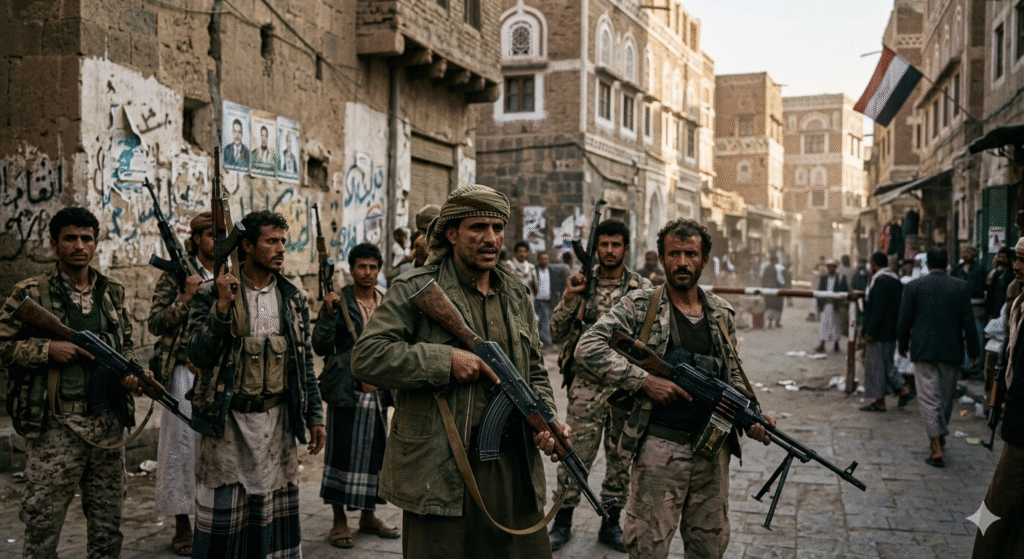
Introduction: A State Captured by Armed Factions
Yemen today is not merely a country devastated by civil war—it is a nation where armed gangs have effectively replaced the state. From the mountainous strongholds of the Houthi movement in the north to the chaotic port city of Aden in the south, organized armed groups operate as de facto authorities, extracting revenues, controlling territory, and increasingly projecting power far beyond Yemen’s borders. While the world’s attention remains fixed on the broader Middle East conflict, a sophisticated network of militias, criminal syndicates, and politically backed armed factions has consolidated power across the country. This article examines the nature of Yemen’s gangs today, their funding sources, their alliances, and the devastating impact they have on the Yemeni people.
Part 1: Defining the Landscape – Who Are Yemen’s Gangs?
Understanding Yemen’s armed groups requires moving beyond simple categorizations. Unlike traditional street gangs in Western cities, Yemen’s armed factions are often intertwined with political movements, military structures, and international alliances. The line between a “legitimate” political actor and a criminal gang in Yemen has become almost invisible.
The most prominent and powerful armed faction remains the Houthi movement (Ansar Allah), which controls much of northern Yemen, including the capital Sana’a. However, significant armed groups also operate in government-controlled areas, including tribal militias, separatist factions like the Southern Transitional Council (STC), and various Islamist groups. Beneath these political umbrellas exist thousands of smaller armed units, checkpoint operators, smuggling networks, and extortion rings that function with near-impunity.
What makes Yemen’s situation unique is that these gangs do not operate in opposition to the state—they have become the state. In Houthi-controlled areas, the movement’s security apparatus functions as both police force and criminal enterprise. In government-held regions, rival factions control checkpoints and ports, extracting revenues that should flow to the central treasury.
Part 2: The “Gray Zone” – Maritime Piracy Returns with a Political Face
Perhaps the most dramatic development of the past week illustrates how Yemen’s gangs have evolved beyond traditional criminality. On May 2, 2026, the MT Eureka, a UAE-managed oil tanker sailing under the Togolese flag, was hijacked off the coast of Yemen’s Shabwa governorate . Approximately nine armed Somali nationals, carrying weapons including rocket-propelled grenades, boarded the vessel and forced its crew to change course toward Somali waters .
The vessel, carrying nearly 2,800 tons of diesel fuel and 12 crew members from Egypt and India, was diverted to the Somali coast as Yemeni Coast Guard patrol boats proved unable to intercept it due to operational constraints . As of the latest reports, the ship was entering Somali territorial waters under armed guard.
What makes this hijacking distinct from traditional Somali piracy is its strategic sophistication. Security analysts point to what they describe as a “functional alliance” between the Houthi movement and armed networks in the Horn of Africa, including Al-Shabaab, the Al-Qaeda affiliate that controls large portions of Somalia .
This alliance operates on several levels. The Houthis have reportedly transferred drone technology and man-portable missiles to their Somali partners. In return, they gain access to logistical bases on the African coast where hijacked vessels can be offloaded and held beyond the reach of Yemeni or international forces. For the Houthis, this provides strategic depth across the Bab el-Mandeb strait—one of the world’s most vital maritime chokepoints .
The system also allows for “plausible deniability.” When ships are hijacked, these operations can be framed as opportunistic criminal piracy triggered by regional instability, while the true objective is to strike vessels linked to states opposing the Iranian-led axis . For Somali groups like Al-Shabaab, the partnership provides advanced weaponry and the ability to disrupt international maritime traffic.
Part 3: Inside Houthi-Controlled Territory – Systematic Extortion as Governance
In the regions under Houthi control, gang-like practices have been institutionalized as a form of governance. A campaign reported just days ago reveals the scale of this systematic extortion.
According to testimonies from merchants and business owners in Sana’a, Houthi supervisors have launched a new round of financial levies on the commercial sector under the banner of “Eid gifts for frontline fighters” . What traders describe as systematic extortion involves armed men conducting field visits to factories, wholesale outlets, and businesses, demanding payments without issuing official receipts.
The scale of these demands is carefully calibrated. Wholesale traders are reportedly forced to pay no less than 100,000 Yemeni rials. Factories and larger companies face demands ranging between 200,000 and 300,000 rials . According to one source within the capital’s municipality, wholesale traders alone were forced to pay nearly 90 million rials in recent weeks—money extracted entirely outside any legal or transparent framework .
Workers at block factories on 50th Street in Sana’a reported that armed men accompanying supervisors stormed their facilities, imposing sums between 50,000 and 100,000 rials under the pretext of preparing “Eid convoys” for fighters on the frontlines . A source at a pharmaceutical plant described how groups linked to the Houthi-appointed governor of Sana’a, led by a supervisor known as Abu Zakaria, visited facilities in the al-Sabaha area and granted only a one-week grace period for those unable to pay—insisting on cash .
These practices are not ad hoc. According to informed sources, these levies are imposed annually under directives from the Houthi’s so-called Mobilization Authority, with local authorities tasked with collection without any transparency or accountability . The campaign extends beyond cash to include in-kind contributions from various businesses, including small retailers.
For Yemen’s already devastated economy, these predatory practices have severe consequences. Business owners warn that systematic extortion further strangles the private sector, discourages investment, and drives up prices for ordinary Yemenis already struggling with deteriorating living conditions .
Part 4: The Southern Checkpoint Economy – Extortion on the Aden-Marib Road
While the Houthis dominate the north, armed groups affiliated with the internationally recognized government and the Southern Transitional Council control much of the south. Here, gang activity takes a different form: the militarization of transportation routes.
Activist Omar Mohammed Al-Daya recently documented shocking figures regarding illegal levies imposed on cargo trucks traveling the vital route between Aden and Marib—one of Yemen’s most important commercial arteries . According to documentation that includes 14 official payment vouchers, the total amount forcibly collected from a single truck during its journey can reach approximately one million Yemeni Rials .
The extortion follows a systematic pattern. Checkpoints in Abyan province extract roughly 300,000 YR across eight different stops. The burden increases dramatically in Shabwa, where fees reach 450,000 YR—two-thirds of which are collected under the guise of “Road Maintenance Funds” that likely never reach any road project. The cycle concludes in the Marib sector with an additional 139,000 YR in fees .
These checkpoints are operated by various factions affiliated with the Saudi-backed forces, each enforcing its own informal tax regime. The result is a predatory system that extracts resources from the commercial sector at every possible opportunity, driving up the cost of essential goods across the country. As Al-Daya warned, these financial burdens ultimately fall on the shoulders of the Yemeni people, further exacerbating the country’s already dire humanitarian and living conditions .
Part 5: Port of Aden – Battleground for Smuggling Revenues
The strategic port city of Aden, Yemen’s temporary capital, has become a battleground where armed groups fight for control of lucrative smuggling operations. Recent reports indicate fierce clashes between factions vying for control of the port, which serves as a gateway for weapons, fuel, and other contraband .
Officials of the internationally recognized government reported that militants using the port for smuggling operations refuse to recognize their authority. In a telling incident, pro-government militia leader Ahmed al-Idrisi was shot dead shortly after reluctantly agreeing to hand over control of the port to government loyalists . His assassination underscores how violence and criminal economic interests have become intertwined in the struggle for Yemen’s most valuable infrastructure.
The Port of Aden represents more than just a smuggling hub—it is a source of enormous potential revenue. Whoever controls the port controls the flow of goods into southern Yemen, and with it the ability to tax imports, facilitate weapons trafficking, and project political power. The fighting over Aden reflects a broader reality: Yemen’s armed factions are not primarily motivated by ideology but by control over economic resources.
Part 6: Espionage and Intelligence Gangs – The Invisible Threat
Beyond the visible military checkpoints and maritime hijackings, Yemen’s gangs operate in the shadows of espionage. The Houthi-controlled Saba News Agency reported this week on the arrest of “espionage cells” allegedly linked to foreign intelligence services—claims that reveal another dimension of gang activity in Yemen .
According to the report, which reflects the Houthi movement’s official position, the Ministry of Interior announced the arrest of individuals described as “traitors, collaborators, and spies” operating in the interest of American, Israeli, British, and Saudi intelligence services . The announcement was met with widespread public demonstrations expressing support for the security forces.
Regardless of the veracity of specific espionage claims, the existence of such networks is undeniable. In a fragmented country where multiple foreign powers maintain competing interests, intelligence agencies inevitably recruit local agents. These individuals function as a form of “invisible gang”—operating in secret, trading information for money or protection, and manipulating the country’s factional rivalries for external patrons.
The Houthi announcement also reveals how the movement uses spy-hunting to consolidate internal control. By claiming that accused collaborators provided “coordinates and information about national leaders and missile, air, and naval forces,” the Houthi leadership frames espionage as an existential threat requiring vigilance and public cooperation with security forces . This narrative serves to legitimize surveillance, restrict dissent, and mobilize popular support for the movement’s security apparatus.
Part 7: The Humanitarian Toll – Ordinary Yemenis Pay the Price
The gang economy that has consumed Yemen carries a devastating human cost. The World Food Programme has repeatedly warned that Yemen faces one of the world’s worst humanitarian crises, with millions of people facing food insecurity. The predatory practices documented across the country—from Houthi extortion in Sana’a to checkpoint fees on the Aden-Marib road—directly contribute to this suffering.
Every illegal levy imposed on a truck carrying food or medicine raises prices for consumers. Every hijacked tanker disrupts fuel supplies, causing shortages that affect hospitals, water pumps, and transportation. Every dollar extracted by armed groups is a dollar that cannot be spent on feeding children, buying medicine, or rebuilding shattered homes.
The situation is particularly dire for internally displaced persons (IDPs), who have fled fighting in their home regions only to face extortion and exploitation in areas nominally under government or Houthi control. Without the protection of family networks or community support, IDPs are especially vulnerable to the armed groups that control checkpoints, displacement camps, and access to humanitarian aid.
Part 8: The Regional Dimension – Yemen’s Gangs as Geopolitical Proxies
Perhaps the most concerning development in Yemen’s gang landscape is the growing integration of armed groups into regional proxy networks. The MT Eureka hijacking is not an isolated incident—it reflects a strategic partnership between the Houthis and Somali armed groups that extends far beyond simple criminal cooperation.
Intelligence reports from 2026 point to a “strategic functional partnership” where roles and logistics are exchanged to carry out complex maritime operations . Ship hijackings off Somalia have surged since the U.S. and Israel began their war against Iran in February 2026. Incidents suggest these operations are highly targeted, relying on detailed knowledge of shipping routes and schedules—information that would be difficult for traditional pirates to obtain .
This alliance has transformed the maritime threat landscape. The Houthis, who previously focused on launching missiles and drones from Yemeni territory at ships in the Red Sea, now have the ability to project power through Somali proxies. This provides strategic depth and complicates international naval responses, as any intervention in Somali waters would require different legal authorities and military assets than operations in Yemeni waters.
The system also serves Iran’s broader strategic interests. By using Houthi and Somali proxies to target ships linked to adversaries, Tehran can maintain “plausible deniability” while still disrupting maritime traffic through one of the world’s most important chokepoints . For the Houthis, the alliance provides access to new revenue streams and the ability to strike at enemies beyond Yemen’s borders.
Conclusion: The Future of Gang Warfare in Yemen
As Yemen enters the twelfth year of its devastating civil war, the lines between political movement, armed faction, and criminal gang have become permanently blurred. The Houthis have transformed from a religious movement into a vertically integrated military-criminal enterprise that controls territory, extracts taxes, and projects power across the Red Sea. In the south, rival factions fight for control of ports and smuggling routes, treating the country’s infrastructure as private property rather than public assets.
The international community’s focus on Yemen has largely been absorbed by the broader Iran-Israel conflict, leaving the country’s internal dynamics under-examined. Yet Yemen’s gangs are not merely a local problem—they are increasingly integrated into regional proxy networks that threaten maritime security, energy supplies, and global trade routes.
For ordinary Yemenis, the future looks grim. Without a functioning state capable of providing security, enforcing laws, and delivering justice, the armed groups that control the country will continue to extract resources from a population that grows poorer and more desperate with each passing year. The gangs of Yemen are not a symptom of the country’s collapse—they are the cause, and they are likely to remain in control for the foreseeable future.
