

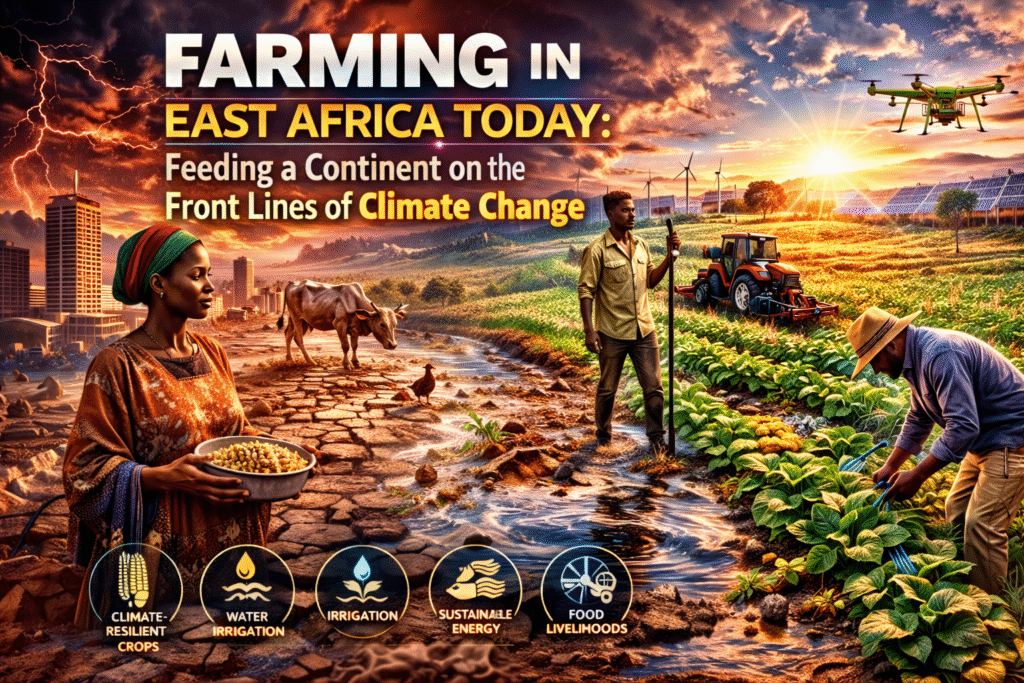
In the lush highlands of Kenya and the arid plains of Somalia, a quiet revolution is underway. Agriculture remains the backbone of East Africa, employing over 70 percent of the population and anchoring the economies of nations from Ethiopia to Tanzania. Yet today, the region’s farmers face an unprecedented convergence of crises: a changing climate that no longer follows traditional patterns, volatile global markets, and the urgent need to feed a population projected to surge from 522 million in 2026 to 855 million by 2050. This article examines the state of farming across East Africa across multiple critical dimensions.
The Hunger Reality: 130 Million Go Hungry
Despite agriculture’s central role, East Africa remains a global hunger hotspot. According to the Food and Agriculture Organization (FAO), one in four people in Eastern Africa goes hungry, with nearly 130 million people—approximately 26 percent of the population—affected by food insecurity.
The numbers are stark. Approximately 38 million people across six Intergovernmental Authority on Development (IGAD) member states—Djibouti, Ethiopia, Kenya, Somalia, South Sudan, and Sudan—face acute food insecurity (IPC Phase 3 or worse). In Somalia, the situation is particularly dire: crop production in some areas is estimated at 83 percent below the long-term average, driven by severe drought and conflict.
The human cost of this crisis is measured not just in statistics but in abandoned farms, emaciated livestock, and families who have watched their livelihoods dissolve with each failed rainy season.
Climate Change: The Unpredictable Enemy
The most profound challenge facing East African farmers today is climate change. The region is experiencing what scientists describe as a “heterogeneous response” of agro-climatic regimes: some areas are becoming drier while others shift toward wetter zones. This unpredictability is devastating for farmers who have relied on generational knowledge of rainfall patterns.
All heat stress indicators—including the frequency of hot spells and the duration and intensity of heat waves—are projected to increase in future climates. Simultaneously, the frequency and intensity of heavy precipitation events are also expected to rise with increased greenhouse gas emissions. The result is a double burden: more drought and more destructive floods, often in rapid succession.
The economic impact is severe. African countries lose between 2 and 5 percent of GDP annually due to climate extremes, with up to 9 percent of national budgets redirected to disaster response rather than long-term development. In East Africa, losses are projected to reach between 2 and 4 percent of GDP per year by 2040.
The human toll is equally devastating. Drought affected more than 15 million people in 2019 alone, while floods in 2020 displaced over 300,000 people and disrupted agriculture, health, and infrastructure across the region. Approximately 4.7 million people across East African Community partner states face persistent climate-related crises, a number expected to rise with the inclusion of the Democratic Republic of Congo and Somalia into the EAC.
Maize Under Threat: The Staple in Peril
Maize is the staple food for over 300 million people across the African continent. But agricultural experts warn that in coming years, drought and rising temperatures could render 40 percent of the continent’s maize-growing areas unsuitable for varieties of maize available today.
Rising temperatures are projected to reduce yields of staple crops such as maize and beans by 10 to 20 percent by 2050. This is not a distant threat; farmers across Kenya are already witnessing the effects. Severe rain shortages between March and June—traditionally the planting season—have devastated maize crops. A strange disease striking maize at the flowering stage in high-yielding regions has further worsened the situation.
In response, the Drought Tolerant Maize for Africa (DTMA) Initiative has developed more than 100 new varieties of maize and hybrids released in 13 African countries. More than 2 million smallholder farmers in sub-Saharan Africa are now growing these varieties, reporting 20 to 30 percent increases in crop yields above what they would have achieved with unimproved varieties.
Climate-Smart Agriculture: The Path Forward
The consensus among agricultural experts is clear: farming in East Africa must become climate-smart. The FAO defines climate-smart agriculture (CSA) as consisting of three pillars: sustainably increasing agricultural productivity and incomes, adapting and building resilience to climate change, and reducing or removing greenhouse gas emissions where possible.
The Alliance for a Green Revolution in Africa (AGRA) has identified several measures to build farmer resilience. These include inclusive partnerships involving governments, private sector agribusinesses, and development organizations to develop, disseminate, and monitor CSA technologies. Harnessing opportunities from South-South cooperation and regional integration is another key measure.
Crucially, experts are calling for a shift away from the dominant “top-down transfer of technology” model that has largely excluded farmers from development and dissemination processes. AGRA president Jane Karuku emphasizes the need for an African-led technology transfer process: “African farmers are aware of the challenges they face—unpredictability of rains, rising temperatures, diseases and pests infestations. All these are a manifestation of climate change”.
The Return of Traditional Crops
One of the most significant shifts in East African farming is the rediscovery of indigenous crops. Dr. Charles Kariuki, director of the Kenya Agricultural Research Institute (KARI), notes that traditional crop varieties contribute significantly to food security as they adapt well to a cross-range of climate variability.
These crops are no longer referred to as “orphan crops” but are now known as “high-yield traditional crops”. Governments across Africa are being urged to support and encourage farmers to embrace root tubers like cassava, yams, coco yams, and sweet potatoes, as well as African leafy vegetables, legumes, and cereals such as sorghum and millet.
This represents a fundamental rethinking of agricultural development. Rather than trying to replicate industrial farming models from temperate zones, East Africa is increasingly looking to its own botanical heritage for climate-resilient solutions.
Digital Innovation: Farming in the Smartphone Age
Technology is transforming how East African farmers access information, markets, and services. In February 2026, representatives from Ethiopia, Eritrea, Kenya, Rwanda, Somalia, South Sudan, and Uganda gathered in Addis Ababa for the East Africa Regional Digital Innovation Workshop for Agrifood Systems Transformation.
The workshop highlighted efforts to strengthen agricultural data systems, modernize advisory and extension services, expand geospatial tools, and improve farmer registration processes. Despite diverse national approaches, countries identified common needs: stronger policy frameworks, improved interoperability, and increased investment in digital infrastructure.
The World Bank is backing this digital transformation. A new $46 million initiative—the Accelerating Innovation and Catalyzing Capacity for Resilience in Africa (AICCRA–FSRP4)—will scale agricultural innovations, raise productivity, and support economic opportunities in Ethiopia, Kenya, and other African nations. The project will reach more than 1.5 million farmers and food-system actors, with more than 250,000 farmers expected to adopt climate-smart technologies as a result.
Digital climate advisory platforms and solar-powered irrigation systems are among the innovations being scaled across the region.
Market Access and Regional Trade
Even when farmers successfully grow their crops, getting products to market remains a major challenge. The East African Community, together with COMESA and SADC, is advancing the Tripartite Simplified Trade Regime (TSTR) to make cross-border trade more accessible, efficient, and cost-effective—particularly for small-scale and informal traders, including youth and women.
Given that most small-scale cross-border trade is agriculture-driven, these traders contribute approximately 43 percent of Africa’s official GDP. The TSTR introduces a harmonized system with a common list of eligible products, simplified documentation, and predictable procedures, aiming to reduce barriers and improve efficiency at border posts across the region.
In a significant development, One Acre Fund and the Eastern Africa Farmers Federation signed a Memorandum of Understanding in April 2026 to strengthen resilience and incomes for over 25 million smallholder farmers. The partnership focuses on advancing policy reforms for affordable agricultural inputs, strengthening regional trade linkages for priority value chains such as avocado and macadamia, expanding farmer access to financing and climate-smart technologies, and mobilizing resources to help farmers manage economic and climate-related risks.
Success Stories: Resilience in Action
Across East Africa, farmers and communities are demonstrating that adaptation is possible. In Ethiopia, the Productive Safety Net Programme (PSNP) and Household Asset Building Programme (HABP) have improved food security for nearly 8 million households, strengthening their resilience to shocks such as droughts and floods while increasing their ability to adapt to longer-term climate change.
In Kenya’s Kasigau region, farmers have abandoned forest destruction and are now earning up to $3 million annually from selling carbon credits to international corporations. This has saved up to 500,000 acres of forest from continued destruction. Farmers use the carbon credit money to initiate sustainable development and farming projects that boost their nutrition and financial status.
Community forest management in Tanzania and a $16 billion fund by the Brazilian government to encourage low-carbon agriculture offer additional models that East African nations are studying and adapting.
The Regional Response: A Coordinated Strategy
Recognizing the scale of the challenge, East African nations are moving toward coordinated action. In March 2026, the East African Community advanced a 10-year Climate Change Strategy to address rising climate risks, strengthen resilience, and support sustainable economic transformation across the region.
The strategy sets out a regional framework with four priorities: strengthening early warning systems and adaptation measures; advancing a low-carbon and circular economy through renewable energy and efficiency; restoring ecosystems through transboundary action and natural capital accounting; and strengthening governance and institutional capacity.
At a regional meeting in March 2026, national food systems conveners and FAO focal points agreed to explore ways to incentivize the private sector, smallholder farmers, and consumers while forging stronger financing, collaboration, and knowledge exchange mechanisms. The goal is to accelerate actions to meet national commitments over the remaining five years to 2030.
The Structural Constraints: Why Progress Is Slow
Despite these initiatives, significant challenges remain. The dominant top-down model of technology transfer has led to low adoption of climate-smart agriculture technologies. Other challenges include variability of rainfall, limited consumer awareness, low financial literacy levels, poor public sector involvement, data scarcity, and the weak technical capacity of African weather stations.
Gaps remain in institutional coordination, policy alignment, financing, and technical capacity. Addressing these requires stronger collaboration, knowledge exchange, and accelerated implementation.
The World Bank reports that agriculture contributes about 23 percent of GDP in Sub-Saharan Africa and employs more than 60 percent of the population, yet productivity levels remain among the lowest globally. In Kenya, smallholder farmers account for roughly 75 percent of total agricultural output, but many struggle with limited access to quality inputs, financing, and reliable markets.
The Future: Farming as Business, Not Subsistence
Perhaps the most important shift underway is conceptual: farming is increasingly being viewed not as subsistence but as business. One Acre Fund CEO Eric Pohlman stated that the organization’s partnership with the Eastern Africa Farmers Federation aims to help farmers transition from subsistence to more commercialized agriculture.
The World Bank’s AICCRA–FSRP4 initiative places strong emphasis on skills development and entrepreneurship, supporting 150 entrepreneurial ventures, strengthening or establishing 25 incubators and accelerators, and enabling $16.5 million in private capital to unlock job opportunities in agribusiness and agri-tech.
This focus on commercialization and job creation recognizes that farming cannot simply be about survival; it must be about prosperity. With agriculture accounting for 52 percent of Africa’s workforce, the sector’s transformation is inextricably linked to the continent’s broader economic future.
Conclusion
Farming in East Africa today is a story of extremes: devastating drought alongside innovative adaptation, hunger alongside record harvests, traditional knowledge alongside cutting-edge technology. The region’s farmers are on the front lines of climate change, facing challenges that would have been unimaginable a generation ago.
Yet there is reason for hope. The development of drought-tolerant maize varieties, the scaling of digital advisory services, the revival of traditional crops, and the strengthening of regional trade frameworks all point toward a more resilient future. The commitment of East African nations to coordinated action—through the EAC’s 10-year Climate Change Strategy and national food systems transformation programs—provides a policy framework for progress.
As the region’s population continues to grow and climate pressures intensify, the stakes could not be higher. The transformation of East African agriculture is not merely an economic imperative; it is a moral one. For the 130 million people who currently go hungry, and for the generations to come, the success or failure of this transformation will determine the region’s future.
